
LED Video Wall Solution for Large Oilfield Command Centers
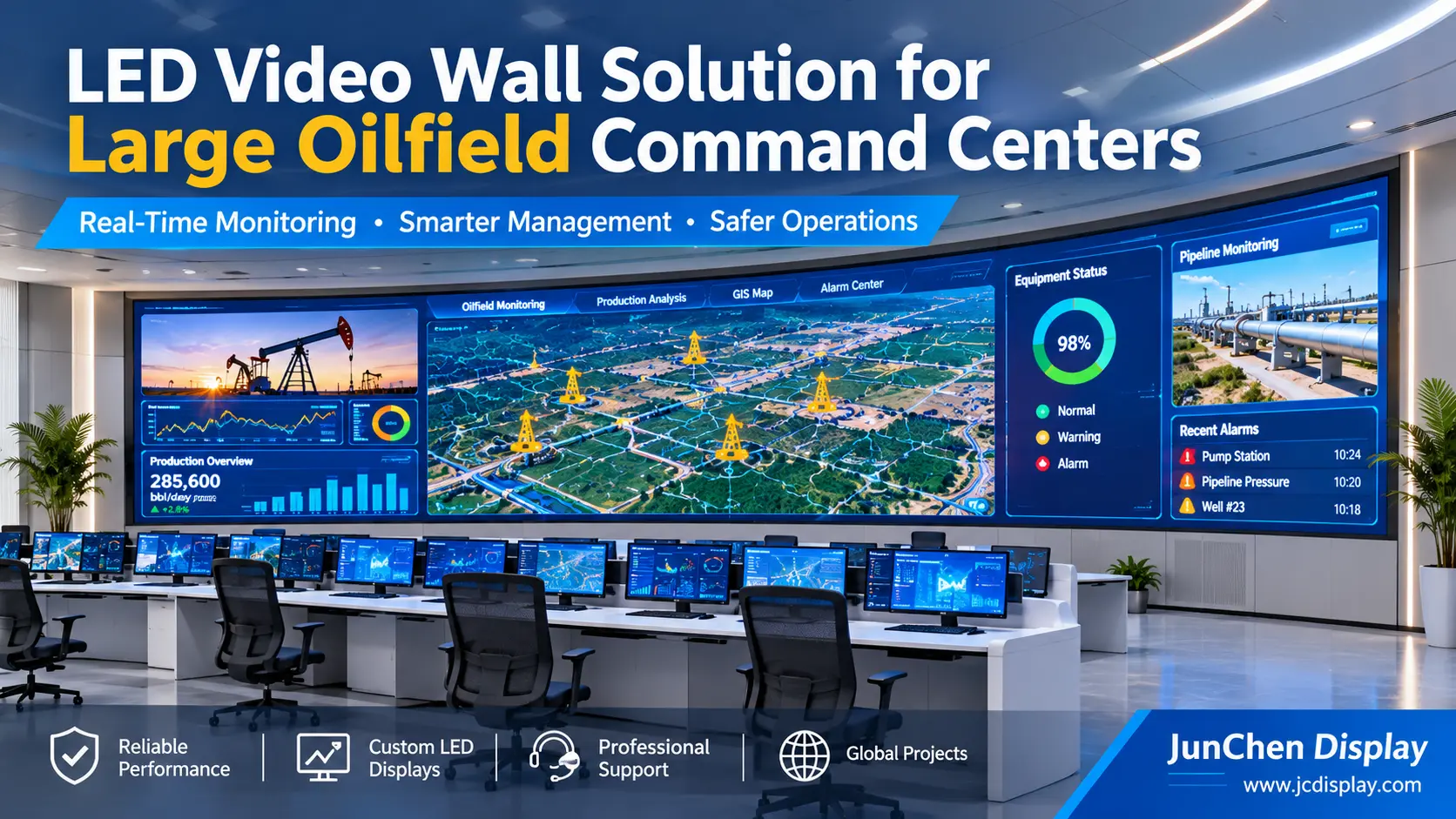
Large oilfields often cover extensive geographical areas, with hundreds or even thousands of distributed wells, pumping stations, pipelines, storage facilities and production sites.
Managing these facilities requires centralized visibility into production data, equipment conditions, security information and operational alarms across multiple locations.
A professional oilfield LED video wall provides a centralized visualization platform that brings information from existing monitoring systems into one large, seamless display environment.
Combined with SCADA, GIS, CCTV and digital oilfield management platforms, LED video walls can support local operators and authorized remote management teams in monitoring geographically distributed operations.
Quick Answer
An LED video wall for a large oilfield command center is a centralized display system designed to visualize:
-
Oil well production and operating status
-
SCADA monitoring dashboards
-
GIS oilfield distribution maps
-
Pipeline and pumping station conditions
-
Remote and unmanned well sites
-
CCTV surveillance
-
Operational alarms and emergency information
-
Production statistics and management reports
The ideal solution combines a fine-pitch LED display, professional video processing, multi-source visualization, appropriate redundancy and secure remote monitoring architecture.
Table of Contents
-
Why Large Oilfields Need LED Command Centers
-
Key Oilfield Monitoring Applications
-
Oilfield LED Video Wall System Architecture
-
Local Operation and Remote Management
-
How to Select the Right LED Video Wall
-
Recommended Configuration and Resolution
-
Reliability and Maintenance
-
Why Choose JunChen Display?
-
Frequently Asked Questions
-
Conclusion
1. Why Large Oilfields Need LED Command Centers
Unlike conventional factories operating within a single site, large oilfields may contain production facilities distributed across deserts, remote regions and extensive industrial areas.
Operators need to understand the status of multiple facilities without physically visiting every location.
An oilfield command center LED display can support:
-
Centralized visibility across multiple production zones
-
Remote monitoring of distributed facilities
-
Production performance comparison
-
Abnormal condition identification
-
Cross-site operational coordination
-
Management-level decision-making
The objective is to create a shared operational overview rather than simply displaying more individual monitoring screens.
2. Key Oilfield Monitoring Applications
2.1 Oil Well and Production Monitoring
An oilfield LED video wall can display information from authorized production monitoring platforms, including oil well status, production volume, pressure, temperature, flow rates and equipment operating conditions.
Production teams can compare information from different wells and production areas within a centralized visual environment.
2.2 SCADA Monitoring and Visualization
SCADA systems are widely used to supervise industrial equipment and distributed operational facilities.
Through compatible visualization interfaces, an LED video wall can present:
-
Oil extraction equipment status
-
Pumping unit conditions
-
Pressure and flow trends
-
Pipeline monitoring information
-
Equipment alarms
-
Historical production data
The LED wall acts as the visualization layer. Primary process control remains within the authorized industrial automation systems.
2.3 GIS Oilfield Mapping
Geographic Information Systems (GIS) are particularly valuable for large oilfields with geographically distributed infrastructure.
A large LED video wall can display an oilfield map containing well locations, pipelines, production zones, pumping stations, roads and monitoring points.
GIS-based visualization helps operators understand the geographical relationship between facilities and identify areas requiring attention.
2.4 Pipeline and Pumping Station Monitoring
An oilfield control room display can present pipeline pressure, flow information, pumping station status and notifications from existing monitoring platforms.
Combining pipeline diagrams, GIS maps and CCTV feeds allows relevant teams to review information from different sources simultaneously.
2.5 Security and Emergency Coordination
A centralized LED display can present perimeter cameras, restricted-area surveillance, incident locations, emergency notifications and response coordination information.
The display supports situational awareness but does not replace certified gas detection, fire protection, emergency shutdown or safety instrumented systems.
3. Oilfield LED Video Wall System Architecture
A digital oilfield visualization system requires coordination between field monitoring platforms, communication infrastructure, video processing equipment and the LED display.
A typical architecture follows five layers:
Field Systems → Communication Network → Monitoring Platforms → Video Processing → LED Video Wall
| System Layer | Main Components and Functions |
|---|---|
| Field sensing | Sensors, meters, cameras, PLCs and RTUs |
| Communication | Fiber-optic, wireless or dedicated industrial networks |
| Monitoring platforms | SCADA, GIS, CCTV and production management systems |
| Video processing | Signal switching, multi-window layouts and image scaling |
| Visualization | Fine-pitch LED video wall and operator workstations |
| Remote management | Authorized management dashboards and remote access platforms |
The LED video wall receives compatible visual outputs from the monitoring platforms rather than directly collecting information from field sensors.
For large projects, modular video processors may be considered according to the required input capacity, display resolution, simultaneous windows and redundancy requirements.
For a detailed explanation, read our LED Command Center Display System Architecture Guide.
4. Local Operation and Remote Management
Large oilfield projects often require two levels of operational visibility.
Local Command Center
Operators can monitor production conditions, review alarms, switch between approved visualization sources and manage display layouts.
Different presets can be configured for daily production monitoring, equipment maintenance, shift handovers and emergency coordination.
Remote Management Center
Authorized management personnel may access selected production dashboards, operational reports and system information through the customer's approved remote management platform.
This architecture can support coordination between regional oilfield command centers and corporate headquarters.
Remote access should follow the customer's industrial cybersecurity policies, network segmentation requirements and permission controls.
For related distributed infrastructure monitoring, see our LED Video Wall Solution for Substation Control Rooms.
5. How to Select the Right LED Video Wall
5.1 Pixel Pitch Selection
Oilfield command centers often display detailed maps, technical diagrams, numerical data and monitoring dashboards.
Fine-pitch indoor LED displays are therefore commonly considered.
| Pixel Pitch | Recommended Application |
|---|---|
| P0.9 | High-resolution monitoring and close viewing |
| P1.25 | Detailed GIS maps and SCADA visualization |
| P1.5–P1.56 | Medium and large command centers |
| P1.8–P1.875 | Larger rooms with moderate viewing distances |
| P2–P2.5 | Large overview displays viewed from farther away |
The final selection should consider text readability, operator viewing distance, screen dimensions, content resolution and budget.
5.2 COB or SMD LED Technology?
COB LED displays may be suitable for high-resolution indoor command centers requiring fine pixel pitch and improved display surface protection.
SMD LED displays remain a practical option for projects requiring different pixel pitch choices, maintenance configurations and investment levels.
Both technologies should be evaluated according to the actual operating environment.
5.3 Screen Layout
A large oilfield LED video wall can be divided into several functional display zones.
| Display Zone | Suggested Content |
|---|---|
| Central area | GIS oilfield overview map |
| Left area | Production dashboards and SCADA |
| Right area | CCTV and remote well monitoring |
| Upper area | Production KPIs and operational summaries |
| Lower area | Alarm notifications and equipment status |
The layout should prioritize important operational information rather than filling the entire display with small, difficult-to-read windows.
6. Recommended Configuration and Resolution
The following is an illustrative configuration for a large indoor oilfield command center, rather than a specification from an installed project.
| Parameter | Suggested Configuration |
|---|---|
| Display technology | Fine-pitch COB or SMD LED |
| Screen dimensions | 8,400 × 2,700 mm |
| Pixel pitch | P1.25 |
| Cabinet dimensions | 600 × 337.5 mm |
| Cabinet arrangement | 14 × 8 |
| Total cabinets | 112 |
| Total display area | 22.68 m² |
| Screen resolution | 6,720 × 2,160 pixels |
| Total pixel count | 14,515,200 pixels |
| Maintenance | Front access |
| Video processing | Multi-input modular video processor |
| Operating schedule | Configured for 24/7 operation |
| Redundancy | According to project requirements |
Example: How Pixel Pitch Affects Resolution
For the same 8.4 × 2.7 m display using compatible 600 × 337.5 mm cabinets:
| Pixel Pitch | Screen Resolution | Total Pixels |
|---|---|---|
| P1.25 | 6,720 × 2,160 | 14.52 million |
| P1.5625 | 5,376 × 1,728 | 9.29 million |
A smaller pixel pitch provides additional space for detailed monitoring information, but also increases the processing capacity required.
The video processor must support the actual LED canvas dimensions, total pixel count, output configuration and simultaneous content windows.
This calculation helps engineering contractors avoid selecting an undersized processing system.
7. Reliability and Maintenance
Large oilfield command centers may operate continuously, making system availability an important consideration.
Recommended planning measures include:
-
Components rated for the required operating schedule
-
Stable power distribution and thermal management
-
Backup signal paths where required
-
UPS integration according to project requirements
-
Spare LED modules, receiving cards and power supplies
-
Front-maintenance cabinet configurations
-
Approved remote technical support
-
Regular system inspection and maintenance
For oilfields located in desert regions, customers should also evaluate dust protection, air conditioning, humidity control and environmental conditions inside the command center.
Standard indoor LED displays should be installed in suitable non-hazardous environments. Classified hazardous locations require separately assessed and appropriately certified equipment.
8. Why Choose JunChen Display?
JunChen Display provides customized LED visualization solutions for engineering contractors, industrial system integrators and international project customers.
Our capabilities include:
-
Customized fine-pitch LED video walls
-
COB and SMD LED display solutions
-
LED cabinet and structural configuration
-
Professional video processor selection
-
Display control systems and accessories
-
One-stop LED component procurement
-
Factory assembly and pre-shipment testing
-
Installation and configuration guidance
-
Three-year warranty and 24/7 remote technical support, subject to applicable terms
Rather than supplying only LED cabinets, JunChen Display helps customers coordinate the display hardware, processing equipment, control configuration and maintenance requirements.
We work with qualified local system integrators responsible for oilfield automation, SCADA integration, industrial communication networks and safety engineering.
9. Frequently Asked Questions
What is an oilfield LED video wall?
It is a centralized LED visualization system used to display production data, SCADA dashboards, GIS maps, CCTV feeds and operational information from oilfield monitoring platforms.
Can one LED video wall monitor multiple oilfields?
Yes, provided the existing monitoring platforms and communication infrastructure make the relevant visualization sources available to the command center.
What pixel pitch is suitable for an oilfield command center?
P0.9 to P1.8 is a common consideration for detailed indoor monitoring. Larger pixel pitches may be suitable for overview displays with longer viewing distances.
Can an oilfield LED video wall operate 24/7?
Yes, when the display, power distribution, cooling and supporting equipment are appropriately configured for continuous operation.
Does the LED display directly control oil wells?
No. Oil well control remains within authorized PLC, RTU, SCADA and industrial automation systems. The LED video wall primarily provides shared visualization.
What information is required for a customized quotation?
Customers should provide control room dimensions, viewing distance, target screen size, input sources, required display windows, operating schedule and project location.
10. Conclusion
A professional oilfield LED video wall connects distributed production information with centralized visual management.
From remote well monitoring and GIS mapping to production dashboards, pipeline surveillance and emergency coordination, a properly designed LED visualization system can support clearer information sharing across large oilfield operations.
The most effective solution is not simply the largest screen or smallest pixel pitch. It is the right combination of:
Resolution + Multi-Source Visualization + Remote Management + Reliability + Maintainability
Planning a Large Oilfield Command Center Project?
JunChen Display provides customized LED video walls, video processing solutions, one-stop component procurement and technical support for industrial system integrators and EPC contractors.
Contact our team to discuss your project requirements.
Website: //www.jcdisplay.com/
LED Video Wall Solution for Large Factory Control Rooms
LED Video Wall Solution for Chemical Industrial Parks

Tell Us What Are You Looking For?
