
LED Video Wall Solution for Chemical Industrial Parks

Quick Answer
An LED video wall for a chemical industrial park is a centralized display system used to present information from multiple authorized monitoring platforms.
Typical applications include:
-
DCS and SCADA dashboard visualization
-
Industrial equipment and utility monitoring
-
CCTV and perimeter security
-
Environmental monitoring dashboards
-
Gas detection alarm status visualization
-
Emergency response coordination
-
Industrial park traffic and logistics monitoring
-
Centralized operational reporting
The LED wall provides shared visual information for operators and management teams. It does not replace industrial control systems, safety instrumented systems or certified emergency protection equipment.
Table of Contents
1. What Is a Chemical Industrial Park LED Video Wall?
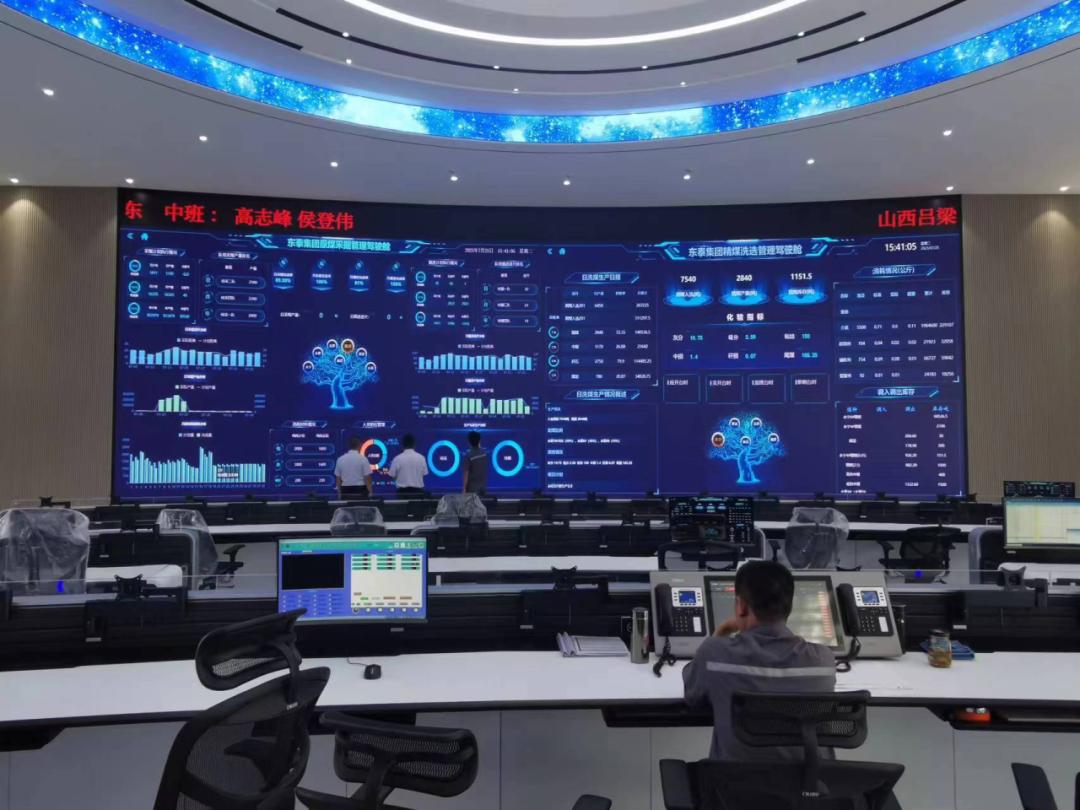
A chemical industrial park LED video wall is a large, seamless display system installed in a centralized command center, industrial monitoring room or emergency coordination center.
Chemical industrial parks may contain chemical manufacturing plants, storage facilities, utility stations, wastewater treatment facilities and logistics infrastructure.
These facilities often operate independent monitoring systems. A centralized command center can present authorized information from these systems in a shared visual environment.
The LED video wall acts as the final visualization interface, allowing personnel to view multiple information sources simultaneously.
Typical functions include:
-
Displaying industrial operating dashboards
-
Presenting facility-wide monitoring information
-
Showing CCTV and security feeds
-
Visualizing alarm status and incident locations
-
Supporting communication between management teams
-
Presenting emergency coordination information
The display must be integrated with the park's existing information infrastructure through approved interfaces.
For a broader explanation of centralized monitoring systems, see our LED Command Center Display System Architecture Guide.
2. Key Monitoring Applications
Different operational areas require different information layouts. The LED video wall should therefore be designed around the actual monitoring responsibilities of the command center.
2.1 DCS and SCADA Monitoring
Distributed Control Systems (DCS) and Supervisory Control and Data Acquisition (SCADA) platforms are commonly used to monitor industrial processes and equipment.
A centralized LED wall can display approved visualization outputs from these systems, including:
-
Equipment operating status
-
Production process diagrams
-
Temperature and pressure trends
-
Utility system status
-
Operational alarms
-
Historical performance charts
The primary control functions remain within the authorized industrial control systems.
For centralized park-level monitoring, the video wall should present relevant summary information rather than attempting to duplicate every individual operator workstation.
2.2 Environmental Monitoring
Chemical industrial parks may use environmental monitoring platforms to collect information about air quality, emissions, wastewater and other environmental conditions.
An LED video wall can present:
-
Environmental monitoring dashboards
-
Air quality trends
-
Wastewater treatment status
-
Monitoring station locations
-
Environmental alarm notifications
-
Historical monitoring reports
These displays help authorized personnel review environmental information from different facilities.
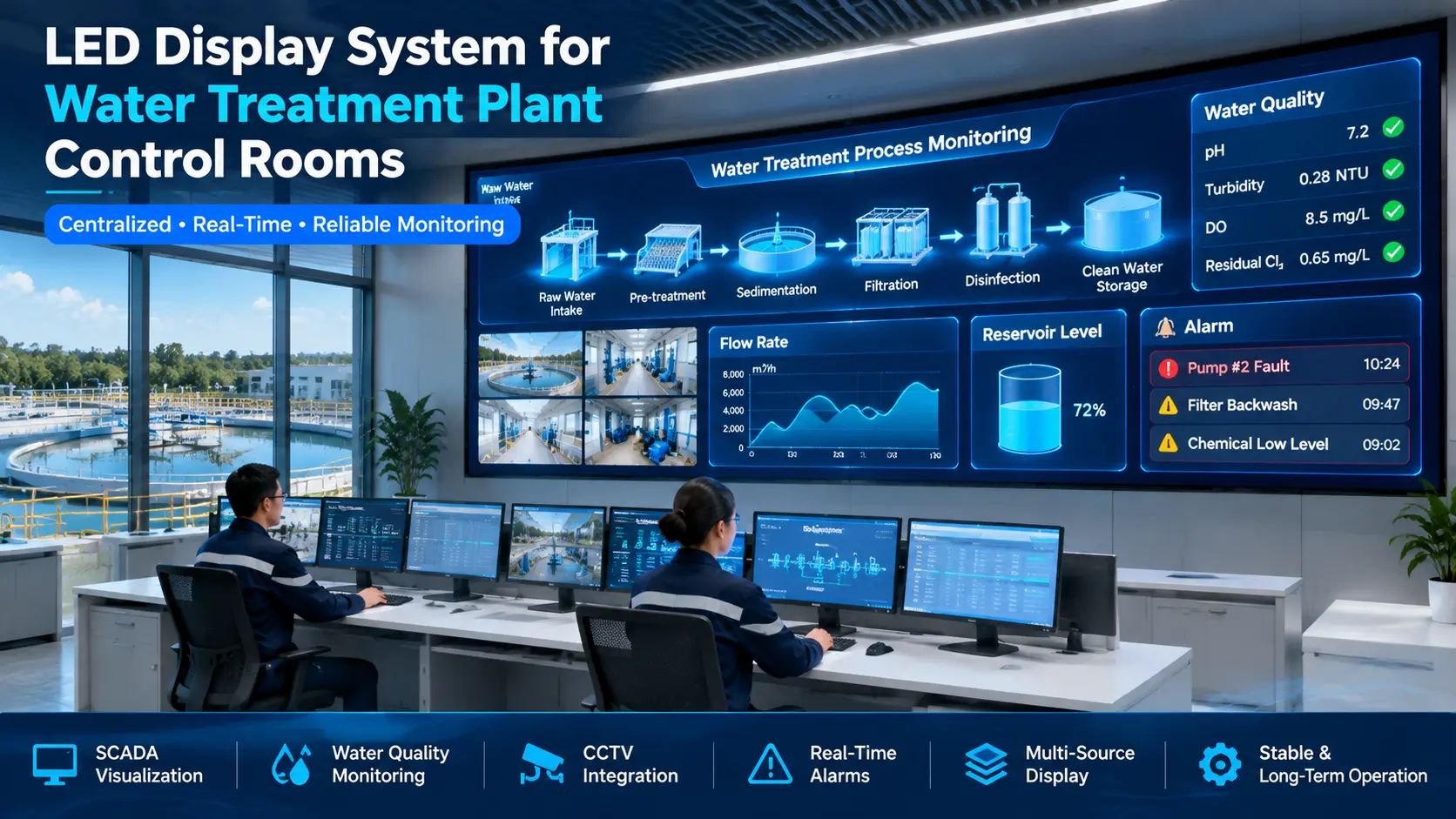
Related application: LED Display System for Water Treatment Plant Control Rooms.
2.3 CCTV and Security Monitoring
Industrial parks often cover large geographic areas with multiple entrances, production zones and restricted locations.
A command center LED video wall can display multiple CCTV feeds to support security monitoring.
Typical areas include:
-
Main entrances and exits
-
Chemical storage facilities
-
Transportation routes
-
Loading and unloading areas
-
Restricted operational zones
-
Facility perimeter boundaries
A suitable video wall controller can organize camera feeds into different monitoring layouts.
For example, a command center may use one preset layout for general security monitoring and another for a specific incident location.
2.4 Emergency Response Coordination
Chemical industrial parks require clearly defined emergency procedures and coordination between responsible teams.
During an incident, a centralized display can present relevant information such as:
-
Incident location maps
-
CCTV views
-
Emergency communication information
-
Authorized alarm dashboards
-
Evacuation route maps
-
Emergency resource locations
These functions depend on the availability and integration of the underlying emergency management systems.
Important: An LED video wall is an information presentation system. It should not be treated as a substitute for independent gas detection, emergency shutdown, fire protection or safety instrumented systems.
2.5 Utility and Energy Infrastructure Monitoring
Chemical industrial parks may operate shared utility infrastructure, including power distribution, water supply and wastewater treatment systems.
A centralized display can present information from approved monitoring sources for these facilities.
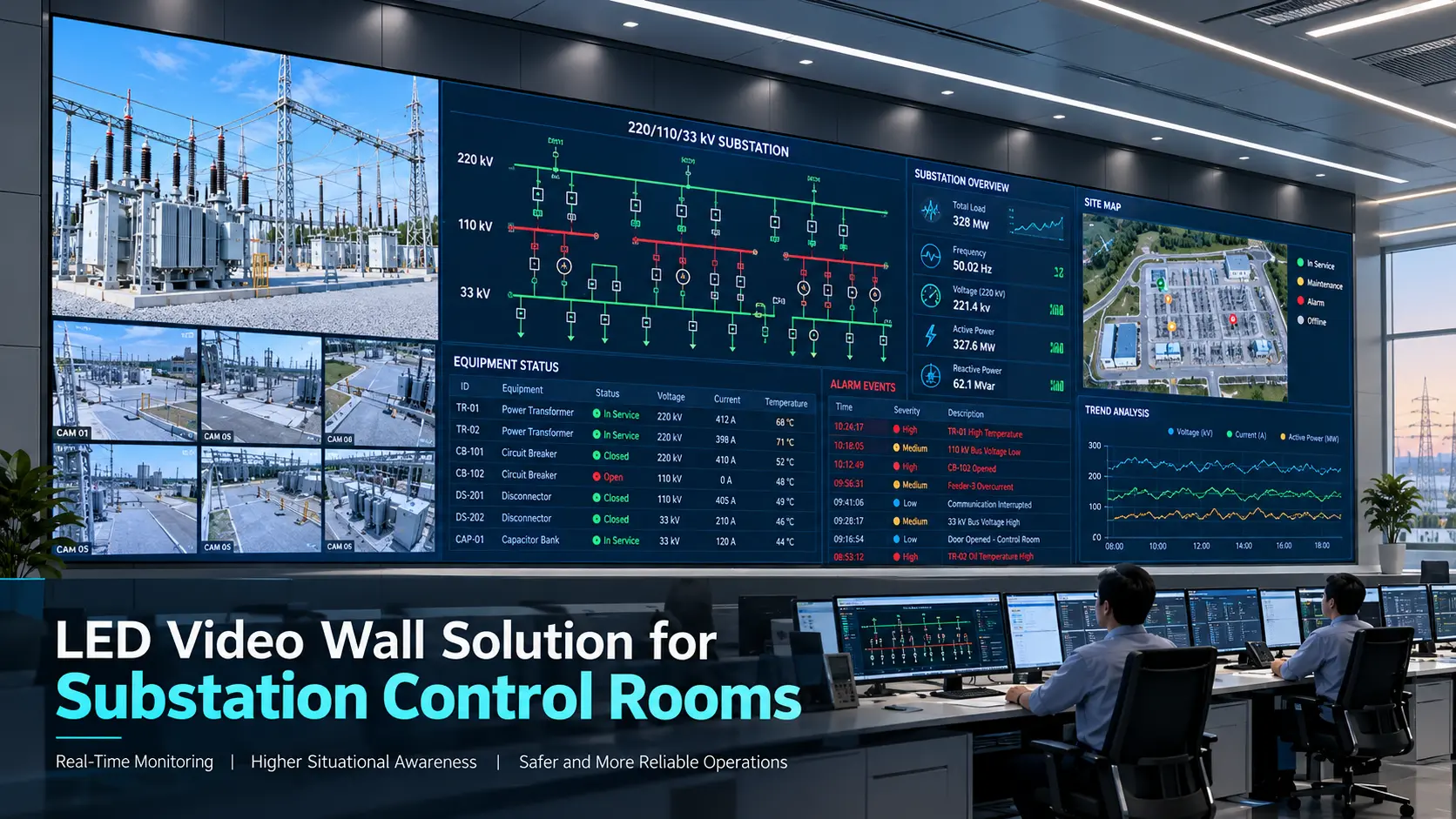
For electrical infrastructure applications, see our LED Video Wall Solution for Substation Control Rooms.
3. LED Video Wall System Architecture
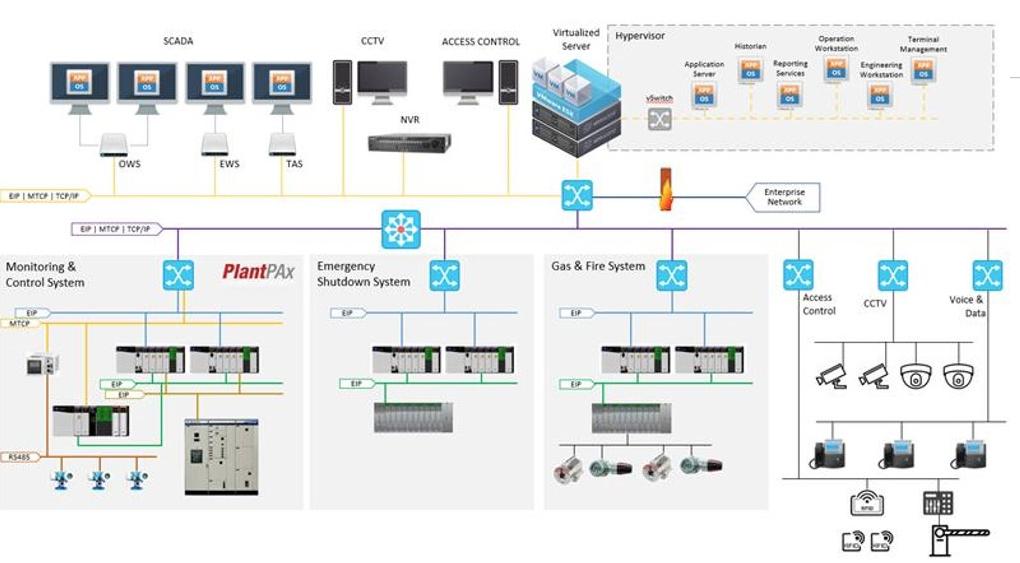
A complete industrial command center display system includes more than LED cabinets.
The architecture must coordinate multiple data sources, video distribution equipment, processing systems and the LED display.
A typical configuration follows this structure:
Industrial Monitoring Platforms → Authorized Visualization Outputs → Signal Distribution → Video Wall Processor → LED Display Controller → LED Video Wall
3.1 Data Sources
Potential sources include:
-
DCS and SCADA workstations
-
CCTV management platforms
-
Environmental monitoring dashboards
-
Industrial GIS systems
-
Emergency management platforms
-
Utility monitoring workstations
-
Security management systems
Not every source needs a direct connection to the LED wall.
For industrial environments, approved workstation outputs or controlled visualization gateways may be more appropriate than direct connections to operational control networks.
3.2 Signal Distribution
Video distribution equipment transfers visual information from approved sources to the video processing system.
Depending on the project, supported interfaces may include HDMI, DisplayPort, SDI, fiber-optic transmission or network-based video distribution.
The appropriate method depends on transmission distance, source resolution, network requirements and equipment compatibility.
3.3 Video Wall Processing
A video processor manages the arrangement of multiple input sources on the LED wall.
Common functions include:
-
Multi-window display
-
Source switching
-
Window resizing
-
Layout presets
-
Image scaling
-
Output resolution management
For large chemical industrial parks, processing capacity should be selected according to the number of simultaneous video sources and required display resolution.
3.4 LED Display System
The final display consists of LED modules, cabinets, power supplies, receiving cards, display controllers and mounting structures.
The LED display resolution must be compatible with the selected processing system.
System integrators should verify the complete signal chain rather than evaluating individual devices separately.
4. How to Select the Right LED Display
Selecting an LED video wall for a chemical industrial park involves balancing image clarity, screen size, viewing distance and project requirements.
4.1 Pixel Pitch
Fine-pitch LED displays are commonly considered for indoor control rooms because operators may need to view detailed diagrams, maps and monitoring information.
The following table provides illustrative selection guidance.
| Pixel Pitch | Typical Consideration |
|---|---|
| P0.9–P1.2 | High-resolution dashboards and closer viewing |
| P1.5 | Detailed monitoring information and medium-sized rooms |
| P1.8 | Larger viewing distances and balanced project budgets |
| P2.5 | Large-format overview displays viewed from farther away |
These are general planning examples, not fixed viewing-distance requirements. Actual selection depends on content resolution, text size, viewing geometry and budget.
4.2 Screen Size and Resolution
The LED video wall should provide enough display area for the required monitoring windows.
Before selecting a screen, project teams should confirm:
-
Control room dimensions
-
Operator viewing positions
-
Required number of monitoring windows
-
Source signal resolutions
-
Text and diagram readability
-
Installation space
A larger screen does not automatically provide better information clarity.
The effective pixel resolution and screen layout must match the content requirements.
4.3 COB or Conventional Fine-Pitch LED?
Both COB and conventional fine-pitch LED technologies may be considered for indoor industrial control rooms.
COB technology can provide a protected light-emitting surface and is often considered where close viewing and surface durability are priorities.
Conventional fine-pitch LED solutions may offer different maintenance options and cost structures.
The final selection should compare:
-
Required pixel pitch
-
Image uniformity
-
Surface protection
-
Maintenance procedures
-
Replacement component availability
-
Total project cost
The appropriate technology depends on the actual installation and operating conditions.
5. Reliability and Industrial Safety Considerations
Industrial command centers may operate continuously, making system availability an important design consideration.
However, display reliability and industrial process safety are separate engineering responsibilities.
5.1 Continuous Operation
For facilities requiring extended or 24/7 operation, the display system should be configured using equipment rated for the intended duty cycle.
Important factors include:
-
Stable power distribution
-
Adequate thermal management
-
Suitable component selection
-
Image uniformity
-
Maintenance access
-
Replacement component availability
Brightness should be adjustable to match the indoor lighting environment.
5.2 Power and Signal Redundancy
For projects with higher availability requirements, redundancy options may include:
-
Backup power arrangements
-
Redundant video signal paths
-
Backup processing equipment
-
Redundant receiving-card configurations
-
Spare LED modules and power supplies
Redundancy must be designed and verified for the actual project. It should not be assumed to exist simply because a product is intended for a control room.
5.3 Industrial Network Security
Chemical industrial parks may contain sensitive operational technology networks.
The LED visualization system should not introduce uncontrolled connections between industrial control networks and general-purpose IT networks.
System integrators should coordinate with the facility's IT and OT security teams regarding:
-
Network segmentation
-
Approved data interfaces
-
Access permissions
-
Remote maintenance access
-
System change management
Industrial cybersecurity requirements should be evaluated separately from the LED hardware specification.
5.4 Safety-Critical System Separation
Emergency shutdown systems, safety instrumented systems and certified alarm functions must retain their required independence.
The LED video wall can present information from authorized monitoring interfaces, but it should not become a single point of failure for critical protection functions.
The project safety team should determine the appropriate separation between operational visualization and safety-critical systems.
6. Installation and Maintenance Requirements
A successful LED video wall project depends on correct structural, electrical and signal planning.
Structural Installation
Before installation, verify:
-
Wall or supporting-frame load capacity
-
Cabinet mounting method
-
Screen alignment
-
Maintenance clearance
-
Cable routing space
-
Equipment access
Electrical Planning
Confirm the total display power requirement, power distribution design, grounding arrangements and any required backup power.
Electrical work should comply with the applicable local requirements and facility engineering procedures.
Maintenance Access
Front-maintenance LED cabinets may be suitable for wall-mounted installations with limited rear space.
Rear-maintenance systems require adequate service access behind the screen.
The maintenance strategy should be confirmed before finalizing cabinet selection.
Commissioning
Commissioning should include:
-
Display alignment inspection
-
Signal compatibility testing
-
Multi-window layout verification
-
Image uniformity checks
-
Power system inspection
-
Approved redundancy testing, where configured
-
Maintenance and operator handover
7. Recommended LED Display Configuration
The following table summarizes typical planning considerations for chemical industrial park command centers.
| Component | Recommended Planning Approach |
|---|---|
| LED display | Indoor fine-pitch LED video wall |
| Pixel pitch | P0.9–P2.5, depending on application |
| Cabinet type | Front- or rear-maintenance configuration |
| Video processor | Multi-input controller sized for actual sources |
| Display control | Compatible sending and receiving system |
| Content | SCADA, DCS, CCTV, GIS and authorized dashboards |
| Operating schedule | Equipment selected for required duty cycle |
| Redundancy | Based on project availability requirements |
| Installation | Engineered wall-mounted or supporting structure |
| Maintenance | Spare parts, access plan and technical support |
These recommendations provide an initial planning framework rather than a fixed bill of materials.
For an accurate proposal, the system integrator should provide the screen dimensions, required resolution, input-source list, operating conditions and control room layout.
8. Why Work with JunChen Display?
Selecting the right LED display manufacturer is important for industrial system integrators and engineering contractors.
JunChen Display provides LED display manufacturing and project support for professional display installations.
Customized LED Display Solutions
We help customers evaluate display dimensions, pixel pitch, cabinet structure and installation requirements according to their project needs.
One-Stop Component Procurement
Project teams can coordinate the procurement of LED display components and accessories, including:
-
LED modules and cabinets
-
Power supplies
-
Receiving cards
-
Display control equipment
-
Power and signal cables
-
Installation accessories
Support for System Integrators
JunChen Display works with engineering contractors, installation companies and system integrators that require reliable display hardware for larger projects.
Our technical support can assist with display configuration, cabinet assembly, signal connections and installation preparation.
Manufacturing and After-Sales Support
JunChen Display offers a three-year product warranty and 24/7 remote technical support, subject to the applicable product and warranty terms.
For industrial command center projects, our role is to provide suitable LED display hardware and display-related technical assistance.
Plant-level automation, industrial cybersecurity and safety-system engineering should be handled by appropriately qualified project specialists.
9. Frequently Asked Questions
What type of LED display is suitable for a chemical industrial park control room?
Indoor fine-pitch LED video walls are commonly considered because they provide a seamless display surface for monitoring dashboards, diagrams, CCTV and other operational information.
Can an LED video wall display DCS and SCADA dashboards?
Yes. Compatible workstation outputs or approved visualization interfaces can be connected to a suitable video wall processing system.
Can one LED video wall display multiple factories?
Yes, if the park's monitoring architecture provides authorized access to the required visualization sources. The display system itself does not collect or authorize industrial data.
Is COB LED suitable for chemical industrial park command centers?
COB LED may be suitable for indoor command centers requiring fine pixel pitch and a protected display surface. The final choice depends on viewing distance, maintenance requirements and budget.
Can an LED video wall replace an emergency alarm system?
No. An LED wall may display authorized alarm information, but it does not replace certified alarms, safety instrumented systems or independent emergency protection equipment.
What information is needed for a quotation?
Customers should provide the required screen size, viewing distance, control room dimensions, number of input sources, preferred pixel pitch, installation conditions and project location.
10. Conclusion
A professional LED video wall helps chemical industrial parks present complex operational information in a centralized visual environment.
From DCS and SCADA dashboards to environmental monitoring, CCTV and emergency coordination, the right display system can support clearer information sharing across industrial management teams.
Successful implementation requires more than choosing an LED screen. System architecture, source compatibility, viewing requirements, reliability and maintenance must all be considered.
JunChen Display supports industrial system integrators and engineering contractors with customized LED display solutions, component procurement and technical assistance.
Planning a chemical industrial park command center project?
Contact JunChen Display to discuss your display requirements and request a customized LED video wall proposal.
Website: https://www.jcdisplay.com/
LED Video Wall for Energy Facility Control Rooms
Tell Us What Are You Looking For?
