
LED Display System for Water Treatment Plant Control Rooms
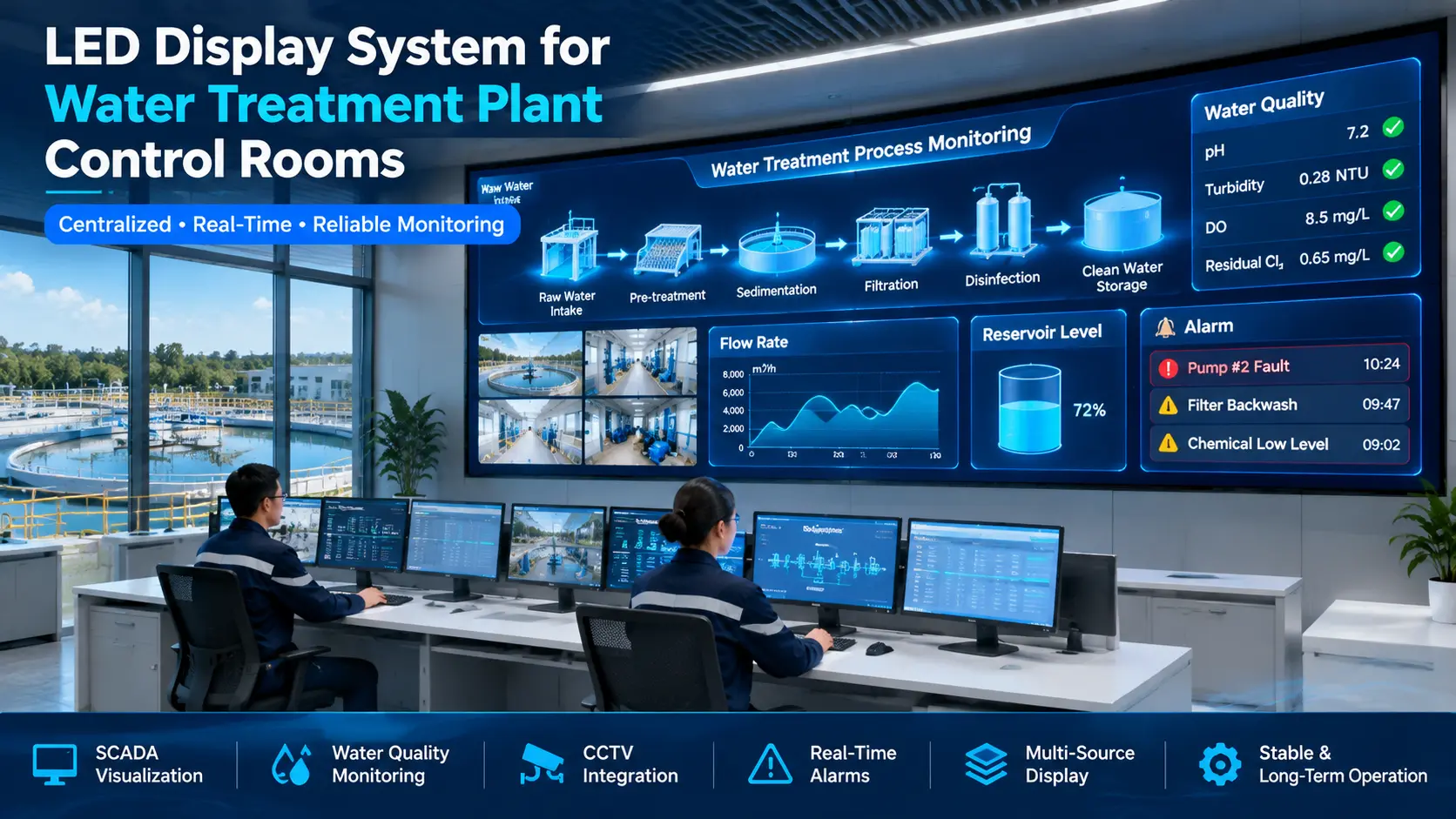
Water treatment plants operate through a continuous flow of information.
Operators may need to monitor water intake, filtration, pumps, tanks, chemical dosing, flow rates, water quality, equipment status, alarms, CCTV cameras and treatment-process data at the same time.
When this information is distributed across many small monitors, it can be difficult to understand the complete operating condition of the plant quickly.
A centralized LED display system for water treatment plant control rooms can bring multiple information sources together on one large visualization platform.
The LED wall does not replace the plant's PLC, SCADA or automation systems.
Instead, it acts as the central visualization layer, helping operators view important operational information more clearly and coordinate responses more efficiently.
Quick Answer
A typical water treatment control room LED system can display:
-
SCADA process screens
-
Water treatment flow diagrams
-
Pump and valve status
-
Tank and reservoir levels
-
Flow and pressure data
-
Water quality indicators
-
Alarm information
-
CCTV camera feeds
-
Historical trends
-
Facility maps
The correct system should be designed according to:
Control Room Size → Viewing Distance → Screen Resolution → Data Sources → Video Processing → Reliability → Maintenance
Table of Contents
-
What Is a Water Treatment Plant Control Room LED Display?
-
Why Water Treatment Plants Need Centralized Visualization
-
What Information Can Be Displayed?
-
Typical LED Display System Architecture
-
How to Choose the Right LED Video Wall
-
SCADA and Multi-Source Visualization
-
Water Treatment Process Visualization
-
Reliability for Long-Hour Operation
-
Front Maintenance and Serviceability
-
Common Water Utility Applications
-
What Buyers Should Provide Before Ordering
-
Why Use LED Instead of Traditional Video Walls?
-
JunChen Display Solution Approach
-
FAQ
-
Conclusion
1. What Is a Water Treatment Plant Control Room LED Display?
A water treatment plant control room LED display is a large-format visualization system used to present operational information from different monitoring platforms.
It may be installed in:
-
Drinking water treatment plants
-
Wastewater treatment facilities
-
Pumping stations
-
Water utility command centers
-
Reservoir monitoring centers
-
Industrial water-treatment facilities
-
Municipal water management centers
The LED wall can display information from existing systems without becoming the primary process-control system itself.
The typical role is:
Collect Visual Information → Arrange Multiple Sources → Display on One Large LED Wall
This gives operators a clearer overall view of plant operations.
2. Why Water Treatment Plants Need Centralized Visualization
Water-treatment facilities may include many different operating areas.
For example:
-
Raw water intake
-
Screening
-
Sedimentation
-
Filtration
-
Disinfection
-
Chemical dosing
-
Pumping
-
Storage tanks
-
Distribution
-
Laboratory monitoring
Each area may generate different operational data.
Without centralized visualization, operators may need to switch between several computers and interfaces.
A large LED video wall can improve situational awareness by presenting important information together.
Key Benefits
Centralized Monitoring
Operators can view several process areas on one screen.
Faster Alarm Recognition
Important alarms can be made more visible during abnormal conditions.
Multi-System Visualization
SCADA, CCTV, maps and operational dashboards can be shown simultaneously.
Better Team Coordination
Multiple operators can see the same information during daily operation or emergency response.
3. What Information Can Be Displayed?
A water treatment control room may display several categories of information.
SCADA Process Screens
SCADA interfaces may visualize:
-
Equipment operating status
-
Flow direction
-
Process values
-
Pump conditions
-
Valve positions
-
Tank levels
-
System alarms
Water Quality Information
Depending on the monitoring system, the display may show water-quality indicators such as:
-
pH
-
Turbidity
-
Conductivity
-
Temperature
-
Dissolved oxygen
-
Residual disinfectant values
The exact parameters depend on the treatment process and the plant's monitoring equipment.
Pump and Equipment Status
Operators may need to monitor:
-
Pump operating status
-
Motor condition
-
Valve position
-
Filter status
-
Equipment availability
CCTV Cameras
Camera feeds can help monitor:
-
Plant entrances
-
Pump rooms
-
Treatment areas
-
Reservoirs
-
Equipment rooms
-
Perimeter security
Alarm Information
Alarm lists can be displayed alongside plant diagrams to improve visibility during abnormal events.
Historical Trends
Trend charts can help operators compare current and historical operating data.
4. Typical LED Display System Architecture
A typical system can follow this structure:
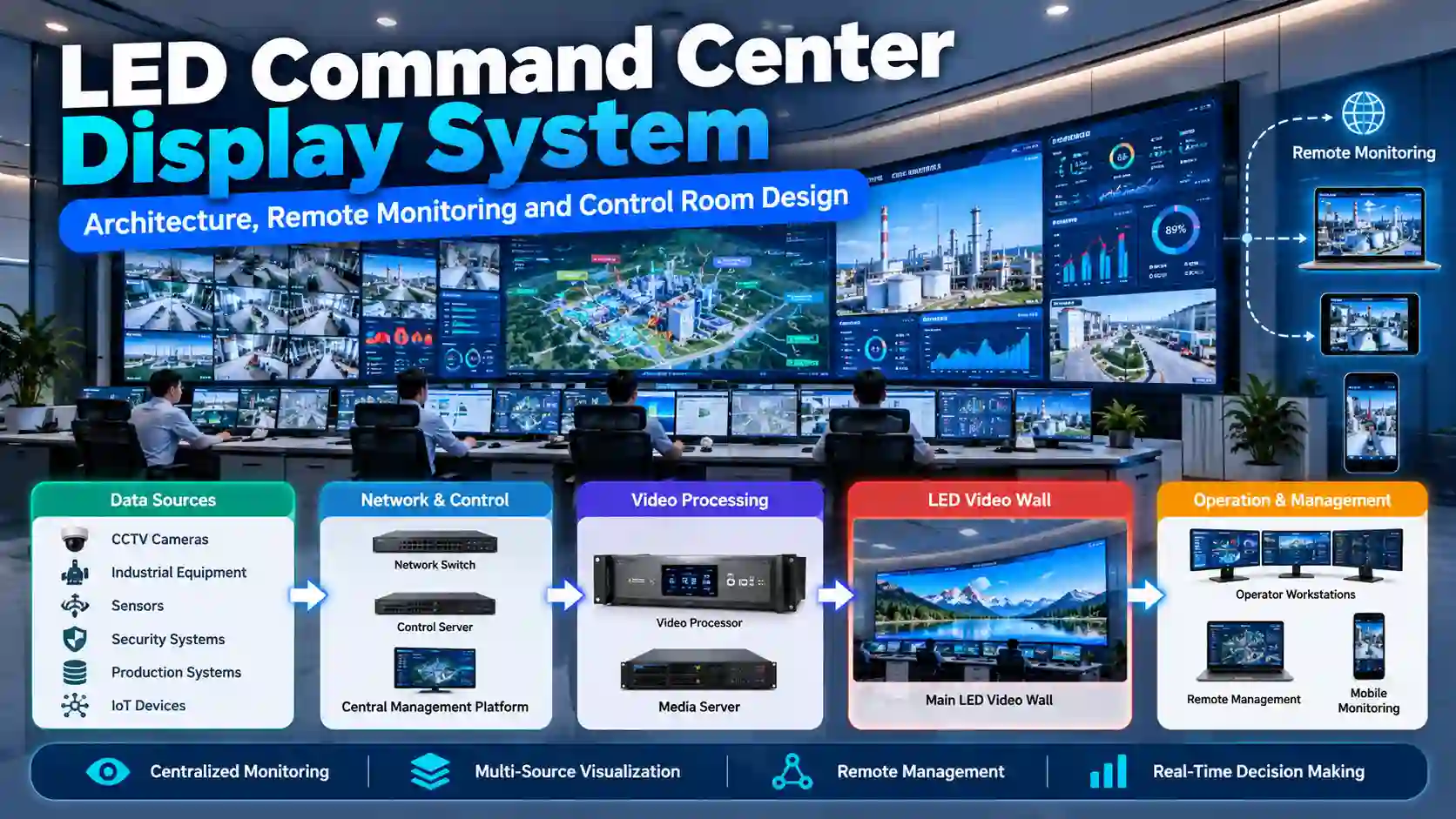
PLC / SCADA / CCTV / Computers → Network & Control → Video Processor → LED Video Wall → Operator Workstations
Data Sources
Potential signal sources include:
-
SCADA computers
-
Engineering workstations
-
CCTV systems
-
Monitoring servers
-
Management platforms
-
GIS systems
-
Presentation computers
Network and Control Layer
The plant's existing network infrastructure may include:
-
Network switches
-
Control servers
-
Signal distribution
-
KVM systems
-
Management computers
The LED display system should integrate with the customer's approved IT and control architecture.
Video Processing
The video processor or video wall splicer receives display signals and arranges them on the LED wall.
It can manage:
-
Multiple windows
-
Source switching
-
Scaling
-
Presets
-
Multi-screen layouts
-
Large-resolution output
LED Video Wall
The LED wall presents the final information to operators.
The objective is to provide a clear, seamless visualization surface for daily monitoring.
5. How to Choose the Right LED Video Wall
Water-treatment control rooms are typically indoor close-viewing environments.
The main selection factors include:
Pixel Pitch
Common fine-pitch options may include:
-
P0.9
-
P1.2
-
P1.5
-
P1.8
-
P2
The correct pixel pitch should be selected according to:
Viewing Distance + Screen Size + Required Detail + Budget
If operators need to read small SCADA labels, values and charts, sufficient pixel density is important.
Screen Size
The LED wall should be sized according to:
-
Available wall dimensions
-
Operator viewing distance
-
Number of workstations
-
Number of simultaneous windows
-
Content type
-
Room layout
A larger screen is useful only if the content remains organized and readable.
Resolution
For control rooms, resolution is often more important than physical size alone.
The screen may need to display:
Plant Flow Diagram + CCTV + Alarm List + Water Quality Dashboard + Trend Chart
simultaneously.
Therefore, the total LED resolution should be calculated before selecting the processor.
6. SCADA and Multi-Source Visualization
One of the main advantages of a professional LED control-room system is the ability to show several sources together.
For example, one screen layout could include:
| Screen Area | Content |
|---|---|
| Main Center | Water Treatment SCADA |
| Left Side | CCTV Cameras |
| Right Side | Water Quality Dashboard |
| Bottom | Alarm List |
| Secondary Window | Historical Trends |
The LED wall does not need to reproduce only one computer screen.
With a suitable video processor, the display can be divided into multiple independent windows.
This helps operators compare operational conditions without constantly switching applications.
7. Water Treatment Process Visualization
Water-treatment plants are particularly suitable for large visualization systems because their processes are sequential.
A simplified drinking-water process may be presented visually as:
Raw Water → Pretreatment → Sedimentation → Filtration → Disinfection → Storage → Distribution
A wastewater treatment facility may have a different process structure.
The LED wall can show the complete process flow while highlighting individual treatment areas.
This allows operators to understand both:
overall plant status
and
specific equipment conditions
on the same display.
Example
If an abnormal pump condition occurs, operators may simultaneously view:
-
Pump status
-
Related process diagram
-
CCTV camera
-
Alarm information
-
Historical trend
This is more useful than viewing each source separately.
8. Reliability for Long-Hour Operation
Water utility control rooms may operate continuously or for extended periods.
The LED display system should therefore prioritize reliability.
Important considerations include:
-
Stable LED modules
-
Reliable power supplies
-
Receiving-card stability
-
Heat management
-
Signal backup
-
Spare modules
-
Spare power supplies
-
Spare receiving cards
-
Processor redundancy where required
Not every water facility needs the same level of redundancy.
A small local pumping station and a major municipal water command center may require very different configurations.
The solution should match the operational importance of the facility.
9. Front Maintenance and Serviceability
In many control rooms, the LED screen is installed directly against a wall.
This makes front maintenance particularly useful.
Technicians can access:
-
LED modules
-
Power supplies
-
Receiving cards
-
Internal connections
from the front of the display.
This reduces the need for a large maintenance corridor behind the screen.
For a long-term infrastructure project, buyers should consider maintenance during the initial design stage.
A useful question is:
If one module or power supply needs replacement, how quickly can technicians access it?
10. Common Water Utility Applications
LED control-room systems can be used in several water-industry environments.
Drinking Water Treatment Plants
For monitoring treatment processes, water-quality information and equipment.
Wastewater Treatment Plants
For visualizing treatment stages, equipment status, alarms and facility monitoring.
Pumping Stations
Large pumping facilities may need centralized pump, pressure and security monitoring.
Reservoir Control Centers
Operators can monitor water levels, cameras, environmental conditions and distribution information.
Municipal Water Command Centers
A larger command center may combine information from multiple plants, pump stations and distribution areas.
Industrial Water Facilities
Factories and industrial parks may operate dedicated water-treatment or wastewater systems requiring their own monitoring centers.
11. What Buyers Should Provide Before Ordering
Before preparing a solution, provide the following information.
Room Information
-
Wall width and height
-
Viewing distance
-
Control room dimensions
-
Number of operators
Display Requirements
-
Target screen size
-
Preferred pixel pitch
-
Required resolution
-
Front maintenance requirement
Signal Requirements
-
Number of SCADA computers
-
Number of CCTV sources
-
HDMI / DP / SDI / IP signals
-
Number of simultaneous windows
-
Required 4K sources
System Requirements
-
Video processor
-
Local control
-
Remote monitoring
-
Optical fiber transmission
-
Backup requirements
-
Daily operating hours
Project Information
-
Water plant type
-
Installation country
-
Installation drawings
-
Delivery destination
The more complete the project information, the more accurately the LED system can be configured.
12. Why Use LED Instead of Traditional Video Walls?
For many new or upgraded control rooms, fine-pitch LED provides several advantages.
Seamless Display
There are no large LCD panel bezels dividing process diagrams or maps.
Flexible Dimensions
The screen can be configured according to the available wall size.
High Resolution
Fine-pitch LED can provide sufficient pixel density for detailed monitoring content.
Multi-Window Visualization
Different information sources can share one large visualization canvas.
Modular Maintenance
Individual modules can be serviced without replacing the entire display.
Better Large-Format Visualization
Large process diagrams and plant maps can extend across the whole screen without being interrupted by panel borders.
13. JunChen Display Solution Approach
For water-treatment projects, JunChen Display focuses on the LED visualization subsystem and its integration with the customer's existing monitoring environment.
Our planning sequence is:
Application → Control Room → Viewing Distance → Screen Size → Pixel Pitch → Resolution → Signal Sources → Processor → Maintenance
The objective is not simply to recommend the smallest pixel pitch.
Instead, the screen should provide enough resolution for the actual SCADA interface, data dashboards and monitoring content.
JunChen Display can work with local system integrators, engineering contractors and water-treatment project teams to provide:
-
Fine-pitch LED displays
-
LED cabinets
-
Control systems
-
Video processors
-
Spare parts
-
Configuration support
-
Project technical coordination
For the wider system concept, this article can also link to:
LED Command Center Display System: Architecture, Remote Monitoring and Control Room Design
This helps buyers understand how the LED visualization layer fits into a complete command-center architecture.
14.FAQ
What is a water treatment plant control room LED display?
It is a large LED visualization system used to display SCADA data, CCTV feeds, process diagrams, alarms, water-quality information and other operational content.
What pixel pitch is suitable for a water plant control room?
P0.9 to P2 fine-pitch LED is commonly considered for close-viewing control rooms, but the final specification should depend on viewing distance and required resolution.
Can the LED wall display SCADA and CCTV simultaneously?
Yes. A suitable video processor can arrange multiple sources into independent windows on the same LED wall.
Does the LED display control the water treatment process?
Normally, no. The LED display acts as the visualization layer. Process control remains within the customer's PLC, SCADA or automation platform.
Is front maintenance suitable for a water control room?
Yes. Front maintenance is often recommended when the LED wall is installed close to the building wall.
Can the system support remote monitoring?
Remote monitoring may be possible depending on the control platform, network architecture and customer cybersecurity requirements.
What information is needed for a quotation?
Provide the control-room dimensions, screen dimensions, viewing distance, source quantity, simultaneous windows, operating requirements and installation destination.
15.Conclusion
A professional LED display system for water treatment plant control rooms should help operators understand the complete plant more clearly.
The most useful system is not simply the largest display.
It should combine:
SCADA Visualization + CCTV + Process Information + Water Quality Data + Alarms + Trends
on one centralized viewing platform.
The core design sequence is:
Understand the Process → Identify Data Sources → Determine Screen Size and Resolution → Select Video Processing → Plan Reliability and Maintenance
For water-treatment plants, wastewater facilities, pumping stations and municipal water command centers, a well-designed LED video wall can provide a clearer and more flexible visualization environment for daily operations.
Planning a Water Treatment Control Room LED Wall?
Send JunChen Display your:
Control Room Size + Screen Size + Viewing Distance + SCADA/CCTV Sources + Required Windows + Destination
We can recommend a suitable fine-pitch LED wall and video-processing configuration.
JunChen Display
Guangzhou JunChen Display Technology Co., Ltd.
WhatsApp: +86 188 1890 1997
Email: admin@ledscreenwholesale.com
Website: www.jcdisplay.com
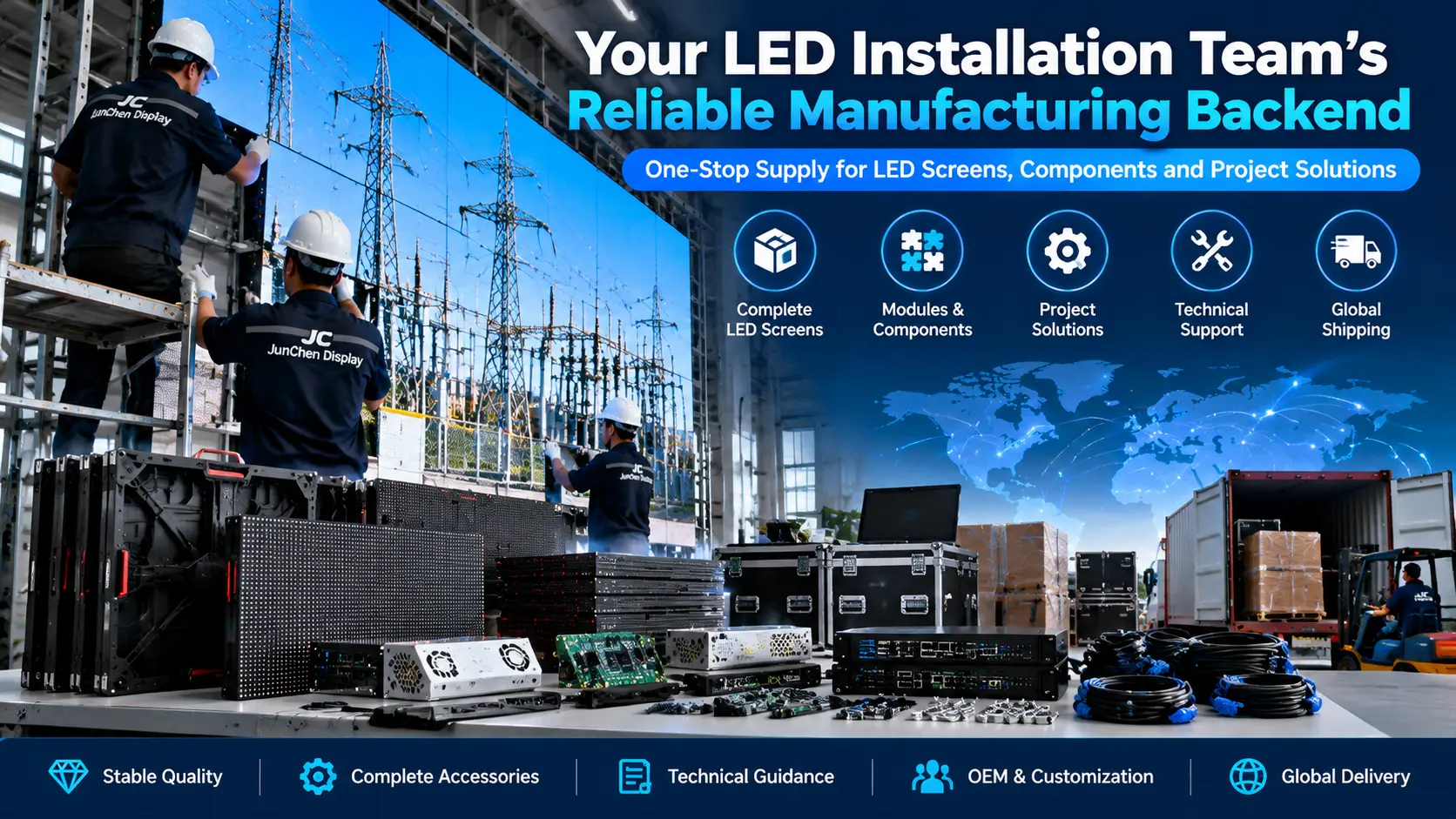
How LED Installation Teams Can Scale Faster with JunChen Display as Their Manufacturing Backend
Tell Us What Are You Looking For?
