
LED Video Wall Solution for Substation Control Rooms
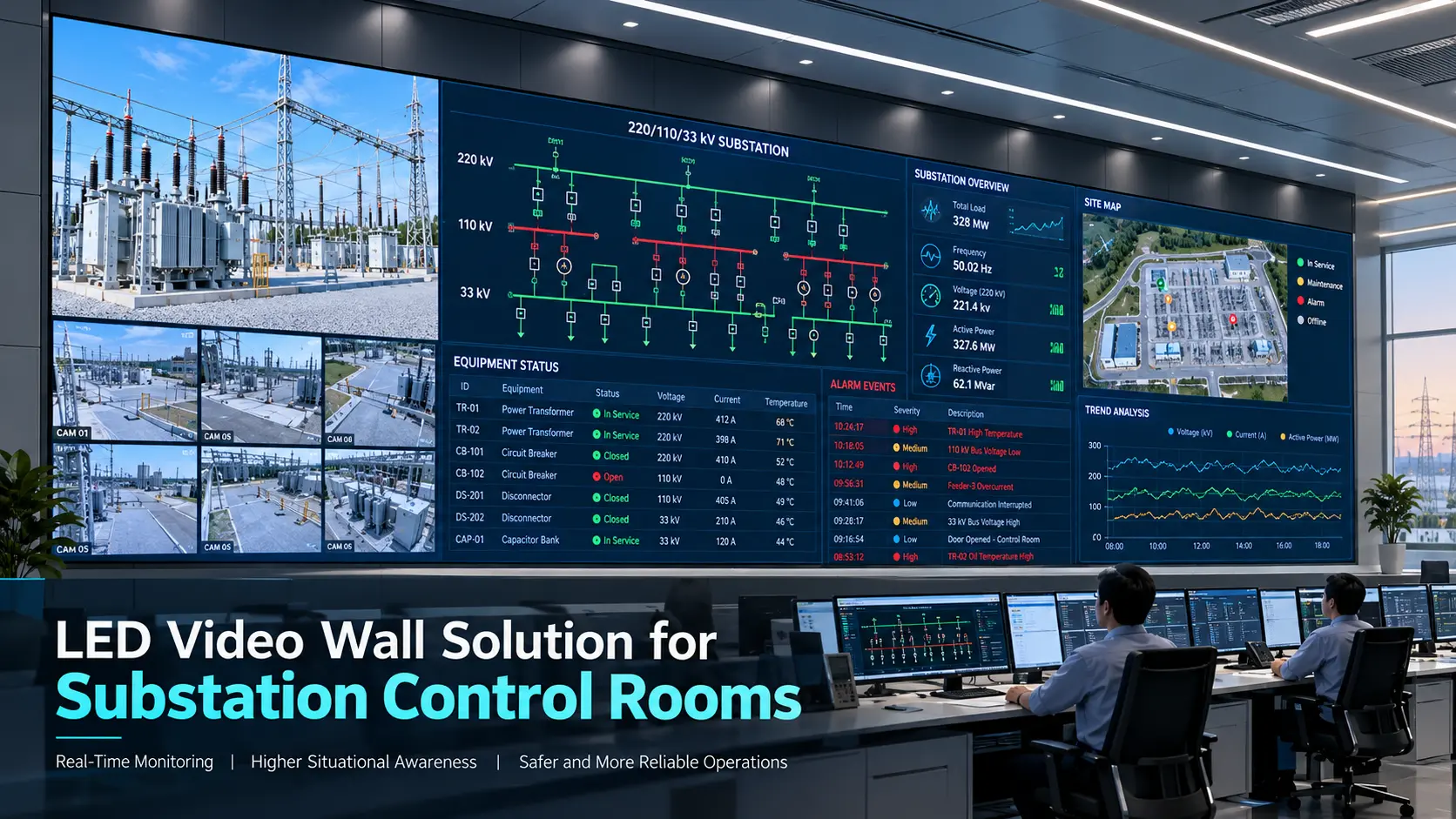
LED Video Wall Solution for Substation Control Rooms
Modern substations depend on fast, accurate and centralized information display.
Operators need to monitor multiple systems at the same time, including SCADA platforms, surveillance cameras, alarms, equipment status, electrical diagrams, trend curves, maps and dispatch information. In many projects, traditional monitors or LCD video walls are no longer enough to provide the size, continuity and flexibility required for efficient supervision.
This is where an LED video wall solution for substation control rooms becomes highly valuable.
A properly designed LED video wall helps operators see critical information more clearly, respond more quickly to abnormal conditions, and manage more signals in one centralized display environment.
Quick Answer
A substation control room LED video wall is typically designed to provide:
- Centralized visualization of SCADA and monitoring systems
- Real-time display of alarms, electrical diagrams and equipment status
- Multi-source display from computers, cameras and network platforms
- Seamless viewing without LCD bezels
- Reliable long-hour operation
- Flexible screen size based on control room dimensions
- Front maintenance for easier service
- Expandable architecture for future upgrades
The correct solution should therefore be selected based on room size, viewing distance, screen resolution, number of signal sources, processor requirements, maintenance method and reliability expectations.
Table of Contents
- What Is an LED Video Wall for a Substation Control Room?
- Why Substations Need Large Centralized Visualization
- What Information Is Typically Displayed?
- Basic System Architecture
- How to Choose the Right LED Video Wall
- Video Processing and Multi-Source Management
- Reliability Requirements for Utility Control Rooms
- Front Maintenance and Serviceability
- Common Installation Scenarios
- What Buyers Should Confirm Before Ordering
- Why LED Is Better Than Traditional Display Methods
- JunChen Display Solution Approach
- FAQ
- Conclusion
1. What Is an LED Video Wall for a Substation Control Room?
A substation control room LED video wall is a large display system used to visualize multiple types of operational information in a centralized monitoring environment.
It is usually installed in:
- Utility dispatch centers
- Power substation control rooms
- Monitoring centers
- Grid management rooms
- Electrical operation centers
The LED wall is not only for showing one full-screen image. In most real projects, it is used to display multiple content windows at the same time, such as:
- SCADA interface
- Single-line electrical diagrams
- Alarm lists
- CCTV camera feeds
- Equipment operating status
- Event logs
- Trend charts
- Dispatch screens
- Maps
- Emergency communication windows
Because substations often operate for long hours and need continuous visibility, the display system must be designed for clarity, reliability and serviceability.
2. Why Substations Need Large Centralized Visualization
Substation operators must monitor different systems simultaneously. When information is separated across many smaller displays, overall situational awareness becomes weaker.
A large centralized LED video wall helps improve visibility by bringing important data together in one location.
Main benefits include:
Faster information recognition
Operators can see key information from across the room without switching between multiple small monitors.
Better multi-source comparison
Different systems can be placed side by side, such as:
SCADA + CCTV + Alarm Panel + Grid Diagram + Dispatch Information
Improved emergency response
In abnormal or alarm conditions, a large LED wall helps operators identify issues more quickly and coordinate responses more efficiently.
More flexible display layout
The display arrangement can be adjusted depending on the shift, task, incident type or project requirement.
For example, during normal operation, the wall may show equipment overview, trend curves and grid diagrams. During an incident, it may switch to alarm windows, camera feeds and operational instructions.
3. What Information Is Typically Displayed?
A substation control room video wall usually needs to integrate information from multiple platforms.
Common display content includes:
SCADA and Power Monitoring Interfaces
These may include equipment status, switching conditions, electrical parameters and control information.
Single-Line Diagrams
Single-line or system diagrams are often among the most important visuals in utility environments because they show the operational relationship of equipment and circuits.
Alarm and Event Information
Alarm lists, warning messages and event records must be clearly visible to operators.
CCTV Feeds
Security and operational cameras may be displayed for perimeter monitoring, equipment observation or incident review.
Trend Curves and Data Reports
Voltage, current, temperature or other performance trends may need to be displayed over time.
GIS or Site Maps
For larger utility sites, maps may help operators understand field conditions or equipment locations.
Communication or Dispatch Windows
Some control rooms may also show coordination screens, internal dispatch information or meeting content.
This is why a substation LED wall should always be planned as a multi-source visualization platform, not just a screen.
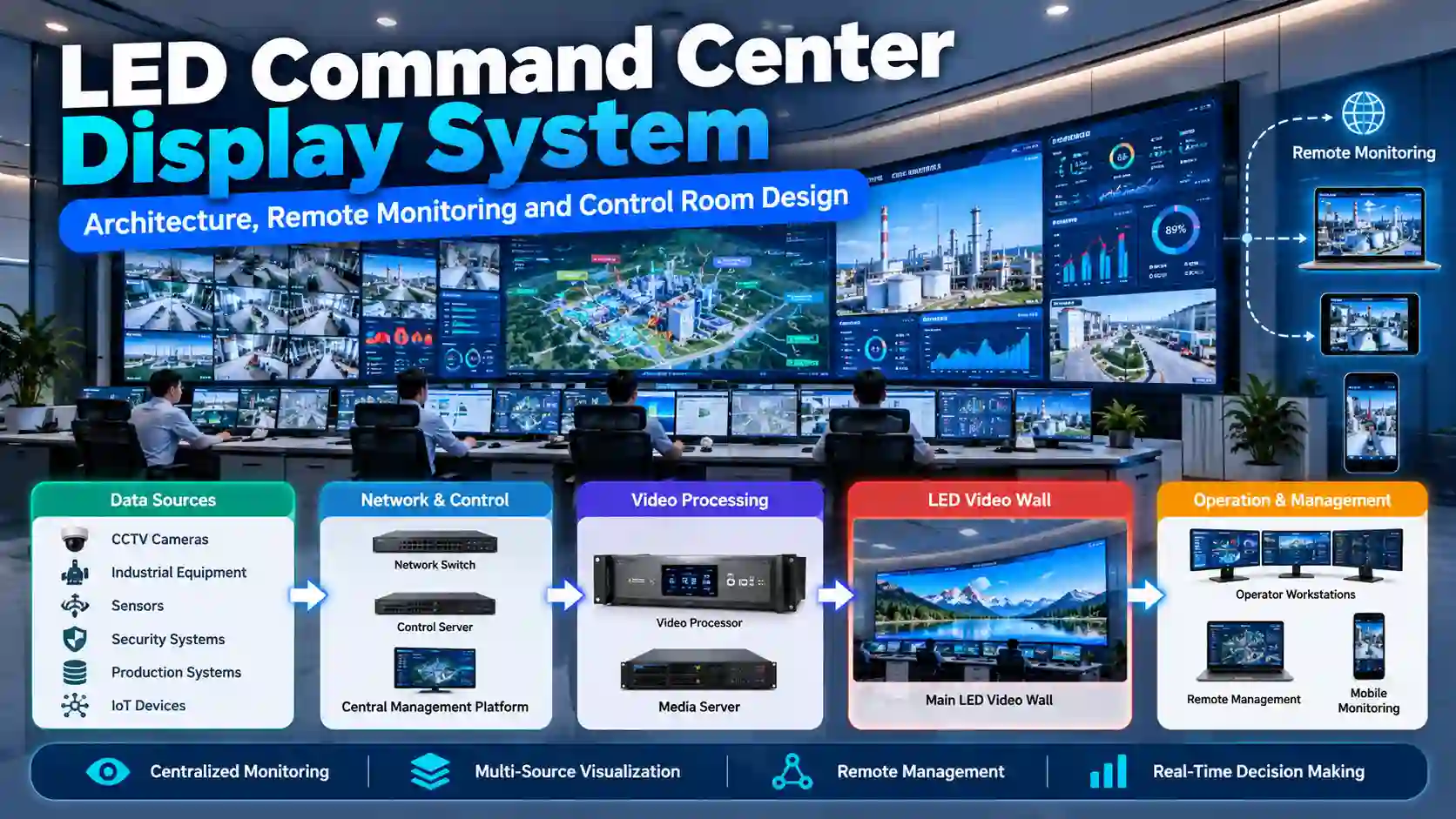
4. Basic System Architecture
A typical substation LED video wall solution follows this logic:
Data Sources → Control / Network Layer → Video Processing → LED Video Wall → Operator Management
Data Sources
These may include:
- SCADA computers
- Engineering workstations
- CCTV systems
- Dispatch computers
- Alarm systems
- Network platforms
- Servers
- Emergency communication systems
Control / Network Layer
Signals and data are connected through:
- Network switches
- Control computers
- Signal distribution equipment
- Management platforms
- KVM or matrix systems where needed
Video Processing Layer
The processor or video wall splicer is responsible for:
- Accepting multiple signal inputs
- Scaling and arranging windows
- Managing presets
- Switching layouts
- Sending the final composition to the LED wall
LED Video Wall Layer
The LED display becomes the central visualization surface for operators in the room.
The result is a flexible and scalable display solution suitable for both new control rooms and upgrade projects.
5. How to Choose the Right LED Video Wall
The best LED wall is not always the smallest pixel pitch or the largest screen.
The correct choice should be based on actual project conditions.
Pixel Pitch
Substation control rooms are usually close-viewing environments, so fine-pitch LED is often preferred.
Common options may include:
- P0.9
- P1.2
- P1.5
- P1.8
- P2
The final choice depends on:
Viewing Distance + Room Size + Content Detail + Budget
If operators need to read diagrams, data tables and text clearly, resolution becomes very important.
Screen Size
The screen should be large enough for all key content to remain readable from the operator positions.
Screen size should be determined by:
- Wall dimensions
- Viewing distance
- Number of operators
- Number of simultaneous windows
- Content complexity
- Room layout
Resolution
A substation control room often displays small text, diagrams and several windows at once. Because of this, the total LED resolution should be carefully planned.
A higher-resolution screen generally improves readability when multiple information sources must be shown simultaneously.
Brightness
Control rooms are indoor spaces, so extremely high brightness is not necessary. The focus should be on:
- Comfortable viewing
- Uniform image quality
- Stable color performance
- Reduced visual fatigue during long shifts
6. Video Processing and Multi-Source Management
The video processor is one of the most important parts of a substation LED wall system.
In many projects, the screen needs to show content from several sources at the same time.
For example:
SCADA Interface + Single-Line Diagram + CCTV + Alarm List + Dispatch Screen
A suitable processor should support:
- Multiple input channels
- Multi-window display
- Preset switching
- Large pixel capacity
- Stable operation
- Potential backup configuration
- Integration with the LED control system
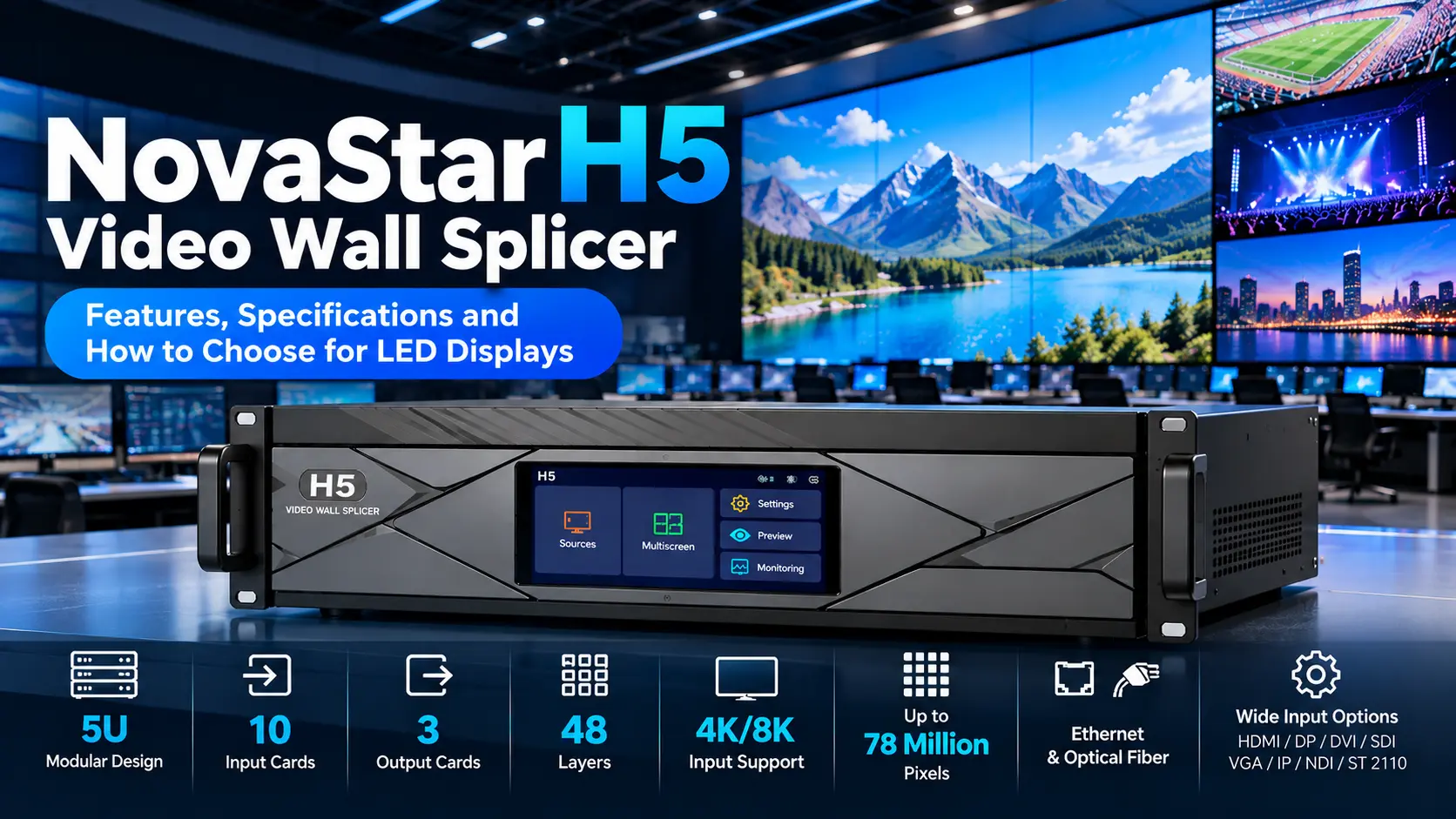
For more complex control rooms, a modular processing platform may be more suitable than a simple fixed-input processor.
This is especially important when the project may expand in the future.
7. Reliability Requirements for Utility Control Rooms
Substation environments require reliable operation. In many cases, the control room display system is expected to run for long periods every day.
Reliability considerations may include:
- Stable LED modules and receiving cards
- High-quality power supplies
- Reliable control system
- Good heat management
- Spare parts planning
- Backup input or processor strategy
- Redundant power or signal design where required
- Clear status monitoring for maintenance teams
A utility control room should not be treated like a retail display project.
The focus should be on:
Operational stability + service continuity + maintainability
This is often more important than simply reducing the initial purchase price.
8. Front Maintenance and Serviceability
Most control room LED walls are installed close to a wall, so maintenance access from behind may be limited.
For this reason, front maintenance is often preferred.
With front maintenance, technicians can service:
- LED modules
- Receiving cards
- Power supplies
- Internal components
from the front of the display.
This offers several advantages:
- Less rear service space required
- Easier installation in compact control rooms
- Faster maintenance access
- Better long-term practicality
Before ordering, buyers should confirm how modules and internal components will be replaced after installation.
9. Common Installation Scenarios
Substation LED walls may be installed in different layouts depending on the room design.
Wall-Mounted Front Maintenance Display
Suitable for many indoor control rooms where the display is installed directly against the wall.
Large Central Monitoring Wall
Used when the control room requires a dominant display surface visible to multiple operators.
Dispatch and Monitoring Combined Room
In some projects, the LED wall may need to serve both real-time monitoring and occasional meeting or coordination use.
Upgrade from Existing LCD Video Wall
A substation that previously used LCD video walls may upgrade to LED for a seamless display and more flexible size options.
10. What Buyers Should Confirm Before Ordering
Before requesting a quotation, the buyer should prepare the following information.
Room and Display Information
- Available wall width and height
- Viewing distance
- Target screen size
- Preferred pixel pitch
- Required screen resolution
Signal Requirements
- Number of computers
- Number of CCTV sources
- SCADA display requirements
- Number of simultaneous windows
- HDMI / DP / SDI / IP input requirements
Project Requirements
- Front or rear maintenance
- Daily operating hours
- Redundancy requirements
- Installation environment
- Delivery destination
- Installation or commissioning expectations
The more complete the information, the more accurate the solution recommendation will be.
11. Why LED Is Better Than Traditional Display Methods
For many control room projects, LED offers several important advantages over traditional display methods.
Seamless Viewing
Unlike LCD video walls, LED does not create thick panel bezels between images.
Flexible Size and Shape
The display can be sized according to the actual wall dimensions.
Better Suitability for Multi-Window Layouts
A seamless surface is especially useful when displaying diagrams, maps and dashboards across a large area.
Higher Visual Integration
Operators can view more information in one unified display environment.
Easier Long-Term Scaling
The solution can often be adapted more flexibly during renovation or future upgrades.
12. JunChen Display Solution Approach
For substation control room projects, JunChen Display focuses on the LED visualization system and its coordination with the broader monitoring environment.
Our planning logic is:
Application → Viewing Distance → Screen Size → Pixel Pitch → Resolution → Signal Sources → Processor → Maintenance → Installation
Instead of recommending a display only by square-meter price, a more professional approach is to first understand:
- What information needs to be shown
- How many sources must be displayed
- How close the operators sit
- How detailed the content is
- How the system will be maintained later
This helps avoid both under-specification and unnecessary over-specification.
For related planning logic, you can also connect this article with:
LED Command Center Display System: Architecture, Remote Monitoring and Control Room Design
That page works well as the parent topic for this industry application page.
13.FAQ
What is an LED video wall for a substation control room?
It is a large centralized display system used to visualize SCADA interfaces, cameras, alarms, diagrams, maps and other operational information in a substation monitoring environment.
What pixel pitch is suitable for a substation control room?
Fine-pitch LED such as P0.9 to P2 is commonly considered, but the right choice depends on viewing distance, required detail, room size and budget.
Can one LED wall show several systems at the same time?
Yes. With a suitable processor, the screen can display multiple independent windows from different input sources at the same time.
Is front maintenance recommended?
Yes, in many indoor control room projects front maintenance is more practical because the screen is often installed close to the wall.
Can the LED wall display SCADA and CCTV together?
Yes. This is one of the most common requirements in substation control rooms.
What should buyers provide before requesting a quotation?
Provide room dimensions, screen size, viewing distance, source requirements, maintenance preference and project destination.
14.Conclusion
A professional LED video wall solution for substation control rooms should be designed as part of a larger monitoring and visualization system.
The goal is not simply to install a bigger screen.
The real objective is to build a display platform that helps operators manage information more clearly, monitor equipment more effectively and respond to conditions more quickly.
The most important selection factors are:
Viewing Distance + Screen Size + Resolution + Signal Sources + Video Processing + Reliability + Maintenance
For utility and substation applications, the best solution is the one that provides:
Clear visualization, stable operation, flexible source management and long-term maintainability
Planning a Substation Control Room LED Wall?
Send JunChen Display your:
Control Room Size + Screen Size + Viewing Distance + Signal Sources + Required Windows + Project Location
We can help recommend a suitable LED video wall and control solution for your project.
JunChen Display
Guangzhou JunChen Display Technology Co., Ltd.
WhatsApp: +86 188 1890 1997
Email: admin@ledscreenwholesale.com
Website: www.jcdisplay.com
LED Command Center Display System: Architecture, Remote Monitoring and Control Room Design
Tell Us What Are You Looking For?
