
LED Command Center Display System: Architecture, Remote Monitoring and Control Room Design
Quick Answer
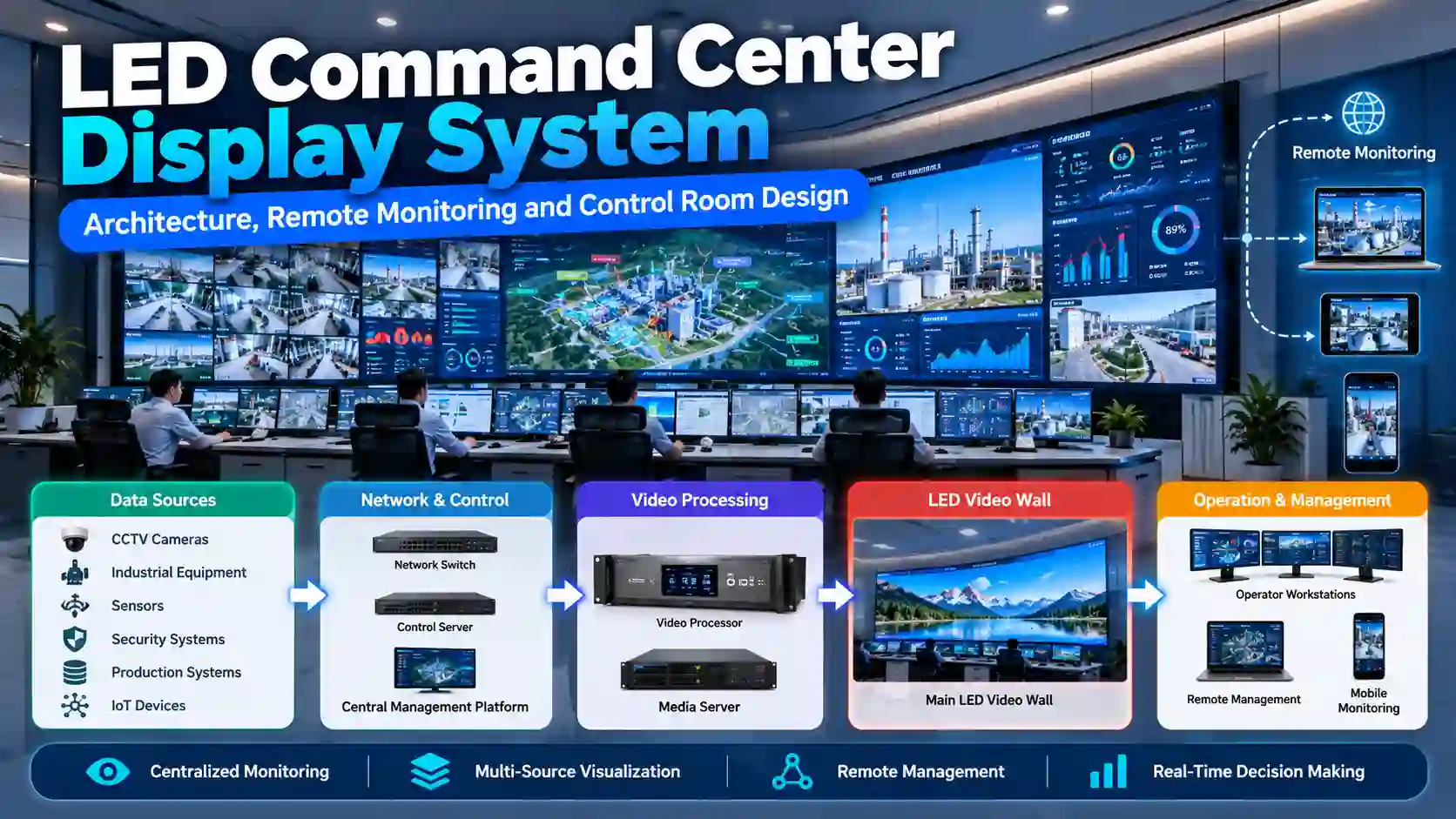
A typical LED command center display system follows this structure:
Data Sources → Network & Control System → Video Processing → LED Video Wall → Operator Workstations → Local & Remote Management
A reliable project should therefore consider not only pixel pitch and screen size, but also input sources, screen resolution, video processing, system redundancy, remote access, maintenance and future expansion.
Table of Contents
1. What Is an LED Command Center Display System?
An LED command center display system is a large-format visualization solution used to display information from multiple sources in a centralized control environment.
It can be used to show:
-
Real-time surveillance video
-
Production information
-
Equipment status
-
Maps
-
Alarm information
-
Operational dashboards
-
Video conferences
-
GIS information
-
Emergency information
-
Data analysis
Unlike a conventional meeting-room screen, a command center LED wall often operates for long periods and may need to display several independent windows simultaneously.
This means the project should be designed as a complete system rather than selecting the LED screen alone.
2. How Does the System Architecture Work?
The basic architecture can be divided into four layers.
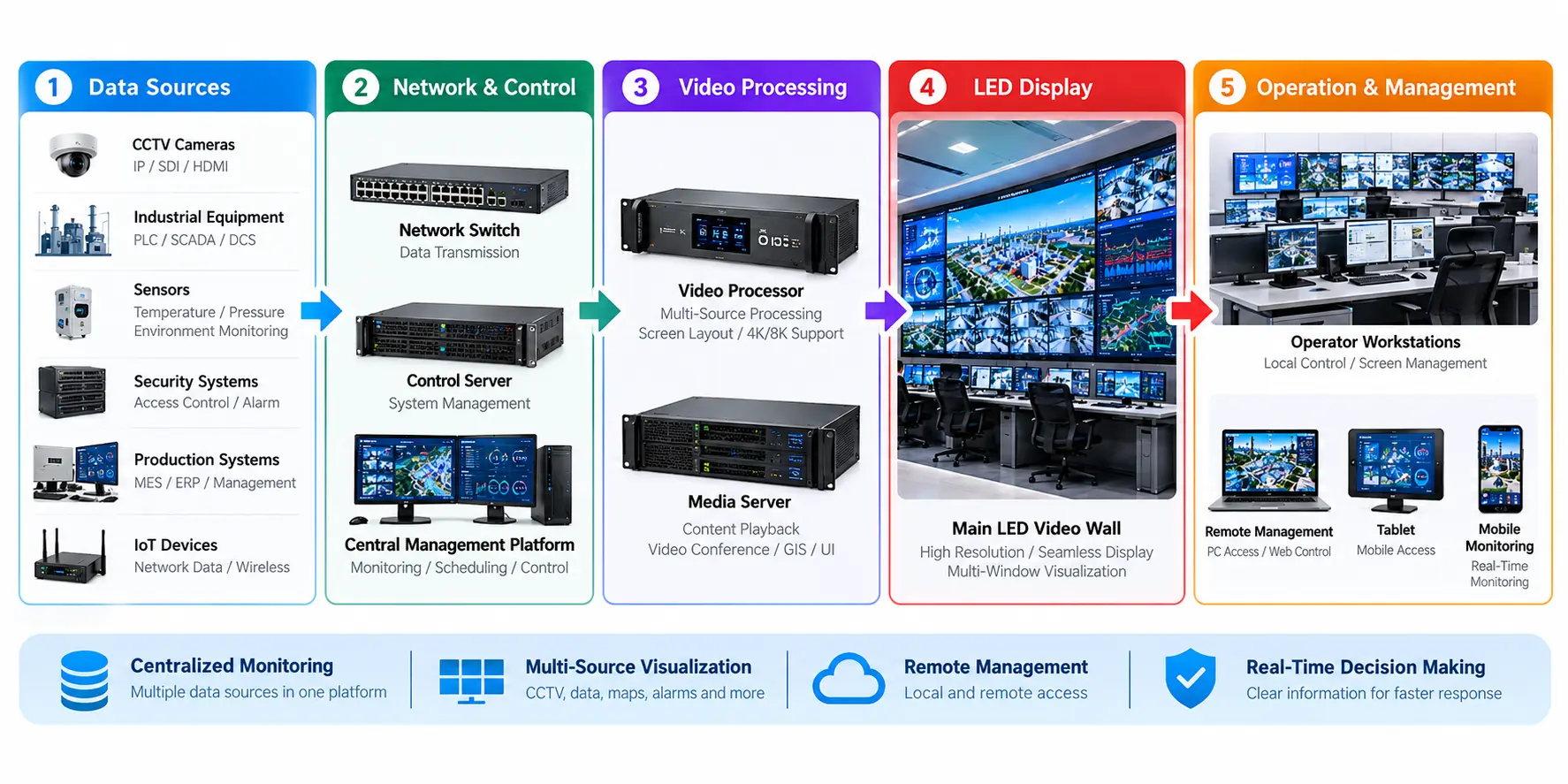
Layer 1: Data and Signal Sources
Information may come from:
CCTV Cameras
Used for security monitoring, factory surveillance, traffic monitoring or perimeter protection.
Industrial Systems
Equipment status, production information and operational data may come from existing industrial management platforms.
Computers and Workstations
Operators may need to display dashboards, maps, documents, software interfaces or presentations.
Media Servers
Large command centers, exhibition centers and event control rooms may use professional media servers for complex visual content.
Network Video Sources
IP cameras and network-based video systems can also become part of the visualization system.
Layer 2: Network and Control
The different information sources are connected through the project's network and control infrastructure.
Depending on the project, this may include:
-
Network switches
-
Control servers
-
Signal converters
-
Video matrix systems
-
KVM systems
-
Central management platforms
The exact architecture depends on the customer's existing infrastructure.
For industrial applications, the LED display system should normally integrate with the client's existing monitoring or control platform rather than replace the industrial control system itself.
Layer 3: Video Processing
Before information reaches the LED screen, signals need to be processed and arranged.
A professional video processor or video wall splicer can manage:
-
Multiple inputs
-
Multiple video windows
-
Screen scaling
-
Signal switching
-
Picture-in-picture
-
Multi-screen management
-
Presets
-
Large-resolution output
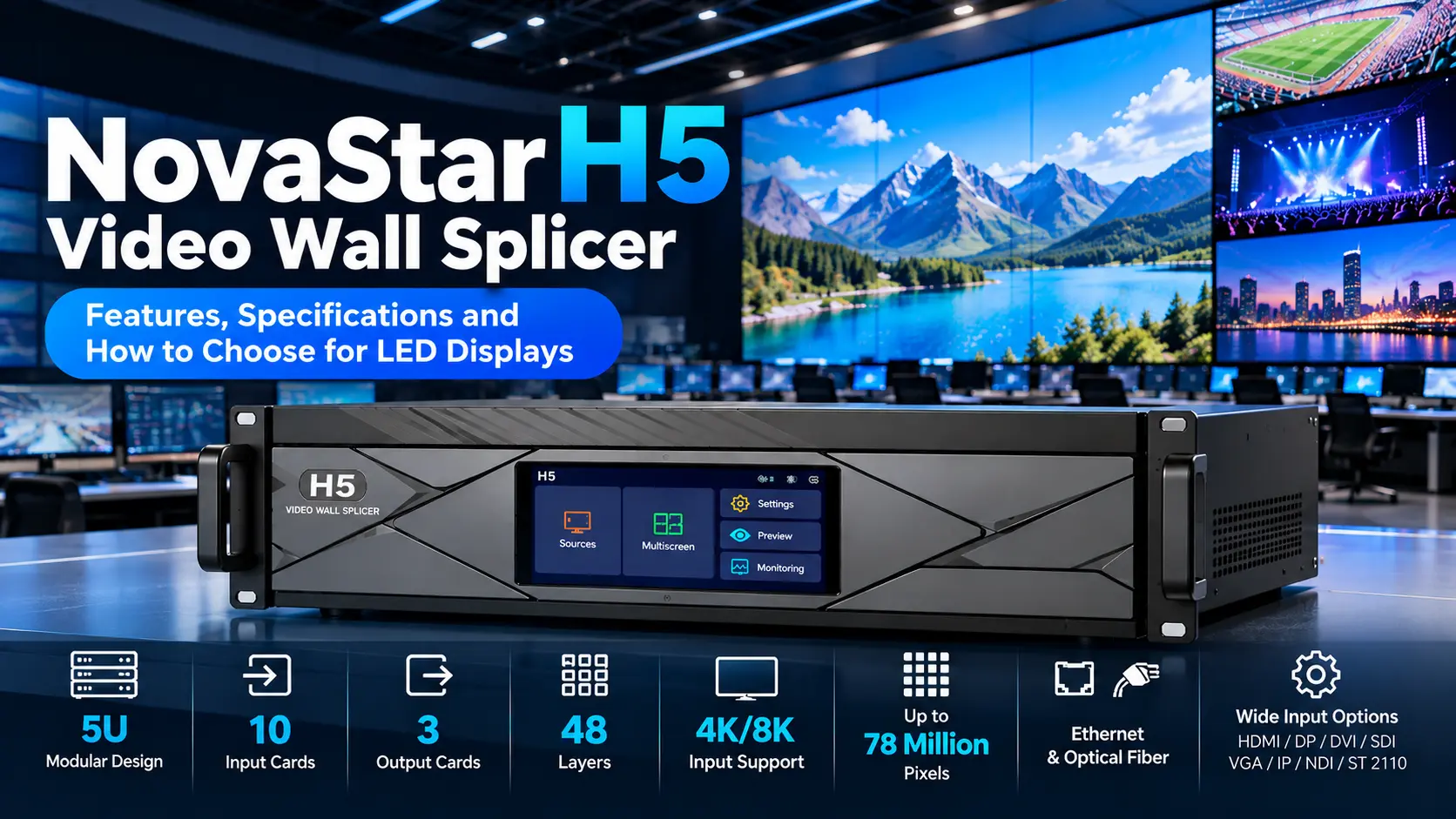
For complex projects, processors such as modular NovaStar H-series systems may be used depending on the required resolution, inputs and layer quantity.
The processor converts multiple sources into the final layout shown on the LED wall.
Layer 4: LED Video Wall and Operator Management
The final information is presented on the main LED display.
Operators can monitor the display from:
-
Control-room workstations
-
Engineering computers
-
Local control terminals
When the wider system supports remote operation, authorized staff may also monitor or manage parts of the system through remote computers or mobile terminals.
The final architecture therefore becomes:
Sources → Network → Processing → LED Wall → Operator Control
3. Core Components of a Control Room Display System
A complete command center display project can include several major components.
| Component | Main Function |
|---|---|
| LED Video Wall | Main visualization platform |
| Video Processor | Signal processing and screen layout |
| Sending System | Sends processed video to LED receiving cards |
| Control Computer | Configuration and daily operation |
| Network Switch | Connects network devices |
| Media Server | Professional content playback |
| Operator Workstations | Daily monitoring and management |
| Backup Equipment | Improves system reliability |
The exact configuration should be determined by the project rather than copied from another control room.
A small school monitoring center and a large power facility command center may both use LED walls, but their system requirements can be completely different.
4. Local Control and Remote Monitoring
One important trend in modern command centers is combining local operation with remote monitoring.
Local Control
Operators inside the control room can directly manage:
-
Display layouts
-
Video sources
-
Presets
-
Brightness
-
Screen status
-
Content switching
This is normally the primary operating method for important command centers.
Remote Monitoring
Depending on the customer's network architecture and security policy, selected system functions may also be monitored remotely.
For example:
-
Equipment status
-
Display status
-
Input-source status
-
Alarms
-
System health information
Remote access can be useful for technical support and multi-site management.
However, industrial and government projects may have strict cybersecurity requirements. Remote access should therefore be designed according to the customer's IT and security policies.
5. How to Choose the LED Video Wall
The correct LED display depends on several factors.
Pixel Pitch
For command centers, viewers are usually relatively close to the screen.
Common fine-pitch options may include:
-
P0.9
-
P1.2
-
P1.5
-
P1.8
-
P2
The correct choice depends on:
Viewing Distance + Screen Size + Required Resolution + Budget
Smaller pixel pitch provides more pixels in the same physical area, but also increases project cost and processing requirements.
For a broader explanation of screen selection, see:
How to Choose the Right LED Display for Your Business
https://www.jcdisplay.com/how-to-choose-the-right-led-display
Screen Size
A command center display should be large enough for operators to read important information from their working positions.
The screen dimensions should be based on:
-
Control room size
-
Viewing distance
-
Number of operators
-
Required content windows
-
Resolution
-
Available wall space
A very large screen is not automatically better.
The objective is to make critical information clearly visible without creating unnecessary display area.
Resolution
The total LED resolution is calculated by:
Horizontal Resolution = Screen Width ÷ Pixel Pitch
Vertical Resolution = Screen Height ÷ Pixel Pitch
For complex control rooms, resolution is especially important because many information windows may appear simultaneously.
A processor and control system should then be selected according to the final total pixel count.
6. Video Processing and Multi-Source Management
Many command centers need to display several signal sources at the same time.
For example:
CCTV + GIS Map + Production Dashboard + Alarm System + Video Conference
A suitable video processor can arrange these sources as independent windows on the LED wall.
Important processor specifications include:
-
Maximum input channels
-
Maximum output capacity
-
Total pixel loading
-
Number of layers
-
Supported resolutions
-
4K/8K input capability
-
Optical transmission
-
Backup capability
This is why the processor should be selected after the LED screen resolution and content requirements are confirmed.
The processor should match the project—not the other way around.
7. Industrial Applications
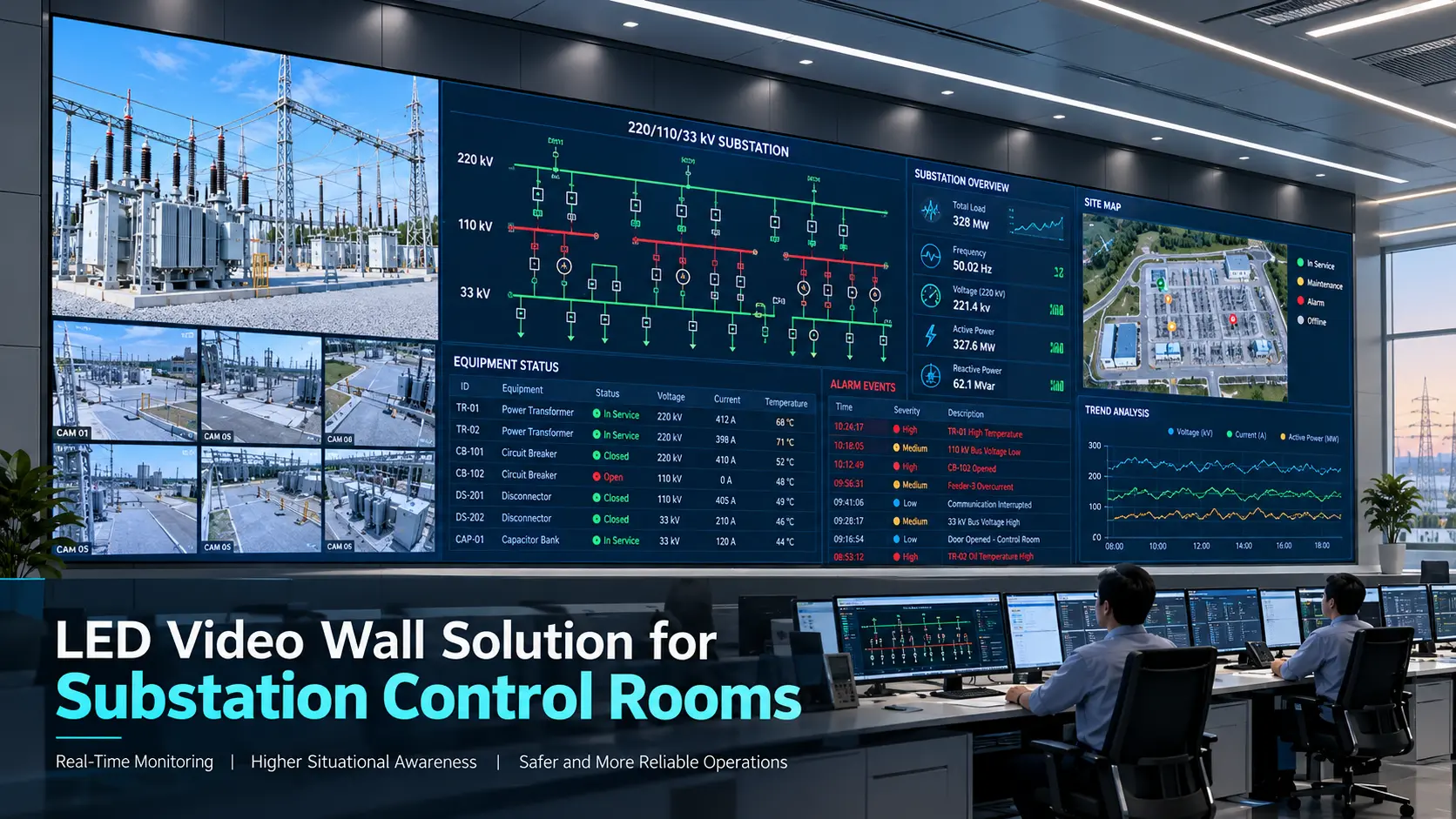
Substation Control Rooms
A substation command center may need to combine surveillance, equipment information, maps, alarms and operational dashboards.
A large LED wall provides one centralized visual platform for operators.
Water Treatment Plants
Water-treatment facilities can use control-room LED screens to visualize:
-
Plant status
-
Security cameras
-
Process information
-
Pump monitoring
-
Alarm information
-
Site maps
The objective is to give operators a clear overall view of plant operations.
Energy Facilities
Energy projects often involve large sites and multiple monitoring systems.
Command center LED displays can provide centralized visualization for:
-
Operational data
-
Security
-
Equipment monitoring
-
Production information
-
Emergency response
Chemical Industrial Parks
Chemical facilities may require continuous monitoring across multiple operational areas.
The LED video wall can integrate information from existing monitoring and management platforms into one centralized display environment.
System reliability and information visibility become particularly important in this type of application.
Large Industrial Factories
A factory command center can use an LED wall to display:
-
Production status
-
Equipment monitoring
-
Factory cameras
-
Quality information
-
Production targets
-
Energy usage
-
Logistics information
This provides management teams with a centralized operational overview.
Large Sports Events
Large sporting events may require dedicated control rooms for:
-
Venue security
-
Camera monitoring
-
Event operations
-
Broadcasting
-
Crowd management
-
Emergency coordination
LED video walls can help operators view multiple systems simultaneously.
Schools and Campuses
Campus command centers may integrate:
-
Security cameras
-
Access control
-
Campus maps
-
Emergency information
-
Facility monitoring
A centralized LED wall can improve multi-building monitoring efficiency.
Hospital Command Centers
Hospitals may use centralized visualization systems for:
-
Security
-
Facilities
-
Emergency management
-
Operational dashboards
-
Multi-department coordination
The exact information shown depends on the hospital's existing systems and privacy requirements.
Agriculture and Forestry Monitoring
Large agricultural or forestry projects can combine:
-
Camera feeds
-
Environmental sensors
-
Maps
-
Weather information
-
Fire warnings
-
Location data
Forest fire monitoring centers are a particularly strong application because operators may need to view GIS maps, camera feeds and warning information simultaneously.
8. Control Room Reliability and Redundancy
A command center may operate for many hours every day, and some critical facilities require continuous operation.
Therefore, reliability should be considered during system design.
Possible considerations include:
-
Backup video sources
-
Backup sending systems
-
Redundant power systems
-
Signal backup
-
Network redundancy
-
Spare LED modules
-
Spare receiving cards
-
Remote status monitoring
Not every project requires the same level of redundancy.
A commercial showroom and a mission-critical industrial control center should not use exactly the same reliability strategy.
9. Front Maintenance and System Serviceability
Maintenance is especially important when the LED display is installed directly against a control-room wall.
For this reason, many fine-pitch control room displays use front maintenance.
Technicians can access:
-
LED modules
-
Receiving cards
-
Power supplies
-
Internal components
from the front of the screen.
This can reduce the amount of service space required behind the LED wall and make future maintenance easier.
Before selecting the LED structure, buyers should ask:
How will a module, receiving card or power supply be replaced after the wall is installed?
10. What Information Should Buyers Provide?
Before requesting a command center LED solution, prepare the following information:
Display Requirements
-
Available wall width and height
-
Viewing distance
-
Required screen size
-
Preferred pixel pitch
-
Required resolution
Signal Requirements
-
Number of computers
-
Number of cameras
-
HDMI / DP / SDI / IP sources
-
Number of simultaneous windows
-
4K or 8K source requirements
System Requirements
-
Local control
-
Remote monitoring
-
Optical fiber transmission
-
Redundancy
-
Operating hours
-
Front or rear maintenance
Project Information
-
Industry
-
Installation location
-
Control room drawings
-
Delivery destination
-
Installation requirements
The more complete the project information, the more accurately the LED display and processor can be configured.
11. Why Choose an LED Video Wall for a Command Center?
LED technology offers several advantages for command-center visualization.
Seamless Display Surface
Unlike conventional LCD video walls, LED displays do not have large panel bezels dividing the image.
Flexible Screen Size
The display can be designed according to the available wall dimensions.
Fine Pixel Pitch
Modern fine-pitch LED technology can provide high pixel density for close-viewing control rooms.
Multiple Content Windows
Combined with a professional video processor, the screen can display several sources simultaneously.
Modular Maintenance
Individual modules and components can be serviced without replacing the complete display.
12. JunChen Display Project Approach
For command center projects, JunChen Display focuses on the LED visualization layer and its integration with the customer's wider control system.
Our project planning sequence is:
Application → Viewing Distance → Screen Size → Pixel Pitch → Resolution → Signal Sources → Video Processor → Maintenance → Installation
Instead of recommending an LED screen based only on price per square meter, the complete visualization requirement should be considered first.
For complex projects, JunChen Display can coordinate the LED display, processor and related display-control configuration with the customer's system integrator or project engineering team.
This approach is suitable for:
Substations • Water Plants • Energy Facilities • Chemical Parks • Factories • Sports Venues • Schools • Hospitals • Agriculture • Forestry Monitoring
13.FAQ
What is an LED command center display system?
It is a centralized visualization system that uses a large LED video wall to display information from multiple sources such as cameras, computers, monitoring platforms and operational systems.
What pixel pitch is suitable for a control room?
Fine pixel pitches such as P0.9–P2 are commonly considered for close-viewing environments, but the correct choice depends on viewing distance, screen size, resolution and budget.
Can one LED wall display multiple sources?
Yes. A professional video processor or video wall splicer can arrange multiple input sources into independent windows on one LED display.
Can a command center LED display be remotely monitored?
Remote monitoring may be possible depending on the processor, management platform and network architecture. Access should follow the customer's IT and cybersecurity requirements.
Is front maintenance recommended?
For LED screens installed close to a wall, front maintenance is often more practical because modules and internal components can be accessed from the front.
What information is needed before designing the system?
Provide the room dimensions, screen size, viewing distance, signal sources, required content windows, resolution, operating hours and installation requirements.
Does JunChen Display provide the complete industrial control system?
JunChen Display focuses on the LED display and visualization subsystem. For SCADA, industrial automation, cybersecurity or other specialized control systems, the LED solution should be coordinated with the customer's qualified system integrator.
14.Conclusion
A professional LED command center display system should not be designed by selecting an LED screen first.
The better process is:
Understand the Application → Identify Data Sources → Determine Screen Size and Resolution → Select Video Processing → Design Control and Monitoring → Plan Maintenance and Redundancy
The LED video wall then becomes the central visualization platform connecting multiple sources and helping operators see critical information more clearly.
For substations, water plants, energy facilities, chemical parks, large factories and other command-center projects, the most valuable solution is not necessarily the largest screen or smallest pixel pitch.
It is the system that provides the right combination of:
Visibility + Resolution + Multi-Source Management + Reliability + Maintainability + Expansion Capability
Planning an LED Command Center?
Send JunChen Display your:
Control Room Size + LED Screen Size + Viewing Distance + Pixel Pitch + Signal Sources + Required Windows + Destination
We can recommend a suitable LED video wall and video-processing configuration for your project.
JunChen Display
Guangzhou JunChen Display Technology Co., Ltd.
WhatsApp: +86 188 1890 1997
Email: admin@ledscreenwholesale.com
Website: www.jcdisplay.com
LED Video Wall Solution for Substation Control Rooms
What Is NovaStar H5 and How Does It Work with LED Displays?
Tell Us What Are You Looking For?
