
How LED Installation Teams Can Scale Faster with JunChen Display as Their Manufacturing Backend
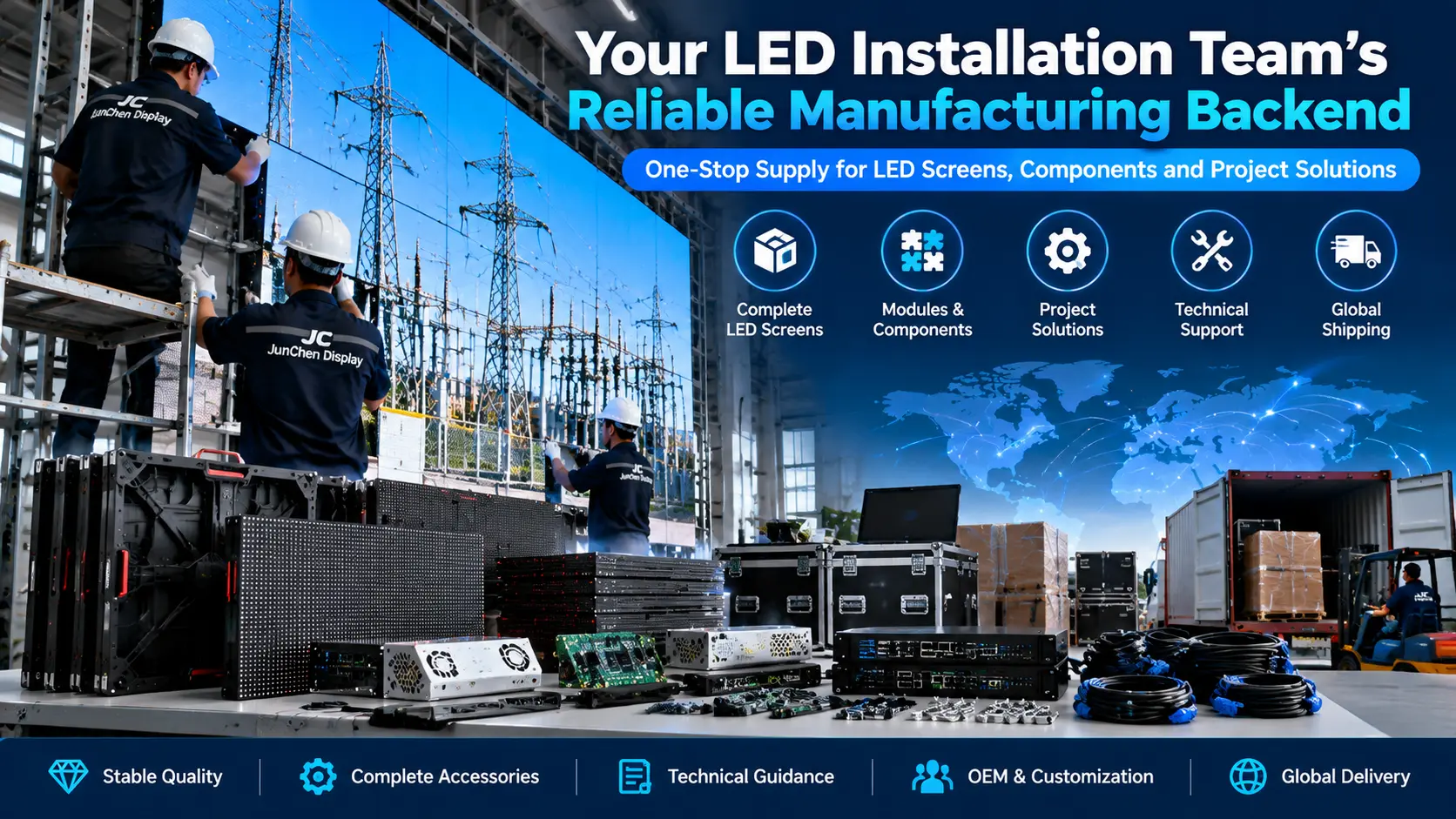
Local LED installation companies often have something extremely valuable:
Customers, project opportunities and installation capability.
What they may not have is a complete manufacturing and supply chain behind every project.
One customer may need a fine-pitch indoor wall. Another may ask for an outdoor billboard, rental screen, stadium perimeter display, transparent screen or completely customized LED structure.
If every project requires finding new module suppliers, control-system suppliers, cabinet factories and spare-parts vendors, a local installation team can spend more time coordinating suppliers than serving customers.
A better model is:
Local Installation & Customer Service + Reliable Manufacturing Backend
This is where Guangzhou JunChen Display Technology Co., Ltd. can support LED installers, assembly companies, AV integrators and project contractors.
Instead of functioning only as a finished-screen supplier, JunChen Display can support the complete purchasing process—from LED modules and cabinets to processors, receiving cards, power supplies, cables, spare parts and project configuration.
The objective is simple:
Let the local team focus on winning and installing projects while JunChen Display supports the manufacturing and supply side.
Table of Contents
1. Why LED Installation Teams Need a Manufacturing Backend
An LED installation company does not necessarily need to manufacture every module itself.
Its competitive advantages may instead be:
-
Local customer relationships
-
Site surveys
-
Installation
-
Steel structure construction
-
Electrical work
-
Project management
-
Local maintenance
-
Fast customer response
These capabilities are difficult for an overseas manufacturer to replace.
At the same time, manufacturing requires a different set of resources:
-
SMT production
-
Module assembly
-
Cabinet production
-
LED component sourcing
-
Control-system configuration
-
Aging tests
-
Quality inspection
-
Packing
-
International shipping
The most efficient cooperation model is therefore not always:
Manufacturer vs. Installer
It can be:
Manufacturer + Local Installer
JunChen Display can act as the manufacturing and supply-chain side while the local partner remains responsible for the customer-facing and installation side of the project.
2. The Hidden Cost of Buying From Too Many Suppliers
Comparing prices from several suppliers may appear to reduce purchasing cost.
But an LED project contains many components that must work together.
For example:
LED Modules + Cabinets + Power Supplies + Receiving Cards + Processor + Cables + Structure + Configuration
If these items come from different suppliers, several problems can appear.
Compatibility Risk
The receiving card may not match the HUB board or cabinet configuration.
The processor may not provide enough loading capacity for the final resolution.
The power supply specification may differ from the module requirements.
Communication Cost
When a problem occurs, one supplier may say the issue is caused by another component.
The installation company then becomes responsible for diagnosing the entire system.
Purchasing Complexity
Instead of one purchase order, one project may require communication with:
-
Module supplier
-
Cabinet supplier
-
Processor supplier
-
Control-card supplier
-
Power-supply supplier
-
Cable supplier
-
Spare-parts supplier
The lowest component price does not always produce the lowest project cost.
3. One Project, One BOM, One Supply Partner
For installation teams, a more practical purchasing model is to prepare one complete BOM — Bill of Materials for the project.
For example:
| Project Requirement | Supply Category |
|---|---|
| LED Modules | Main display components |
| Cabinets | Fixed / rental / customized |
| Power Supplies | Matched to screen configuration |
| Receiving Cards | Matched control system |
| HUB Boards | Cabinet configuration |
| Video Processor | Based on total resolution |
| Sending System | LED signal transmission |
| Cables | Power and signal |
| Spare Modules | Future maintenance |
| Spare Components | PSU / receiving cards / cables |
| Configuration Files | Screen setup |
| Packing | Export shipment |
Instead of purchasing every category independently, JunChen Display can coordinate the main LED system components around one project requirement.
This gives the installation team one clearer technical reference point.
4. Complete Screens or Local Assembly: Both Models Work
Different LED teams operate differently.
Some partners want a complete finished LED screen ready for installation.
Others already have experienced assembly technicians and prefer purchasing modules and components for local assembly.
JunChen Display can support both models.
Model A — Complete LED Display
Suitable for installers that want:
Finished Cabinets → Shipping → Local Installation
The factory handles module production, cabinet assembly, testing and configuration before shipment.
Model B — Semi-Finished Supply
Suitable for companies that want to perform part of the assembly locally.
The project can include:
-
LED modules
-
Cabinets
-
Power supplies
-
Receiving cards
-
HUB boards
-
Cables
-
Accessories
Model C — Modules and Components
Some experienced assembly companies only need stable module and component supply.
This gives the local partner more control over cabinet design, assembly and local inventory.
The key advantage is flexibility.
The partner does not have to change suppliers simply because the next project uses a different assembly model.
5. Components and Spare Parts From One Source
For installation and maintenance companies, components can be just as important as finished displays.
A project may require:
-
Indoor LED modules
-
Outdoor LED modules
-
Flexible modules
-
Power supplies
-
Receiving cards
-
Sending controllers
-
HUB boards
-
Flat cables
-
Power cables
-
Signal cables
-
Connectors
-
Cabinet locks
-
Spare LEDs
-
Replacement modules
A one-stop supply relationship makes it easier to prepare both the initial project materials and the future maintenance inventory.
This is particularly useful for companies managing multiple LED installations in their local market.
6. Project Solution and Compatibility Support
A supplier should not simply receive a screen size and immediately send a price.
For many projects, the technical configuration should be determined first.
Important questions include:
-
Indoor or outdoor?
-
What is the viewing distance?
-
What pixel pitch is appropriate?
-
What is the total resolution?
-
Front or rear maintenance?
-
How many signal sources?
-
What processor capacity is required?
-
Ethernet or optical fiber transmission?
-
What spare parts should be included?
-
How will the screen be installed?
For example, a 10 × 4 m outdoor billboard and a 10 × 4 m indoor command-center LED wall may have the same physical dimensions but require completely different technical configurations.
This is why JunChen Display can support partners with project planning before finalizing the BOM.
7. Control Systems and Video Processing
The LED screen is only one part of the complete system.
Depending on the project, the installer may also need:
-
NovaStar receiving cards
-
Sending controllers
-
Video processors
-
Video wall splicers
-
Fiber transmission
-
Media servers
-
Screen configuration
For a simple advertising display, a basic controller may be sufficient.
For a large command center, theatre or multi-source LED wall, a more advanced processor may be required.
The processor should therefore be selected according to:
Total Pixels + Input Sources + Required Layers + Output Capacity + Transmission Distance
By coordinating the LED display and control equipment together, compatibility can be checked before shipment rather than after the installation team arrives on site.
8. Support for Customized LED Projects
Installation teams often receive requests that are not standard rectangles.
Examples include:
-
Curved LED walls
-
Flexible LED screens
-
Cylindrical displays
-
90° corner displays
-
Transparent LED installations
-
Creative retail screens
-
Vehicle LED displays
-
Stadium perimeter screens
-
Custom cabinet dimensions
These projects may be difficult for a local contractor to manufacture independently.
A manufacturing partner allows the installer to accept more customized projects without investing in an entire production line.
The cooperation model becomes:
Local Team Finds the Opportunity → JunChen Develops the LED Solution → Local Team Installs and Services the Project
This expands the range of projects the installation company can confidently pursue.
9. Spare Parts and Long-Term Maintenance
The project does not end when the screen is switched on.
Local customers may require maintenance several months or years later.
For this reason, installation companies should prepare spare parts from the beginning.
A typical maintenance package may include:
-
Spare LED modules
-
Spare receiving cards
-
Spare power supplies
-
Spare HUB boards
-
Signal cables
-
Power cables
-
Other project-specific parts
One important advantage of purchasing spare modules together with the original project is better production consistency.
This is especially important when modules need to be replaced later.
For installation companies, spare-parts planning also creates another business opportunity:
Installation Revenue + Maintenance Revenue + Upgrade Revenue
10. Quality Control Before Delivery
Every problem discovered before shipment is easier to solve than a problem discovered at the installation site.
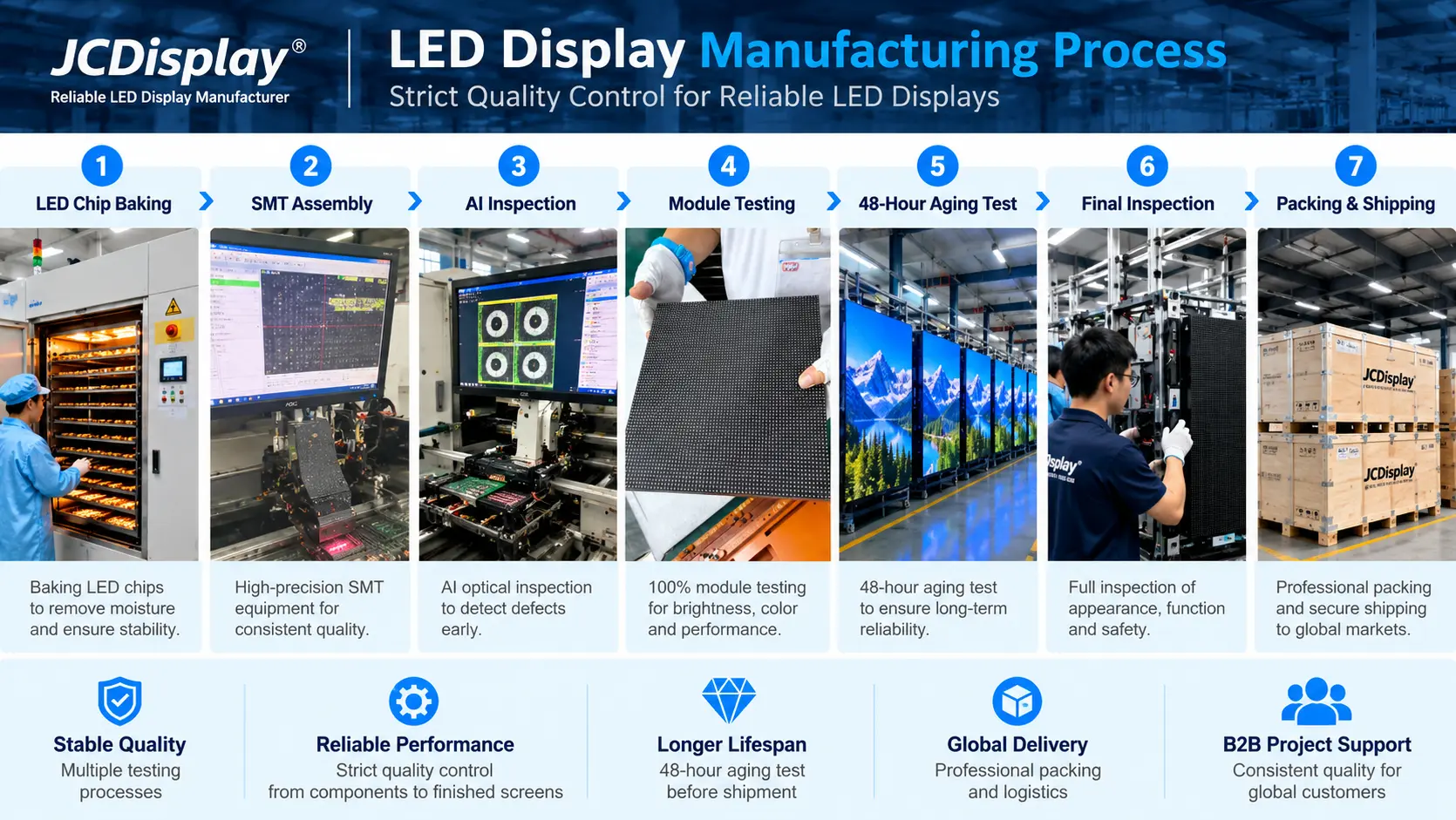
JunChen Display uses multiple inspection stages during production, including checks of incoming materials, SMT production, LED modules, assembled screens and aging before shipment.
For project partners, factory testing helps reduce:
-
Dead pixels
-
Module abnormalities
-
Color inconsistency
-
Connection problems
-
Cabinet issues
-
On-site troubleshooting
Aging and complete-screen testing are especially important for projects that will be installed overseas.
The objective is not simply to ship the order.
It is to make the local installation process more predictable.
11. How This Cooperation Model Helps Installation Companies Grow
The greatest value of a manufacturing partner is not one order.
It is the ability to accept more types of projects without building every capability internally.
Consider a local LED company that receives five opportunities:
| Customer | Project |
|---|---|
| Corporate Client | Fine-pitch meeting room |
| Shopping Mall | Indoor advertising screen |
| Event Company | Rental LED display |
| Stadium | Football perimeter display |
| Retail Brand | Curved creative LED screen |
Without a manufacturing partner, these projects may require several different suppliers.
With a broader manufacturing backend, the local company can keep the customer relationship while sourcing different LED solutions through the same supply channel.
That allows the local team to focus more resources on:
-
Sales
-
Customer communication
-
Site surveys
-
Installation
-
Project management
-
Local after-sales service
This is where a supplier relationship becomes a business-growth relationship.
12. Which Companies Are Suitable for This Model?
This cooperation model is especially suitable for:
-
LED installation teams
-
LED assembly companies
-
AV integrators
-
System integrators
-
Electrical contractors
-
Advertising companies
-
Event production companies
-
Digital signage companies
-
Engineering contractors
-
Local LED dealers
It is particularly useful for companies that already have local customers and technical capabilities but do not want to maintain their own complete LED manufacturing facility.
13. What Information Should Partners Provide?
To prepare an accurate project solution, send:
Basic Project Information
-
Application
-
Indoor or outdoor
-
Screen width and height
-
Quantity
-
Viewing distance
-
Installation location
Technical Requirements
-
Pixel pitch if already specified
-
Required brightness
-
Resolution requirements
-
Refresh rate
-
Maintenance method
-
Control-system requirements
Cooperation Requirements
-
Complete finished screen
-
Semi-finished cabinets
-
Modules only
-
Components and spare parts
-
OEM requirements
-
Installation drawings
-
Shipping destination
If some specifications are unknown, that is not a problem.
A professional supplier should help determine the configuration based on the project rather than expecting the installer to specify every component independently.
14.FAQ
Can JunChen Display supply only LED modules?
Yes. Partners can purchase modules and related components instead of complete finished screens when they already have local assembly capability.
Can you provide complete LED project components?
Depending on the project, the supply can include LED modules, cabinets, power supplies, receiving cards, control systems, processors, cables, accessories and spare parts.
Can installation companies assemble the screens locally?
Yes. The supply model can be adjusted according to the partner's assembly and installation capabilities.
Can JunChen Display help choose a processor?
Yes. Processor selection should be based on total screen resolution, input sources, required layers and transmission requirements.
Can you support customized LED projects?
Yes. Customized projects can include curved, flexible, transparent, creative, vehicle, stadium and other special LED display configurations.
Should spare modules be ordered with the original project?
For most professional installations, yes. Preparing spare modules and critical components during the original production cycle can simplify future maintenance.
Does JunChen Display replace the local installation company?
No.
The ideal model is complementary:
JunChen Display handles manufacturing and supply support while the local partner manages customers, installation and local service.
15.Conclusion
For LED installation and assembly companies, growth does not necessarily require building a factory.
What matters is having access to a manufacturing backend that can support different projects when opportunities appear.
Instead of managing separate suppliers for:
Modules + Cabinets + Power Supplies + Control Cards + Processor + Cables + Spare Parts
installation teams can simplify the process through a more integrated supply relationship.
The JunChen Display cooperation model can be summarized as:
Your Local Customer & Installation Capability + Our Manufacturing, Components and Project Support
This allows both sides to focus on what they do best.
The local partner stays close to the customer.
JunChen Display supports the production and supply chain behind the project.
Looking for a Long-Term LED Manufacturing Partner?
If your company installs, assembles or integrates LED display systems, send us your next project requirements.
Whether you need:
Complete LED Screens • Modules • Cabinets • Components • Processors • Spare Parts • Customized Solutions
JunChen Display can help build a suitable supply package for your project.
JunChen Display
Guangzhou JunChen Display Technology Co., Ltd.
WhatsApp: +86 188 1890 1997
Website: www.jcdisplay.com
LED Video Wall Solution for Substation Control Rooms
Related Article
Tell Us What Are You Looking For?
