
How to Choose the Right LED Display Size? Complete LED Screen Size Guide
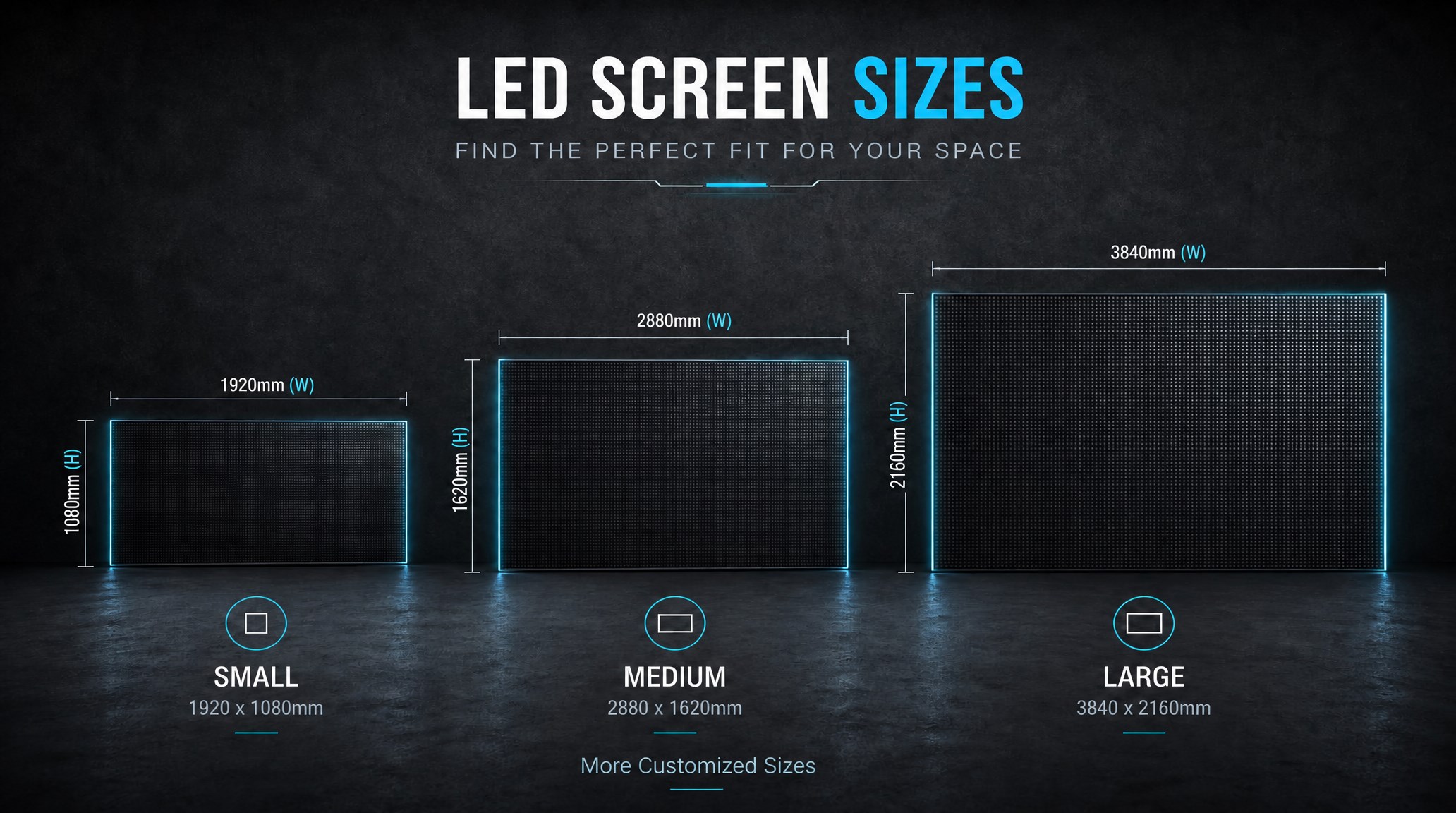
A properly sized LED display provides better visual impact, clearer images, and improved investment value. An oversized screen may increase unnecessary costs, while an undersized display may reduce visibility and communication effectiveness.
For LED distributors, AV integrators, and project buyers, calculating LED screen dimensions before production helps avoid installation problems and ensures the final display matches the application.
This guide explains how to calculate LED display size, select the right dimensions, understand pixel pitch requirements, and work with manufacturers such as JUNCHEN LED Display for customized LED solutions.
Table of Contents
- What Determines LED Display Size?
- How Does Pixel Pitch Affect LED Display Size?
- How Do You Calculate LED Display Dimensions?
- What LED Display Size Is Suitable for Different Resolutions?
- How Does Viewing Distance Affect LED Screen Size Selection?
- How to Choose Indoor and Outdoor LED Display Sizes?
- What Common Mistakes Should Buyers Avoid When Choosing LED Screen Size?
- How Does JUNCHEN LED Display Customize Screen Sizes?
- Frequently Asked Questions About LED Display Size
- Conclusion: Choosing the Right LED Display Dimensions
1. What Determines LED Display Size?
The correct led display size is determined by the relationship between installation environment, viewing distance, pixel pitch, content resolution, and cabinet structure. Professional buyers should not select screen dimensions only based on available space because image quality and viewing experience are equally important.
A suitable LED display size should balance:
- Visual impact
- Image clarity
- Budget efficiency
- Installation conditions
- Future expansion requirements
For commercial LED projects, manufacturers usually calculate the final screen dimensions based on LED modules and cabinet sizes rather than creating random dimensions.
1.1 Installation Location
The first factor affecting LED screen size is where the display will be installed.
Different environments require different sizing strategies.
Indoor Applications
Common locations:
- Conference rooms
- Retail stores
- Shopping malls
- Control rooms
- Churches
- Exhibition halls
Indoor LED displays usually prioritize:
- Higher resolution
- Shorter viewing distance
- Better image details
Example:
A conference room may require a smaller fine-pitch LED wall because viewers sit closer to the screen.
Outdoor Applications
Common locations:
- Advertising billboards
- Stadiums
- Transportation areas
- Building facades
Outdoor LED displays usually require:
- Larger dimensions
- Higher brightness
- Longer viewing distance
- Weather protection
Example:
A roadside advertising screen needs a larger LED display size because viewers may only see the content for a few seconds.
1.2 Viewing Distance
Viewing distance is one of the most important factors when choosing LED display dimensions.
The farther the audience is from the screen, the larger the display usually needs to be.
A simple principle:
Short viewing distance → smaller pixel pitch → higher resolution
Long viewing distance → larger screen size → larger pixel pitch acceptable
Table 1. LED Display Size Selection Based on Viewing Distance
The following table provides general guidance for professional buyers.
|
Viewing Distance |
Recommended Pixel Pitch |
Typical Application |
|
1–3 meters |
p0.9–p2.5 |
Meeting rooms, studios |
|
3–8 meters |
p2.5–p4 |
Retail, corporate spaces |
|
8–20 meters |
p4–p6 |
Events, commercial displays |
|
20–50 meters |
p6–p10 |
Outdoor advertising |
|
50+ meters |
p10+ |
Large outdoor billboards |
Summary
Viewing distance helps determine both pixel pitch and required LED display size. Buyers should evaluate audience position before selecting screen dimensions.
1.3 Pixel Pitch and LED Display Size Relationship
Pixel pitch refers to the distance between two LED pixels, measured in millimeters.
For example:
- p1.25 means pixels are spaced 1.25mm apart.
- p4 means pixels are spaced 4mm apart.
A smaller pixel pitch provides:
- Higher image resolution
- Better close-up viewing experience
- More detailed content
However, smaller pixel pitch products usually have a higher cost.
2.How Pixel Pitch Affects Screen Size
The relationship between pixel pitch and display size can be explained through pixel density.
A larger LED display with a large pixel pitch may still provide acceptable image quality when viewed from a distance.
Example:
A p6 outdoor LED billboard can look clear from 30 meters away, while a p1.5 indoor LED wall is designed for viewers only a few meters away.
Table 2. Pixel Pitch and Recommended LED Display Applications
|
Pixel Pitch |
Recommended Screen Size |
Applications |
|
p0.9–p1.5 |
Small to medium LED walls |
Control rooms, premium meeting rooms |
|
p1.8–p2.5 |
Medium LED walls |
Conference rooms, retail |
|
p2.5–p4 |
Medium and large displays |
Commercial spaces |
|
p4–p6 |
Large displays |
Events, outdoor entrances |
|
p8–p10 |
Very large displays |
Billboards, stadiums |
Summary
Pixel pitch does not directly determine physical screen size. It determines image quality at a specific viewing distance.
3. How Do You Calculate LED Display Dimensions?
LED display size calculation requires understanding three main components:
- LED module size
- Cabinet size
- Required number of cabinets
Professional manufacturers normally build displays by combining standardized cabinets.
3.1 Basic LED Screen Size Formula
The basic calculation formula is:
Screen Width
cabinet width × number of horizontal cabinets
Screen Height
cabinet height × number of vertical cabinets
Example Calculation
Assume:
Cabinet size:
500mm × 500mm
Required configuration:
10 cabinets horizontally
6 cabinets vertically
Calculation:
Width:
500mm × 10
= 5000mm
= 5 meters
Height:
500mm × 6
= 3000mm
= 3 meters
Final LED screen size:
5m × 3m
Table 3. LED Display Size Calculation Example
|
Parameter |
Calculation |
Result |
|
Cabinet width |
500mm × 10 |
5000mm |
|
Cabinet height |
500mm × 6 |
3000mm |
|
Screen width |
Converted to meters |
5m |
|
Screen height |
Converted to meters |
3m |
|
Total area |
5 × 3 |
15㎡ |
Summary
LED display dimensions are calculated by combining cabinet quantities. This method ensures compatibility with manufacturing and installation requirements.
3.2 LED Module Quantity Calculation
LED modules determine the final cabinet configuration.
Formula:
total modules = horizontal modules × vertical modules
Example:
A cabinet contains:
4 modules horizontally
2 modules vertically
Total modules per cabinet:
4 × 2 = 8 modules
3.3 Pixel Resolution Calculation
Resolution depends on:
- Screen size
- Pixel pitch
- Number of pixels
Formula:
pixels = display size ÷ pixel pitch
Example:
A 5-meter-wide LED screen using p2.5:
5000mm ÷ 2.5mm
= 2000 pixels horizontally
This means the display provides approximately:
2000 pixels width
4. What LED Display Size Is Suitable for Different Resolutions?
Modern LED projects often require specific resolutions such as:
- HD 1920×1080
- 2K
- 4K UHD
The physical LED display size required depends on pixel pitch.
Table 4. LED Display Size Examples for Common Resolutions
|
Resolution Target |
Recommended Pixel Pitch |
Approximate Application |
|
HD 1080p |
p2.5–p4 |
Conference rooms |
|
2K |
p1.8–p3 |
Commercial video walls |
|
4K UHD |
p0.9–p2 |
Broadcast, premium spaces |
Summary
Higher resolution requirements usually require smaller pixel pitch or larger physical screen dimensions.
Section Summary
✓ LED display size depends on location, viewing distance, pixel pitch, and content requirements.
✓ Larger screens are not always better; correct sizing improves image quality and cost efficiency.
✓ Cabinet and module dimensions determine the final physical screen size.
✓ Professional manufacturers calculate screen dimensions based on project requirements.
5. How Does Viewing Distance Affect LED Screen Size Selection?
Viewing distance directly affects the recommended led display size, pixel pitch, and overall viewing experience. A professional LED project should calculate the relationship between audience distance and screen dimensions before production.
A larger LED display is usually required when viewers are farther away because the screen needs enough visual impact to attract attention.
However, increasing physical size alone does not improve image quality. Buyers must balance:
- Screen dimensions
- Pixel density
- Content resolution
- Audience position
- Installation environment
5.1 LED Display Viewing Distance Formula
A common industry guideline is:
Minimum viewing distance ≈ pixel pitch × 1000
Example:
For a p3 LED display:
3 × 1000 = approximately 3 meters
This means viewers should generally stay about 3 meters or farther away for comfortable viewing.
Another calculation method:
Best viewing distance ≈ pixel pitch × 1500–3000
Example:
p2.5 LED display:
2.5 × 1500 = 3.75 meters
2.5 × 3000 = 7.5 meters
Recommended viewing range:
Approximately 4–8 meters
Table 5. Pixel Pitch and Viewing Distance Reference
|
Pixel Pitch |
Minimum Viewing Distance |
Recommended Applications |
|
p0.9 |
0.9–2m |
Premium conference rooms |
|
p1.5 |
1.5–4m |
Corporate video walls |
|
p2.5 |
2.5–7m |
Retail and meeting rooms |
|
p4 |
4–12m |
Commercial spaces |
|
p6 |
6–18m |
Events and outdoor areas |
|
p10 |
10m+ |
Large outdoor displays |
Summary
Viewing distance helps buyers choose the correct pixel pitch and LED display size. A professional supplier should evaluate the audience position before recommending a solution.
5.2 LED Display Size for Conference Rooms
Conference rooms usually require clear images at close viewing distances.
Important factors:
- Room size
- Number of viewers
- Camera requirements
- Presentation content
Recommended solutions:
|
Room Size |
Recommended LED Display Size |
|
Small meeting room |
1.5m–3m width |
|
Medium conference room |
3m–5m width |
|
Large conference hall |
5m+ width |
Suitable products:
- fine pitch led display
- all-in-one led display
- indoor led video wall
5.3 LED Display Size for Stage Events
Rental LED screens require a balance between visual impact and transportation efficiency.
Factors include:
- Stage width
- Audience distance
- Camera shooting requirements
- Event type
Common configurations:
|
Event Type |
Typical LED Screen Size |
|
Small corporate event |
3m × 2m |
|
Exhibition stage |
5m × 3m |
|
Concert stage |
8m × 5m or larger |
|
Outdoor festival |
Customized large format |
Rental companies usually prefer modular cabinet systems because they allow flexible screen sizes.
6. How to Choose Indoor and Outdoor LED Display Sizes?
Indoor and outdoor LED displays have different sizing requirements because they operate in different environments.
6.1 Indoor LED Display Size Selection
Indoor LED screens are usually viewed from shorter distances.
The priority is:
- image detail
- resolution
- visual comfort
Common applications:
Recommended considerations:
1. Viewing Distance
Closer viewers require:
- smaller pixel pitch
- higher resolution
2. Available Installation Space
Measure:
- wall width
- ceiling height
- viewing angle
3. Content Type
Different content requires different resolution.
Examples:
Text-heavy content:
Need higher pixel density.
Video content:
Need balanced brightness and contrast.
6.2 Outdoor LED Display Size Selection
Outdoor LED displays focus on visibility and durability.
Common applications:
Important factors:
Brightness
Outdoor environments require higher brightness because sunlight reduces screen visibility.
Weather Protection
Outdoor LED displays require:
- waterproof cabinet design
- heat management
- stable operation
Viewing Distance
Large outdoor screens are usually designed for longer viewing distances.
Table 6. Indoor vs Outdoor LED Display Size Selection
|
Factor |
Indoor LED Display |
Outdoor LED Display |
|
Viewing distance |
Short |
Long |
|
Pixel pitch |
Smaller |
Larger |
|
Brightness |
Lower |
Higher |
|
Main priority |
Image detail |
Visibility |
|
Common size |
Small-medium |
Medium-large |
|
Applications |
Meeting rooms, retail |
Billboard, stadium |
Summary
Indoor LED screens prioritize resolution, while outdoor LED screens prioritize visibility, brightness, and durability.
7. What Common Mistakes Should Buyers Avoid When Choosing LED Screen Size?
Many LED projects experience problems because buyers select dimensions without considering technical requirements.
Mistake 1: Choosing Screen Size Only Based on Budget
A lower price does not always mean better value.
A smaller LED screen may reduce initial cost but fail to provide enough visual impact.
Better approach:
Evaluate:
- audience distance
- application purpose
- content requirements
Mistake 2: Ignoring Pixel Pitch
Screen size and pixel pitch work together.
Example:
A large LED screen with unsuitable pixel pitch may look unclear at close distance.
Buyers should select pixel pitch according to:
- viewing distance
- content type
- budget
Mistake 3: Not Considering Future Expansion
Commercial projects often need upgrades later.
Consider:
- spare cabinet availability
- control system capacity
- installation structure
Mistake 4: Selecting Non-Standard Dimensions
Custom dimensions may increase:
- manufacturing difficulty
- spare part complexity
- maintenance cost
Professional manufacturers can help optimize cabinet combinations.
Mistake 5: Ignoring Installation Conditions
Before production, confirm:
- mounting structure
- power supply
- ventilation
- maintenance access
- transportation route
Table 7. LED Display Size Selection Checklist
|
Item |
Buyer Should Confirm |
|
Installation area |
Available width and height |
|
Viewing distance |
Audience position |
|
Pixel pitch |
Required image quality |
|
Resolution |
Content requirements |
|
Cabinet size |
Production compatibility |
|
Maintenance |
Front or rear access |
|
Future expansion |
Upgrade possibility |
8. How Does JUNCHEN LED Display Customize Screen Sizes?
JUNCHEN LED Display provides customized LED display manufacturing solutions for distributors, AV integrators, rental companies, and commercial projects.
Different projects require different screen dimensions. Instead of forcing customers to select fixed sizes, professional LED manufacturers can optimize cabinet configuration according to project requirements.
JUNCHEN Custom LED Display Size Process
Step 1. Project Requirement Analysis
Engineers evaluate:
- Application environment
- Installation location
- Viewing distance
- Content requirements
- Target screen size
Step 2. Product Recommendation
Based on requirements, JUNCHEN recommends:
- Pixel pitch
- Cabinet size
- Screen structure
- Control system
Step 3. Custom Configuration
Solutions may include:
- Custom cabinet arrangement
- Different aspect ratios
- Special installation designs
- Branding requirements
Step 4. Production and Testing
Manufacturing includes:
- Component inspection
- Cabinet assembly
- Signal testing
- Aging testing
- Final inspection
JUNCHEN LED Display Size Solutions
Rental LED Display Size Solutions
Suitable for:
- concerts
- exhibitions
- events
- stage applications
Advantages:
✓ flexible configuration
✓ fast installation
✓ reusable cabinet design
Indoor LED Video Wall Solutions
Suitable for:
- conference rooms
- control centers
- commercial spaces
Advantages:
✓ high resolution
✓ close viewing support
✓ professional appearance
Outdoor LED Screen Solutions
Suitable for:
- advertising
- public information
- stadium applications
Advantages:
✓ high brightness options
✓ durable structure
✓ customized dimensions
Contact JUNCHEN LED Display
Website:
Email:
admin@ledscreenwholesale.com
WhatsApp:
+86 188 1890 1997
Section Summary
✓ Viewing distance is a key factor in determining LED display size.
✓ Indoor LED screens focus on resolution, while outdoor screens focus on visibility.
✓ Buyers should consider pixel pitch, installation conditions, and future expansion.
✓ JUNCHEN provides customized LED display size solutions for global B2B projects.
How Can Buyers Calculate the Right LED Display Size Before Purchasing?
Before ordering an LED display, buyers should calculate the required screen dimensions based on project requirements rather than choosing a standard size.
A professional calculation process should consider:
- installation space
- viewing distance
- pixel pitch
- cabinet dimensions
- content resolution
- application environment
A correct calculation helps reduce unnecessary costs and ensures the final LED display delivers the expected visual performance.
LED Display Size Calculation Formula
Step 1: Confirm Available Installation Space
Measure:
- Width
- Height
- Depth
- Maintenance space
Example:
Available wall space:
Width: 6 meters
Height: 3 meters
Maximum LED display size:
Approximately 6m × 3m
Step 2: Select Cabinet Size
LED displays are assembled from cabinets.
Common cabinet sizes:
|
Cabinet Size |
Typical Application |
|
500mm × 500mm |
|
|
500mm × 1000mm |
Rental and fixed installation |
|
640mm × 480mm |
Indoor commercial displays |
|
Customized cabinets |
Special projects |
Step 3: Calculate Cabinet Quantity
Formula:
Horizontal Cabinets = Screen Width ÷ Cabinet Width
Vertical Cabinets = Screen Height ÷ Cabinet Height
Example:
Required screen:
5m × 3m
Cabinet:
500mm × 500mm
Calculation:
Horizontal:
5000mm ÷ 500mm = 10 cabinets
Vertical:
3000mm ÷ 500mm = 6 cabinets
Total:
10 × 6 = 60 cabinets
Table 8. LED Display Size Calculation Example
|
Item |
Value |
|
Target Screen Size |
5m × 3m |
|
Cabinet Size |
500mm × 500mm |
|
Horizontal Cabinets |
10 |
|
Vertical Cabinets |
6 |
|
Total Cabinets |
60 |
|
Total Display Area |
15㎡ |
Summary
LED display dimensions are calculated through cabinet quantity planning. This method ensures manufacturing compatibility and easier installation.
How Does Aspect Ratio Affect LED Display Size?
Aspect ratio describes the relationship between screen width and height.
Common ratios:
- 16:9
- 4:3
- Custom formats
16:9 LED Display Size
16:9 is widely used because it matches:
- HD video
- Full HD
- 4K content
Common applications:
- Conference rooms
- Broadcast studios
- Corporate displays
Table 9. Common 16:9 LED Wall Dimensions
|
Resolution Target |
Approximate LED Wall Size |
|
1080p |
Small-medium LED wall |
|
2K |
Medium LED wall |
|
4K |
Large fine-pitch LED wall |
Summary
A 16:9 aspect ratio simplifies content compatibility, especially for video-based applications.
LED Display Size Buying Guide
Who Should Buy Customized LED Display Sizes?
Customized LED display solutions are suitable for:
✓ LED distributors
✓ AV system integrators
✓ Rental companies
✓ Advertising contractors
✓ Commercial projects
✓ Government projects
Who Should Not Focus Only on Custom Size?
For simple applications such as:
- standard digital signage
- small promotional screens
- temporary displays
standard products may provide a faster deployment solution.
Comparison: Fixed Size vs Customized LED Display
Table 10. Standard LED Display vs Customized LED Display
|
Factor |
Standard LED Display |
Customized LED Display |
|
Production speed |
Faster |
Requires engineering |
|
Flexibility |
Limited |
High |
|
Installation match |
Depends on space |
Optimized |
|
Branding |
Limited |
Available |
|
Project suitability |
Simple projects |
Professional projects |
Recommendation:
For large commercial projects, customized LED displays are usually more suitable because they provide better space utilization and project compatibility.
People Also Ask
What is the standard size of an LED display?
How do I calculate LED screen dimensions?
What size LED screen is best for a conference room?
How does pixel pitch affect LED display size?
What LED screen size is suitable for outdoor advertising?
Can LED manufacturers customize screen dimensions?
How many LED cabinets are needed for a video wall?
What is the best LED display size for events?
9.Frequently Asked Questions
What is the best LED display size for a conference room?
The best LED display size depends on room dimensions, viewing distance, and presentation requirements. Small meeting rooms may use LED walls around 1.5–3 meters wide, while large conference halls may require larger displays. Fine-pitch LED displays are commonly selected because they provide clear images at close viewing distances.
How do I calculate LED screen size?
LED screen size is calculated based on cabinet dimensions and quantity. The formula is:
Screen Width = Cabinet Width × Horizontal Cabinets
Screen Height = Cabinet Height × Vertical Cabinets
Professional manufacturers use this calculation method to design compatible LED display structures.
Does pixel pitch determine LED display size?
Pixel pitch does not directly determine physical screen size, but it affects image quality at different viewing distances. Smaller pixel pitch is suitable for closer viewing, while larger pixel pitch is usually used for larger outdoor screens viewed from farther away.
What LED screen size is suitable for outdoor advertising?
Outdoor advertising LED displays are usually larger because they need strong visual impact from long distances. The final size depends on location, viewing distance, traffic conditions, and advertising requirements.
Can LED display manufacturers customize screen sizes?
Yes. Professional LED manufacturers can customize screen dimensions based on project requirements. Customization may include cabinet configuration, aspect ratio, installation structure, appearance design, and branding options.
What information should I provide when requesting an LED display quotation?
Buyers should provide:
- Screen width and height
- Indoor or outdoor environment
- Viewing distance
- Pixel pitch requirement
- Installation method
- Application purpose
This information allows manufacturers to recommend the correct solution.
Is a larger LED display always better?
No. The correct LED display size depends on application requirements. A properly sized screen provides better image quality, viewing experience, and cost efficiency compared with simply choosing the largest possible display.
Overall Key Takeaways
✓ LED display size should be selected based on viewing distance, pixel pitch, and application.
✓ Physical dimensions are calculated through LED cabinet and module configuration.
✓ Indoor LED displays prioritize resolution and image detail.
✓ Outdoor LED displays prioritize brightness, durability, and visibility.
✓ Pixel pitch determines viewing experience rather than screen size alone.
✓ Professional manufacturers can customize LED display dimensions.
✓ Rental LED projects require flexible cabinet configurations.
✓ Commercial projects should consider future maintenance and expansion.
✓ JUNCHEN LED Display provides customized LED solutions for global B2B customers.
✓ Working with an experienced manufacturer helps reduce project risks.
10.Conclusion: Choosing the Right LED Display Dimensions
Selecting the correct led display size is a critical step in achieving successful LED projects. The ideal screen dimensions depend on multiple technical factors, including installation environment, viewing distance, pixel pitch, resolution requirements, and content type.
For professional buyers, choosing an LED display should not be based only on available space or initial cost. A well-designed LED solution considers image quality, maintenance requirements, future expansion, and long-term operational value.
Whether the project involves a conference room video wall, outdoor advertising display, rental stage screen, or retail digital signage system, working with an experienced LED manufacturer can simplify the selection process.
JUNCHEN LED Display provides customized LED display manufacturing solutions for distributors, AV integrators, rental companies, and commercial projects. With flexible production capability, OEM/ODM support, and engineering experience, JUNCHEN helps customers develop LED displays that match specific project requirements.
For LED display size consultation, customized solutions, or technical support:
Website:
Email:
admin@ledscreenwholesale.com
WhatsApp:
+86 188 1890 1997
What LED Displays Can a 4S Dealership Use and How Should They Be Combined?
What Is the HD-B8L Poster Screen Control System? A Complete Technical Guide for Commercial LED Displays
Related Article

Tell Us What Are You Looking For?
