
What LED Displays Can a 4S Dealership Use and How Should They Be Combined?
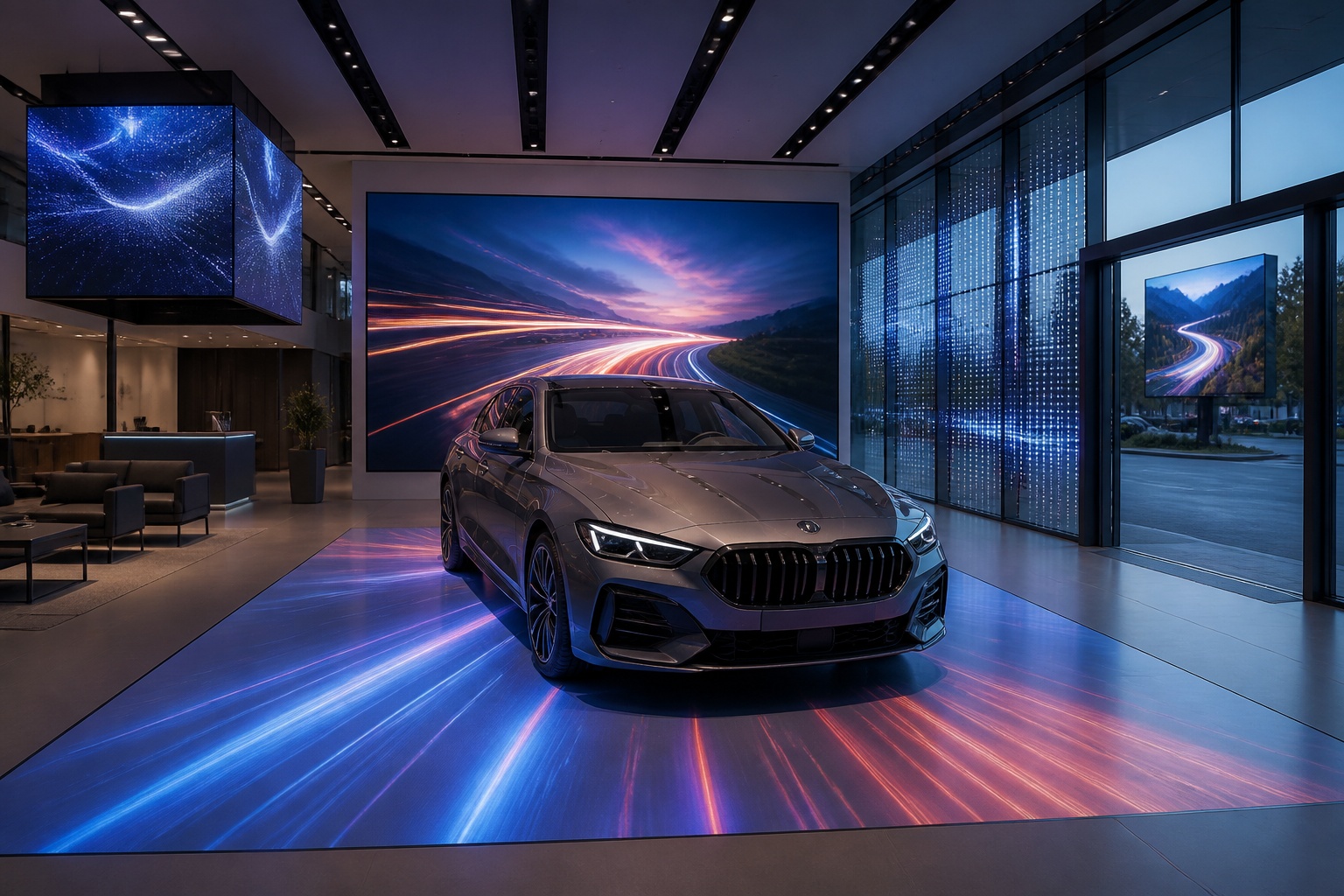
A 4s dealership led display solution should not be selected as a single screen simply because it has a large image area. A professional automotive showroom normally needs different display functions: long-term brand presentation, vehicle promotion, customer interaction, architectural integration, and outdoor visibility. The right approach is to combine LED technologies according to location, viewing distance, content type, and installation conditions. This guide explains how indoor fixed LED, outdoor fixed LED, transparent LED, LED floor displays, cube displays, poster displays, and other creative formats can work together in a 4S dealership.
Table of Contents
- What Is a 4S Dealership LED Display Solution?
- What LED Display Types Are Suitable for a 4S Dealership?
- How Should an Indoor Fixed LED Display Be Used?
- When Should a Dealership Use an Outdoor Fixed LED Display?
- How Can LED Floor Displays Improve Vehicle Presentation?
- Why Use Cube, Transparent and Other Creative LED Displays?
- How Should Different LED Displays Be Combined?
- How Do Buyers Choose Pixel Pitch, Brightness and Installation Type?
- What Questions Should Buyers Ask Before Ordering?
- What Is the Recommended 4S Dealership LED Display Strategy?
1. What Is a 4S Dealership LED Display Solution?
A 4S dealership LED display solution is a coordinated group of LED screens designed for different areas of an automotive retail facility. Instead of using one screen technology everywhere, integrators can assign each display type to a specific job: fixed LED for large-format branding, outdoor LED for roadside communication, floor LED for interactive vehicle presentation, and creative LED formats for architectural or experiential content.
A 4S dealership typically has several visual zones:
- Exterior entrance and roadside
- Reception area
- Brand wall
- Vehicle showroom
- New-model launch area
- Customer lounge
- Delivery area
- Event or activation area
- Glass façade
- Special display or interactive zone
The objective is therefore not simply to maximize screen size. The objective is to create a display architecture in which every screen has a defined communication function.
Section Summary
- A 4S dealership can require several LED display formats.
- Different areas have different viewing and environmental requirements.
- Fixed, floor, transparent and creative LED products can be combined.
- The solution should be designed around application rather than product category alone.
2. What LED Display Types Are Suitable for a 4S Dealership?
A 4S dealership can use indoor fixed LED, outdoor fixed LED, transparent LED, LED floor displays, cube displays, LED poster displays, and selected creative LED products. JUNCHEN's current product portfolio includes indoor and outdoor fixed displays, transparent displays, LED dance floors, poster displays, cube displays, flexible displays and other creative formats.
Table 1. LED display types for 4S dealerships
The following table maps common dealership areas to suitable LED display technologies.
|
Dealership area |
Recommended display |
Primary purpose |
Key consideration |
|
Main showroom |
Brand and vehicle content |
Viewing distance |
|
|
Brand wall |
Premium visual presentation |
Image detail |
|
|
Outdoor entrance |
Traffic and brand visibility |
Brightness and weather |
|
|
Vehicle presentation area |
Immersive presentation |
Load-bearing and protection |
|
|
Glass façade |
Advertising without fully blocking the façade |
Transparency |
|
|
Feature zone |
3D/360° visual impact |
Content design |
|
|
Reception |
Promotional information |
Space and flexibility |
|
|
Event area |
Temporary campaigns |
Setup and mobility |
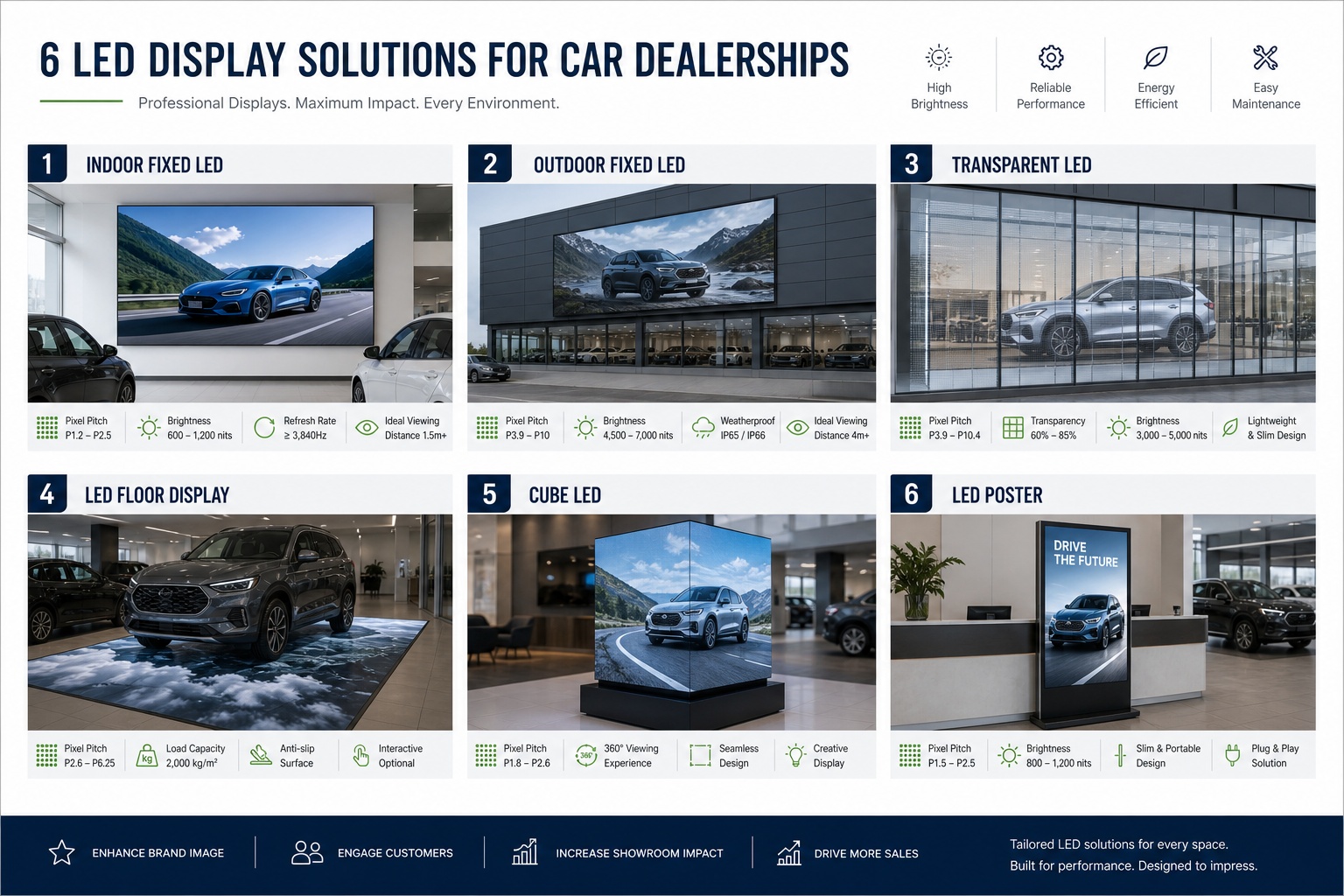
The right combination depends on the dealership's architecture and marketing strategy rather than simply selecting every available technology.
Section Summary
- Indoor fixed LED is the main large-format showroom solution.
- Outdoor fixed LED handles external visibility.
- Floor and creative displays support experiential marketing.
- Transparent LED is useful where glass and natural light must remain visually open.
- Not every dealership needs every display type.
3. How Should an Indoor Fixed LED Display Be Used?
An indoor fixed LED display is usually the core visual display for a 4S showroom because it provides a large, seamless canvas for brand campaigns, vehicle launches, promotional videos and corporate messaging. JUNCHEN's indoor portfolio includes fixed LED displays and fine-pitch options designed for commercial indoor environments, including retail and corporate spaces.
Recommended locations
The strongest applications include:
- Main brand wall
- New vehicle launch backdrop
- Reception background
- Customer lounge
- VIP delivery area
- Conference or training room//www.jcdisplay.com/p2.5-led-panel-indoor.html
For a premium automotive environment, pixel pitch should be selected according to the actual viewing distance, not simply by choosing the smallest available pixel pitch.
For example, a screen viewed from several meters away does not necessarily require the same pixel pitch as a screen viewed from one meter. A closer viewing distance increases the value of finer pixel pitch because text, vehicle details and product imagery become easier to resolve.
COB for premium showroom environments
COB LED is another option when the dealership wants a high-end indoor display with fine pixel pitch and a more protected LED surface. JUNCHEN describes its COB indoor fixed display as using COB packaging, high grayscale, wide viewing angles and front maintenance, with applications including conference rooms and exhibition environments.
Section Summary
- Indoor fixed LED should normally form the visual centerpiece of the showroom.
- Viewing distance should determine pixel-pitch selection.
- Fine-pitch or COB displays can be considered for close-viewing premium environments.
- Front maintenance can be valuable where rear access is restricted.
4. When Should a Dealership Use an Outdoor Fixed LED Display?
An outdoor fixed LED display is appropriate when the dealership needs communication that remains visible from roads, parking areas and external circulation zones. Typical content includes vehicle launches, financing campaigns, dealership branding, seasonal promotions and directional information.
Outdoor and indoor displays should not be specified in the same way. Outdoor installations must account for environmental exposure, brightness, structural mounting, ventilation, maintenance access and local electrical requirements.
JUNCHEN offers an outdoor fixed LED category as part of its commercial display portfolio, alongside other outdoor formats.
Where should it be installed?
Common locations include:
- Roadside-facing signage
- Main entrance
- Parking entrance
- Building façade
- Service-center entrance
- Used-car display area
Technical selection
For outdoor screens, the integrator should confirm:
- Required viewing distance
- Daytime ambient light
- Required brightness
- IP protection
- Cabinet structure
- Wind load
- Maintenance method
- Power distribution
- Content management
- Local permitting requirements
The most expensive mistake is selecting an outdoor LED screen based only on price per square meter while ignoring the mechanical and environmental requirements of the installation.
Section Summary
- Outdoor fixed LED is primarily an external visibility tool.
- Brightness and environmental protection matter more outdoors than in a controlled showroom.
- Structural engineering must be considered before ordering.
- The screen should be selected according to viewing distance and installation conditions.
5. How Can LED Floor Displays Improve Vehicle Presentation?
An LED floor display turns the area beneath or around a vehicle into part of the visual presentation. Unlike a conventional wall screen, the floor becomes a content surface, allowing the dealership to create effects such as moving graphics, launch animations, road simulations and branded environments.
JUNCHEN's LED Dance Floor Display is described as an interactive, sensor-equipped LED floor product with non-slip and wear-resistant characteristics and high refresh rate, aimed at entertainment and interactive applications.
For an automotive showroom, the important issue is not simply whether an LED floor can display video. The integrator must confirm the mechanical load, surface protection, module/cabinet structure, maintenance method and installation depth for the intended application.
A practical automotive application
Imagine a new vehicle positioned in the center of a launch area.

The floor LED can display:
Road graphics → vehicle movement → brand animation → product highlights
while the main wall LED presents the vehicle video and technical story.
This creates a coordinated presentation rather than two independent screens.
Section Summary
- LED floor displays can make the vehicle presentation zone interactive.
- They are particularly useful for launches and experiential marketing.
- Mechanical loading and surface protection must be confirmed.
- Floor LED works best when synchronized with wall or creative LED content.
6. Why Use Cube, Transparent and Other Creative LED Displays?
Creative LED displays are useful when a dealership wants to differentiate its showroom architecture rather than simply install another rectangular video wall. JUNCHEN's portfolio includes transparent, cube, flexible, mechanical and other custom-shaped LED products.
Cube LED display
A cube LED display provides multiple viewing faces and can create a 360-degree visual feature. JUNCHEN lists cube LED products with customized specifications and applications including commercial signage, exhibitions and shopping environments.
For a dealership, a cube can be positioned:
- Near the reception
- In a central feature zone
- Near a staircase or atrium
- In a new-model launch area
- In a brand experience center
The cube should not replace the main fixed LED wall. Its role is to create a visual landmark.
Transparent LED display
Transparent LED is particularly relevant to automotive architecture because dealerships often use large glass façades. JUNCHEN's transparent LED range is designed to preserve visual openness while displaying digital content; its site describes transparent solutions for glass walls, windows and architectural applications.
This makes transparent LED useful for:
- Glass showroom façades
- Window advertising
- Atrium features
- Brand graphics
- Promotional campaigns
Section Summary
- Cube LED is suitable for distinctive 360-degree visual features.
- Transparent LED can add content to glass without using a conventional opaque video wall.
- Creative LED should support the showroom architecture rather than compete with every other display.
- These products are especially valuable for premium brand experiences.
7. How Should Different LED Displays Be Combined?
The most effective 4S dealership LED solution usually uses one primary display plus several supporting displays. A practical design can divide the showroom into communication layers rather than installing identical screens throughout the facility.
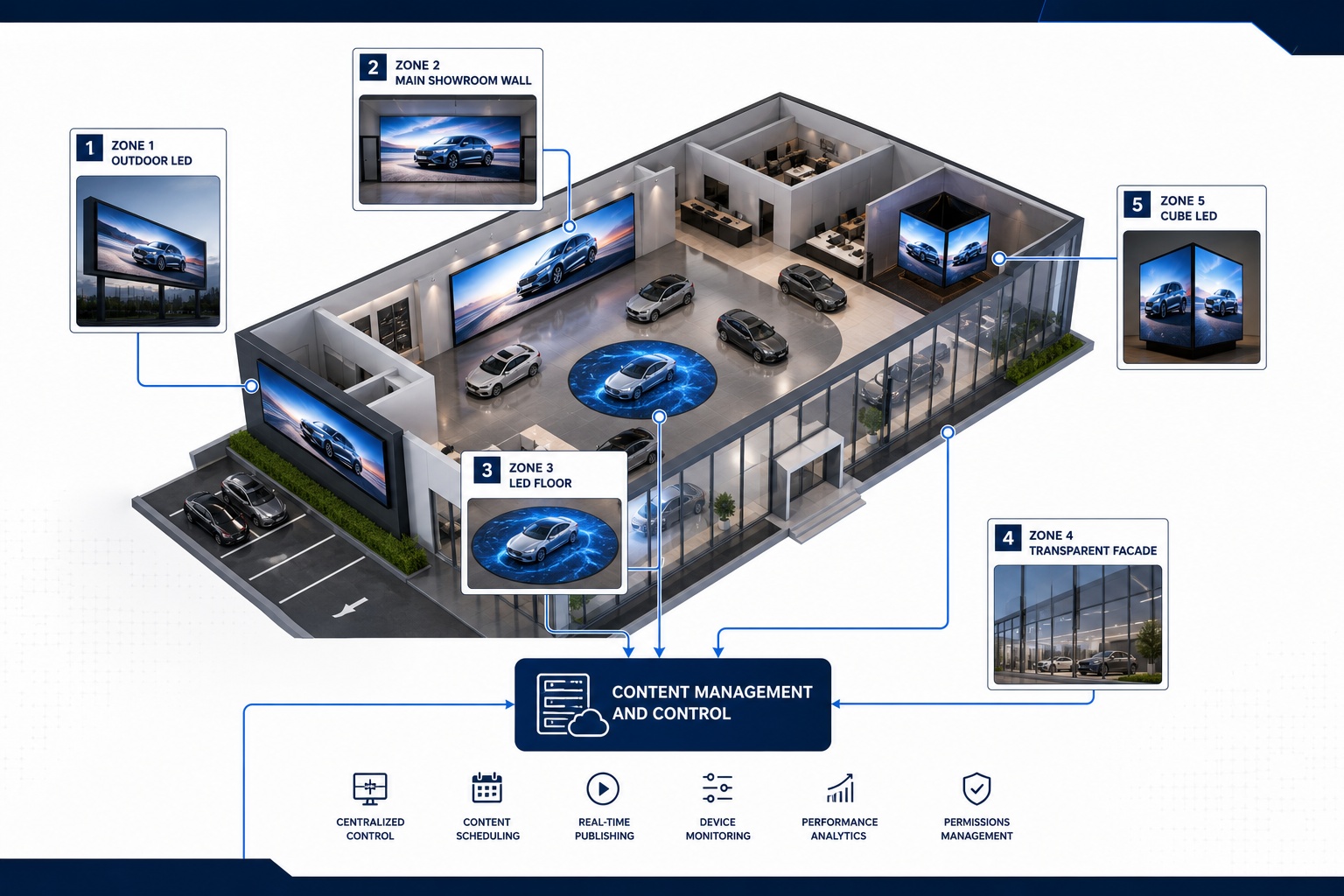
Table 2. Recommended 4S dealership LED display combinations
|
Project level |
Main display |
Supporting displays |
Best for |
|
Basic |
Indoor fixed LED |
LED posters |
Standard showroom |
|
Brand-focused |
Fine-pitch fixed LED |
Outdoor fixed LED |
Premium dealerships |
|
Experience-focused |
Indoor fixed LED |
Floor LED + cube LED |
Vehicle launches |
|
Architectural |
Fixed LED |
Transparent LED |
Glass-front dealerships |
|
Full experience |
Fixed + outdoor LED |
Floor + transparent + cube |
Flagship 4S showroom |
Combination A: Standard dealership
The fixed wall provides large-format branding while poster displays handle localized promotions.
Combination B: Premium showroom
Fine-pitch indoor LED + outdoor fixed LED + floor LED
The main LED handles high-quality visual communication, the outdoor screen attracts traffic, and the floor display creates an immersive vehicle presentation area.
Combination C: Flagship experience center
Indoor fixed LED + transparent LED + floor LED + cube LED + outdoor LED
This is the most visually ambitious configuration. It is appropriate when the dealership is also intended to function as a brand experience center.
Recommendation
For most dealerships, do not begin with five different LED technologies. Start with the main communication requirement and add creative displays where they solve a specific architectural or marketing objective.
Section Summary
- Use the indoor fixed screen as the primary visual platform.
- Add outdoor LED for external visibility.
- Add floor LED for experiential vehicle presentation.
- Add transparent LED where glass architecture is important.
- Add cube LED as a visual landmark.
8. How Do Buyers Choose Pixel Pitch, Brightness and Installation Type?
The correct LED specification depends on the environment, viewing distance and content rather than the dealership name itself. A showroom selling premium vehicles may need finer image detail than an outdoor roadside screen, while an entrance display requires environmental protection and structural engineering.
Pixel pitch
Pixel pitch determines the physical distance between LED pixels.
As viewing distance decreases, finer pixel pitch generally becomes more important.
A buyer should therefore provide:
Screen size + viewing distance + content type
rather than asking only:
“What is your smallest pixel pitch?”
Brightness
Indoor and outdoor screens have different brightness requirements.
An indoor showroom with controlled lighting does not need to be specified like a roadside billboard exposed to direct sunlight.
Refresh rate
High refresh rate is valuable when the display will be photographed or filmed, particularly during:
- Vehicle launches
- Corporate events
- Social-media content production
- Broadcast-style presentations
Maintenance
Maintenance access should be determined during design.
For a wall installed close to a vehicle display area, front maintenance can reduce disruption if rear access is unavailable. JUNCHEN's indoor COB fixed display information specifically highlights front maintenance as one of its characteristics.
Section Summary
- Pixel pitch should follow viewing distance.
- Brightness should follow ambient-light conditions.
- High refresh rate matters for camera-facing applications.
- Maintenance access should be planned before installation.
- Screen selection should begin with application data, not product price.
9. What Questions Should Buyers Ask Before Ordering?
A professional procurement process should define the project before comparing quotations.
Technical checklist
1. Where will the display be installed?
Indoor, outdoor, glass, floor, façade or suspended?
2. What is the closest viewing distance?
This determines the appropriate pixel pitch.
3. What content will be shown?
Vehicle photography, text, live video, 3D animation or promotional content?
4. Will the screen be filmed?
If yes, refresh rate and camera compatibility become more important.
5. Is the screen permanent or temporary?
Permanent installations generally favor fixed LED, while temporary events may favor rental products.
6. How will maintenance be performed?
Confirm front or rear access before finalizing cabinet structure.
7. What is the electrical capacity?
Confirm power distribution and project-level electrical requirements with the integrator.
8. Is the building façade glass?
If yes, transparent LED may be worth evaluating.
9. Does the project require an interactive area?
If yes, consider LED floor technology.
10. Does the showroom need a signature visual feature?
If yes, cube, flexible, mechanical or other creative LED formats can be considered.
Section Summary
- Define the installation environment before selecting products.
- Viewing distance is a fundamental specification.
- Content and camera use influence display selection.
- Maintenance and electrical planning should be part of procurement.
- Creative LED should have a defined business or architectural purpose.
10. What Is the Recommended 4S Dealership LED Display Strategy?
The recommended strategy is to build the dealership display system in layers: primary communication, external visibility, experiential interaction and architectural differentiation. This avoids the common mistake of purchasing several visually impressive products without giving each screen a clear role.
Table 3. 4S dealership LED solution planning matrix
|
Function |
Recommended solution |
Buyer priority |
|
Main brand communication |
Very high |
|
|
Vehicle launch backdrop |
Very high |
|
|
Roadside advertising |
High |
|
|
Glass façade advertising |
Medium–high |
|
|
Vehicle experience zone |
Medium–high |
|
|
Signature showroom feature |
Medium |
|
|
Local promotion |
Medium |
|
|
Temporary campaign |
Project dependent |
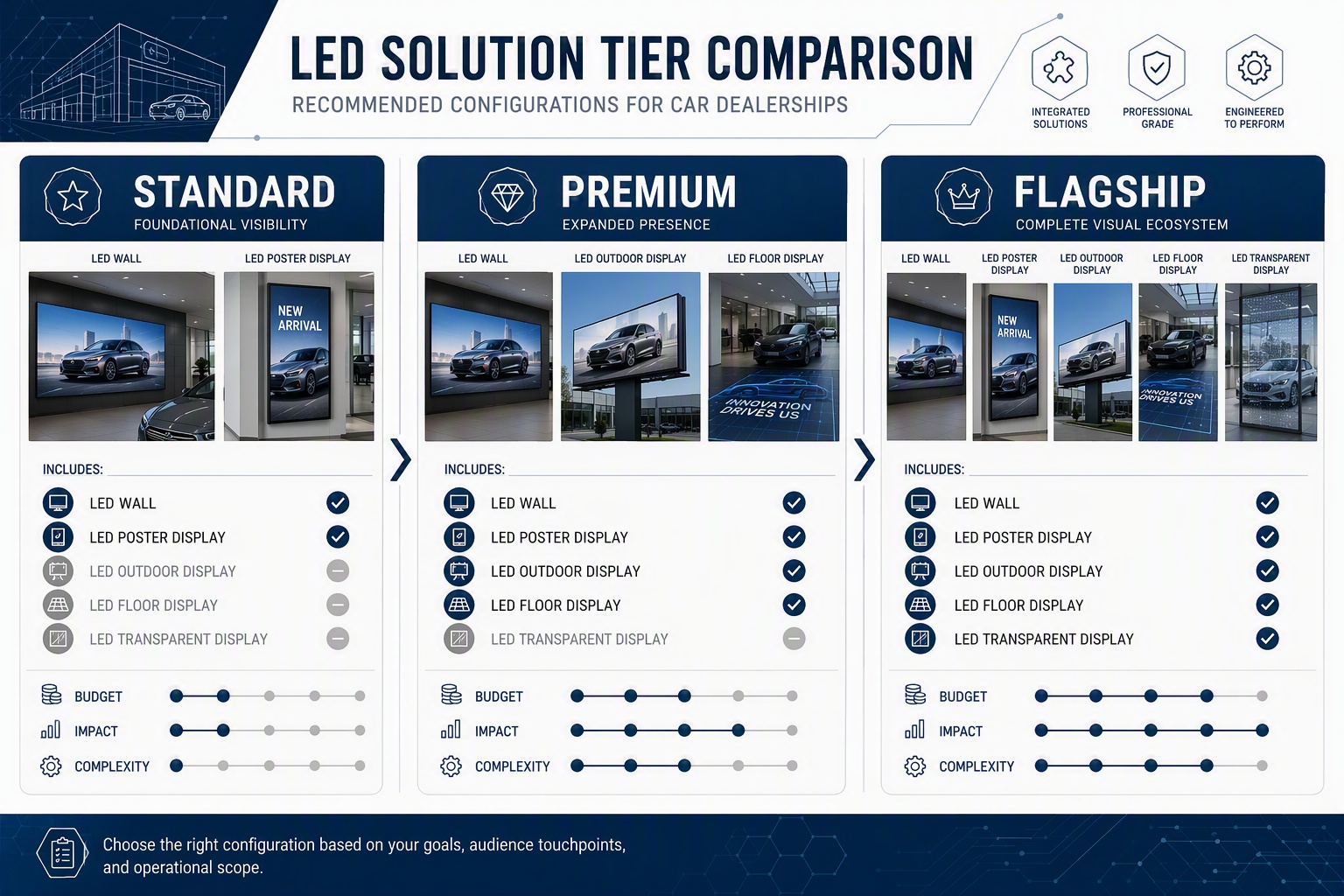
Recommended deployment
For a typical medium-to-large 4S dealership, a practical starting point is:
1 × main indoor fixed LED
LED posters for localized promotion
Then add:
if the dealership has a vehicle launch or experience area.
Add:
if the building has substantial glass frontage.
Add:
if the showroom needs a signature architectural feature.
This approach provides a better balance between visual impact, technical complexity and budget control.
Section Summary
- The main indoor LED should normally be the first investment.
- Outdoor LED extends communication beyond the showroom.
- Floor LED adds an experiential layer.
- Transparent LED works particularly well with glass architecture.
- Cube LED is best treated as a signature feature rather than a general-purpose screen.
FAQ
What LED display is best for a 4S dealership?
An indoor fixed LED display is usually the best starting point for the main showroom because it provides a large, seamless canvas for brand and vehicle content. However, the best overall solution depends on the dealership layout. Outdoor fixed LED can handle roadside visibility, while floor, transparent and cube LED displays can support specialized experience zones.
What pixel pitch should an automotive showroom LED screen use?
The appropriate pixel pitch depends primarily on viewing distance. A screen viewed at close range generally benefits from a finer pixel pitch, while a large wall viewed from several meters away may use a different specification. Buyers should provide screen dimensions, closest viewing distance and content requirements before selecting the pixel pitch.
Can LED floor displays be used in a car showroom?
Yes, LED floor displays can be considered for vehicle presentation and interactive experience zones, provided the selected product is designed for the expected mechanical and environmental conditions. JUNCHEN offers LED dance-floor products featuring interactive sensing, non-slip and wear-resistant characteristics.
Is transparent LED suitable for a dealership glass façade?
Yes. Transparent LED is particularly useful when the dealership wants to display advertising or brand content on glass while maintaining visual openness. JUNCHEN describes transparent LED solutions for glass walls and windows and lists high-transparency products for architectural applications.
What is a cube LED display used for?
A cube LED display is primarily used as a creative visual feature. Its multiple faces allow content to be viewed from different directions, making it suitable for showroom feature zones, exhibitions, commercial spaces and brand experiences. It is generally better used as a complementary display than as a replacement for the main video wall.
Should a 4S dealership use indoor and outdoor LED together?
For dealerships that need both showroom communication and roadside visibility, combining indoor and outdoor LED can create a more complete communication system. The two displays should be specified separately because indoor and outdoor environments impose different requirements for brightness, protection, structure and maintenance.
How should a dealership control multiple LED displays?
A multi-screen dealership should define the content architecture before selecting the control system. Depending on the screen types and project requirements, the system may need independent playback, synchronized playback, multiple inputs, remote management or different control zones. The controller and processor should therefore be selected after the display architecture is finalized.
Is a cube LED display necessary for every dealership?
No. Cube LED is an optional creative feature. It makes more sense for flagship showrooms, brand experience centers or dealerships that want a distinctive architectural element. A conventional dealership may receive more practical value from investing first in the main indoor fixed screen, outdoor signage and localized promotional displays.
Overall Key Takeaways
- A 4s dealership led display should be designed as a system rather than a single screen.
- Indoor fixed LED is normally the primary large-format showroom display.
- Fine-pitch LED is appropriate when customers view detailed vehicle content from close distances.
- Outdoor fixed LED improves visibility from roads and parking areas.
- LED floor displays can transform vehicle presentation areas into interactive experiences.
- Transparent LED can integrate digital content into glass façades while preserving visual openness.
- Cube LED displays can create distinctive 360-degree showroom features.
- LED poster displays are useful for localized promotional communication.
- Pixel pitch should be selected according to viewing distance and content requirements.
- Maintenance, electrical capacity, structural conditions and operating environment should be confirmed before procurement.
- Buyers should build the solution in stages rather than automatically purchasing every creative LED technology.
- JUNCHEN provides indoor, outdoor, transparent, floor, poster, rental and custom-shaped LED display categories that can be combined for different commercial applications.
Conclusion
A successful 4S dealership LED project is not defined by the largest screen or the highest specification. It is defined by whether each display performs a clear communication or experience function within the dealership.
For most projects, an indoor fixed LED display should form the primary visual platform for vehicle launches, brand storytelling and large-format content. An outdoor fixed LED display can extend that communication toward roads and parking areas. Where the dealership emphasizes customer experience, an LED floor display can turn the vehicle presentation zone into an immersive environment. For glass architecture, transparent LED can add digital content without completely blocking the façade, while a cube LED display can create a recognizable visual landmark.
The best procurement approach is therefore to start with the showroom layout, viewing distances, content strategy, environmental conditions and maintenance requirements. From there, the integrator can determine which combination provides the right balance between visual performance, installation complexity and long-term operating value.
If you are planning a new automotive showroom, renovation or multi-location 4S dealership rollout, contact JUNCHEN LED Display for a project-specific display configuration, technical recommendation and quotation. The company provides customized LED display design, production, logistics and technical support for international B2B projects.
How Much Does an LED Display Cost? A Complete Pricing Guide
How to Choose the Right LED Display Size? Complete LED Screen Size Guide
Related Article

Tell Us What Are You Looking For?
