
What Is the HD-B8L Poster Screen Control System? A Complete Technical Guide for Commercial LED Displays
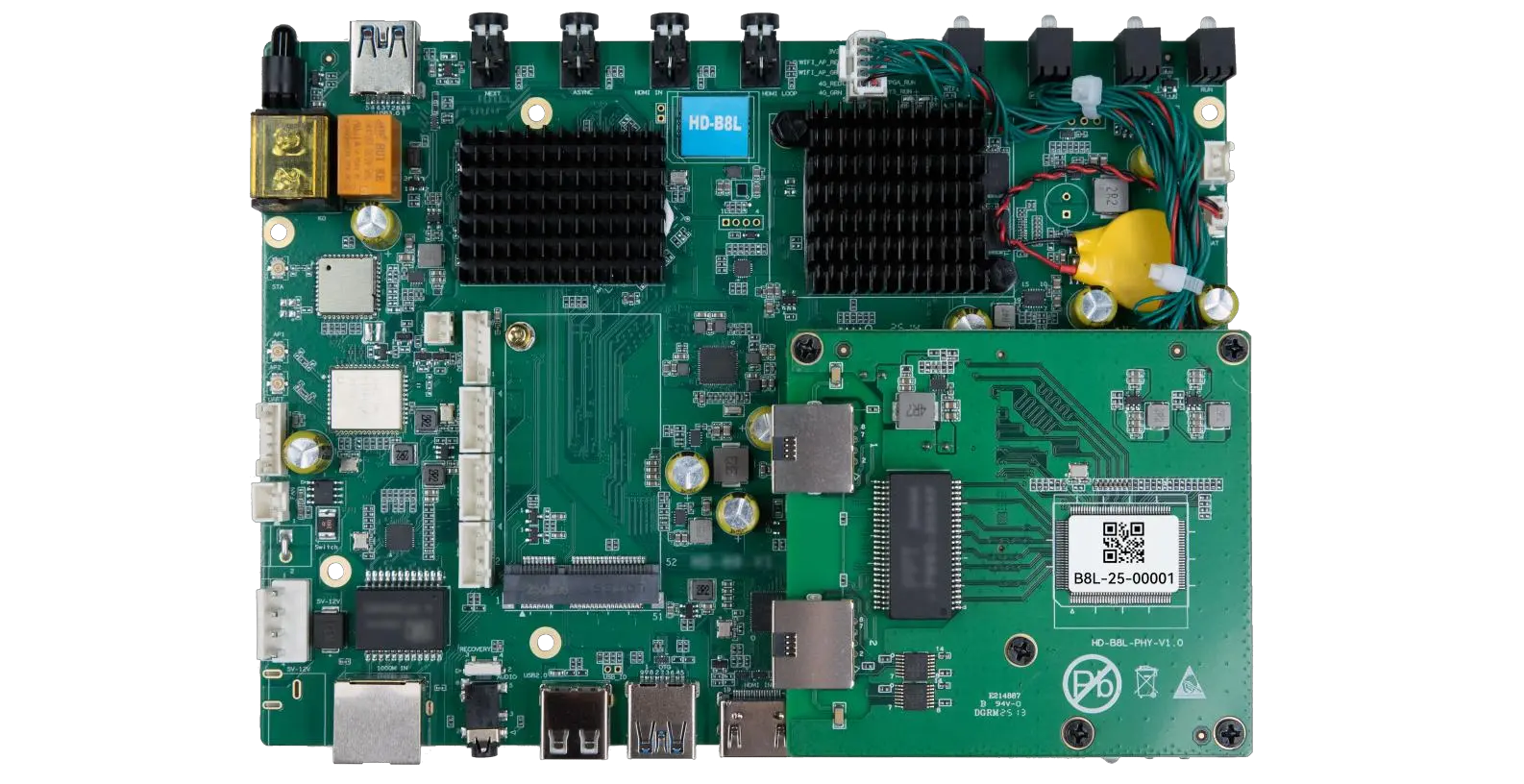
The HD-B8L Poster Screen Control System is an integrated Android-based LED display controller developed for commercial digital signage and LED poster applications. By combining media playback, asynchronous sending capabilities, network communication, and cloud-based content management in a single hardware platform, it reduces system complexity while improving deployment flexibility.
Unlike traditional LED control systems that require multiple external devices, the HD-B8L provides built-in Wi-Fi, Gigabit Ethernet, USB interfaces, HDMI synchronization, and optional 4G connectivity, making it suitable for standalone advertising displays as well as synchronized multi-screen projects.
This guide explains its hardware architecture, key interfaces, application scenarios, software ecosystem, and engineering considerations to help professional buyers determine whether it is the right controller for their projects.
Table of Contents
- What Is the HD-B8L Poster Screen Control System?
- What Hardware Does the HD-B8L Include?
- How Does the HD-B8L Process LED Content?
- What Interfaces Are Available?
- Which Software Platforms Are Supported?
- What Are the Main Technical Specifications?
- Where Can the HD-B8L Be Used?
- How Does It Compare with Other LED Controllers?
- Frequently Asked Questions
- Conclusion
1. What Is the HD-B8L Poster Screen Control System?
The HD-B8L is an all-in-one Android LED display controller designed for commercial LED poster screens, digital signage, and creative LED installations. It combines media playback, asynchronous LED sending, networking, and cloud management into a single compact controller, reducing external hardware requirements.
Unlike a traditional architecture that separates the media player, sending card, and network controller, the HD-B8L integrates these functions into one platform. This simplifies installation, reduces wiring complexity, and makes maintenance easier for system integrators.
For commercial projects requiring remote content updates, synchronized playback, or standalone advertising displays, this integrated design offers operational efficiency while supporting scalable deployment.
HD-B8L Hardware Overview
The following table summarizes the verified hardware information available from the product datasheet.
|
Parameter |
Specification |
|
Operating System |
Android 11 |
|
Processor |
RK3568 Quad-Core Cortex-A55 |
|
Memory |
4GB RAM |
|
Storage |
64GB eMMC |
|
Network |
Gigabit Ethernet |
|
Wireless |
Built-in Wi-Fi |
|
Optional Communication |
4G, GPS |
|
USB |
USB 3.0, USB OTG |
|
Video Input |
HDMI |
|
Video Loop |
HDMI Loop |
|
Cloud Control |
Supported |
|
Management Software |
HDPlayer, LedArt |
Why This Matters for Commercial Projects
For LED display distributors and system integrators, controller selection directly affects installation time, maintenance costs, and future scalability. An integrated controller such as the HD-B8L minimizes external equipment, simplifies system architecture, and supports centralized management—advantages that are especially valuable in retail chains, shopping malls, transportation hubs, and corporate digital signage networks.
2. What Hardware Does the HD-B8L Include?
The HD-B8L includes an integrated Android computing platform, LED sending control hardware, multiple communication interfaces, and optional wireless modules. Its hardware architecture is designed for independent LED poster displays, commercial digital signage, and creative LED display projects that require flexible content control.
The controller uses an RK3568 quad-core Cortex-A55 processor with Android 11 operating system, allowing it to handle media playback, network communication, and LED display management tasks without requiring an additional external media player.
For LED system integrators, this integrated structure reduces installation complexity and provides a practical solution for retail, transportation, exhibition, and commercial display environments.
2.1 Android 11 Operating System Architecture
How Does Android 11 Improve LED Display Management?
The HD-B8L runs on Android 11, providing a familiar software environment for digital signage applications. Android-based architecture enables flexible application development, remote management, and compatibility with modern cloud-based content platforms.
Compared with traditional standalone LED controllers, Android controllers provide more possibilities for content management, including mobile control, network publishing, and third-party application integration.
Technical Meaning
Android 11 acts as the operating platform that manages:
- media playback
- network communication
- application installation
- content scheduling
- remote monitoring
Business Value
For distributors and integrators, Android architecture reduces the learning curve because many technicians are already familiar with Android-based systems.
Application Example
A retail chain can deploy multiple LED poster displays in different stores and update advertising content remotely through cloud management software.
2.2 RK3568 Processor Performance
What Processor Does the HD-B8L Use?
The HD-B8L uses the RK3568 quad-core Cortex-A55 processor, which provides computing capability for LED display control, multimedia processing, and network communication.
The processor combines low power consumption with sufficient performance for commercial digital signage applications.
HD-B8L Processor and Computing Specifications
The following table summarizes the main computing hardware specifications.
|
Parameter |
Specification |
|
Processor |
RK3568 |
|
CPU Architecture |
Quad-core Cortex-A55 |
|
Operating System |
Android 11 |
|
RAM |
4GB |
|
Storage |
64GB |
Why These Specifications Matter
A stronger processor improves system responsiveness when handling:
- high-quality video playback
- multiple media formats
- remote content updates
- cloud communication
- multi-screen control
2.3 Integrated Storage and Memory
How Does Storage Affect LED Display Operation?
The HD-B8L provides 64GB internal storage and 4GB RAM, allowing users to store media files locally and operate the display independently without continuous internet access.
Local storage is important for commercial installations where uninterrupted playback is required.
Typical Applications
Examples include:
- shopping mall advertising screens
- airport information displays
- exhibition displays
- retail promotional screens
If the network connection becomes unavailable, locally stored content can continue playing.
2.4 Network Connectivity
How Does the HD-B8L Connect to Networks?
The HD-B8L supports multiple communication methods, including Ethernet and Wi-Fi, with optional 4G connectivity for remote locations.
This allows installers to choose the most suitable communication method according to project requirements.
HD-B8L Network Interfaces
The following table explains available communication options.
|
Interface |
Function |
Application |
|
Ethernet |
Wired network communication |
Stable commercial installations |
|
Wi-Fi |
Wireless configuration and control |
Retail and indoor applications |
|
4G Optional |
Mobile network connection |
Outdoor or remote projects |
|
GPS Optional |
Location-based management |
Fleet or distributed displays |
Network Advantages
Multiple connectivity options provide flexibility for:
- centralized management
- remote troubleshooting
- distributed advertising networks
- large-scale digital signage deployment
2.5 HDMI Video Interfaces
What HDMI Interfaces Does the HD-B8L Support?
The HD-B8L provides HDMI input, HDMI loop output, and HDMI output interfaces for synchronized video applications and external signal connection.
These interfaces allow the controller to work with external video sources and support creative LED display installations.
HDMI IN
Function
HDMI input allows external video signals from devices such as:
- computers
- cameras
- media players
- video processors
to be displayed on LED screens.
Application Example
A conference room can connect a laptop through HDMI and display presentations directly on an LED wall.
HDMI LOOP
Function
HDMI loop allows the incoming signal to continue to another device or display system.
Business Value
It simplifies multi-device signal distribution and reduces additional equipment requirements.
HDMI OUT
Function
HDMI output allows video signals to connect with external monitoring devices.
Application Example
Installers can connect a preview monitor during commissioning and maintenance.
HD-B8L HDMI Interface Functions
|
Interface |
Purpose |
Typical Use |
|
HDMI IN |
Receive external video |
PC, camera, media source |
|
HDMI LOOP |
Pass signal through |
Multi-device connection |
|
HDMI OUT |
Output monitoring signal |
Installation debugging |
2.6 USB Connectivity
How Are USB Interfaces Used?
The HD-B8L provides USB connectivity for system expansion, data transfer, and device communication.
Available interfaces include:
- USB 3.0
- USB 2.0 OTG
USB 3.0
Used for:
- faster media transfer
- external storage connection
- system maintenance
USB OTG
Used for:
- device communication
- configuration support
- engineering setup
2.7 RS232 and RS485 Communication
Why Are Industrial Interfaces Important?
RS232 and RS485 interfaces allow the HD-B8L to integrate with professional control systems.
These communication methods are commonly used in:
- building automation
- industrial control
- AV integration systems
Application Example
A shopping mall can integrate LED poster displays with a centralized control system to manage multiple advertising zones.
Advantages of HD-B8L Hardware Architecture
✓ integrated android 11 operating platform
✓ rk3568 quad-core processing architecture
✓ built-in storage for independent playback
✓ multiple network communication methods
✓ hdmi synchronization capability
✓ professional industrial communication interfaces
✓ suitable for scalable digital signage projects
3. How Does the HD-B8L Process LED Content?
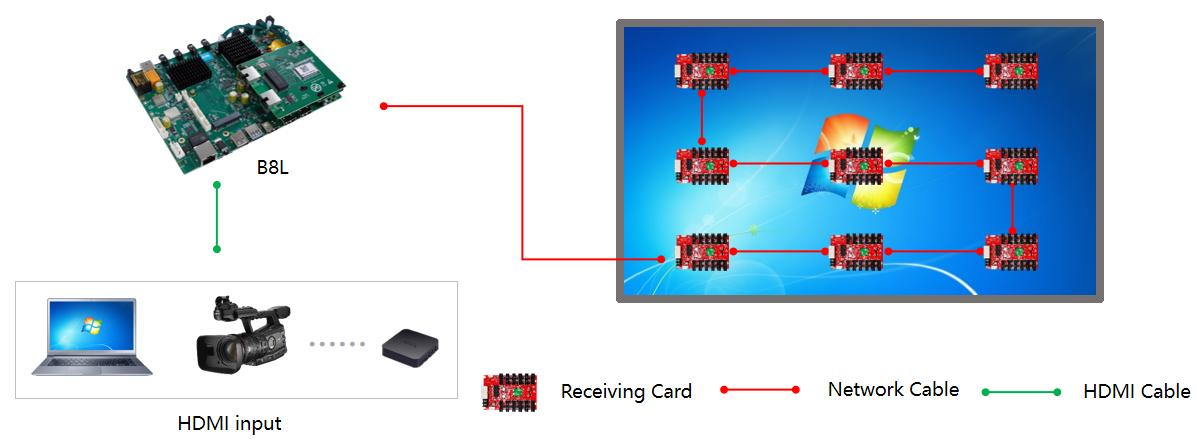
The HD-B8L processes LED content through an integrated media playback and LED control architecture that combines Android computing, video decoding, sending control, and network communication. It can receive content from local storage, HDMI sources, USB devices, or cloud platforms, then transmit processed signals to LED modules through the LED control system.
This architecture allows the HD-B8L to operate as an independent LED poster controller without requiring a separate external media player. For commercial LED applications, this reduces system complexity and improves deployment flexibility.
The controller is suitable for advertising displays, retail LED posters, creative LED screens, exhibitions, and digital signage projects that require reliable content playback.
3.1 What Is the LED Content Processing Workflow?
How Does an LED Controller Process Video?
An LED display controller converts digital media content into signals that LED modules can display. The process includes content input, decoding, image processing, signal transmission, and LED output control.
The HD-B8L follows this workflow:
Content Source
↓
HDMI / USB / Network / Cloud Platform
↓
Android Media Processing
↓
LED Control Processing
↓
Receiving Card / LED Modules
↓
Displayed Image
3.2 Asynchronous Playback Capability
What Is Asynchronous LED Playback?
Asynchronous playback allows an LED display controller to store and play content independently without requiring a continuous connection to a computer or external video source.
The HD-B8L uses this method for standalone LED poster applications where displays need to operate independently after installation.
How Does It Work?
The workflow is:
- Content is uploaded through software or network.
- Media files are stored inside the controller.
- The controller processes playback schedules.
- LED modules display programmed content automatically.
Why Is It Important?
For commercial buyers, asynchronous operation provides:
- independent screen operation
- reduced hardware requirements
- easier remote management
- lower maintenance complexity
Application Example
A retail store can install an LED poster display near the entrance and update promotional videos remotely without connecting a computer permanently.
3.3 Synchronous HDMI Display Mode
How Does HDMI Synchronization Work?
HDMI synchronization allows the HD-B8L to display real-time video signals from external sources such as computers, cameras, or professional AV systems.
This mode is useful when LED displays need to show live content instead of stored media.
Common Applications
Conference Rooms
Requirement:
Real-time presentation display.
Solution:
Connect laptops through HDMI input.
Broadcast Environments
Requirement:
Live video playback.
Solution:
Receive external video signals through HDMI.
Events and Exhibitions
Requirement:
Dynamic content presentation.
Solution:
Use HDMI sources for real-time visual output.
HD-B8L Content Playback Methods
The following table compares different content input methods.
|
Method |
Description |
Suitable Application |
|
Local Storage |
Playback stored media files |
Retail advertising |
|
HDMI Input |
Real-time video source |
Events and conferences |
|
USB |
Offline content update |
Maintenance and installation |
|
Network |
Remote content publishing |
Multi-location projects |
|
Cloud Platform |
Centralized management |
LED display networks |
Summary
The HD-B8L supports multiple content workflows, allowing integrators to select the best method according to project requirements.
3.4 Video Decoding Capability
What Video Formats Can the HD-B8L Process?
The HD-B8L supports common multimedia formats used in commercial digital signage environments.
According to the datasheet, supported media includes common formats such as:
- MP4
- AVI
- MKV
- MOV
- TS
- MPEG
- JPG
- PNG
- GIF
HD-B8L Media Format Support
|
Category |
Supported Formats |
|
Video |
MP4, AVI, MKV, MOV, TS |
|
Image |
JPG, PNG, BMP, GIF |
|
Audio |
Common digital audio formats |
Why Does Video Compatibility Matter?
Commercial LED displays often run different types of advertising content.
Wide format compatibility helps reduce the need for content conversion and simplifies daily operation.
3.5 Multi-Screen and Creative Display Capability
How Does HD-B8L Support Creative LED Displays?
The HD-B8L supports creative LED display applications by allowing multiple screens and flexible content layouts. This capability is useful for LED poster combinations, artistic displays, and customized commercial installations.
Common Creative Applications
LED Poster Wall
Multiple LED posters can be combined to create a larger visual area.
Shopping Mall Digital Display
Several screens can display coordinated advertising campaigns.
Exhibition Display
Creative layouts can attract visitor attention.
HD-B8L Application Scenarios
|
Application |
Requirement |
HD-B8L Advantage |
|
Retail Store |
Easy content updates |
Network management |
|
Shopping Mall |
Multiple advertising zones |
Centralized control |
|
Exhibition |
Creative visuals |
Flexible playback |
|
Corporate Lobby |
Professional presentation |
HDMI support |
|
Museum |
Stable operation |
Independent playback |
3.6 HDPlayer and LedArt Software Ecosystem
Which Software Supports the HD-B8L?
The HD-B8L works with professional LED management software including:
- HDPlayer
- LedArt
These software platforms help users configure screens, upload content, and manage playback.
HDPlayer
Main Functions
- screen configuration
- program editing
- content publishing
- display monitoring
LedArt
Main Functions
- mobile management
- wireless operation
- quick content updates
Advantages of HD-B8L Content Processing
✓ independent media playback
✓ hdmi real-time input support
✓ multiple content sources
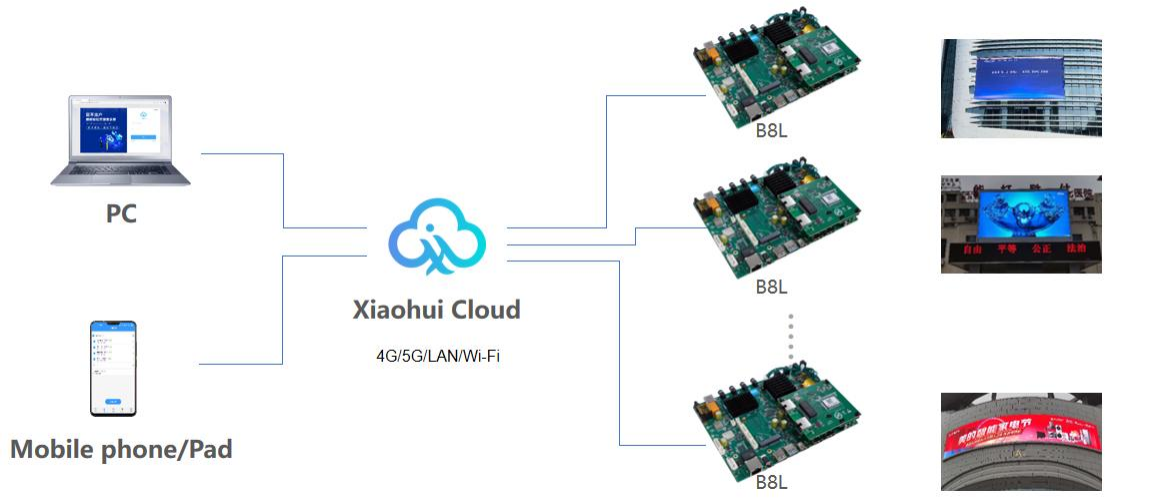
✓ cloud-based management capability
✓ compatible with digital signage workflows
✓ supports creative led display projects
4. What Interfaces Are Available on the HD-B8L Poster Screen Control System?
The HD-B8L provides multiple professional interfaces including HDMI input, HDMI loop, HDMI output, Ethernet, Wi-Fi, USB, RS232, RS485, and optional 4G and GPS modules. These interfaces allow the controller to connect with video sources, networks, external devices, and intelligent management systems.
For LED display engineers and AV integrators, interface flexibility is one of the most important factors when selecting a controller because it directly affects installation design, system integration, and future expansion.
The HD-B8L interface architecture supports standalone LED poster displays, commercial digital signage networks, and creative LED display projects.
4.1 HDMI Interfaces
How Do HDMI Interfaces Improve LED Display Integration?
The HD-B8L supports HDMI input, HDMI loop, and HDMI output interfaces, allowing integration with external video sources and professional AV systems. These connections make the controller suitable for applications requiring real-time video playback, signal distribution, and installation monitoring.
HDMI remains one of the most common digital video transmission standards because it provides stable high-quality signal transmission between devices.
HDMI IN
Definition
HDMI IN is the input interface that receives external video signals.
How It Works
The controller accepts video signals from external devices and processes them before sending content to the LED display system.
Why It Matters
HDMI input allows the LED screen to display live content without uploading media files in advance.
Application Examples
- conference presentations
- live event broadcasting
- camera monitoring
- exhibition demonstrations
HDMI LOOP
Definition
HDMI LOOP is a signal forwarding function that passes the incoming HDMI signal to another device.
How It Works
The controller receives an HDMI source and outputs the same signal through the loop interface.
Business Value
This reduces additional signal distribution equipment and simplifies system wiring.
Application Example
A large exhibition project can distribute one HDMI source to multiple display devices.
HDMI OUT
Definition
HDMI OUT provides video signal output for external monitoring or additional devices.
Application Examples
- installation debugging
- preview monitoring
- system testing
HD-B8L HDMI Interface Functions
The following table explains the purpose of each HDMI interface.
|
Interface |
Function |
Typical Application |
|
HDMI IN |
Receive external video signals |
PC, camera, media source |
|
HDMI LOOP |
Forward HDMI signal |
Multi-device connection |
|
HDMI OUT |
Output processed signal |
Monitoring and testing |
Summary
HDMI connectivity makes the HD-B8L adaptable for both standalone digital signage and professional AV integration projects.
4.2 Ethernet Network Connection
How Does Ethernet Support LED Display Management?
The HD-B8L supports Ethernet communication for stable wired network connections, making it suitable for commercial LED installations that require reliable data transmission and remote management.
Compared with wireless connections, wired Ethernet provides higher stability in fixed installations.
Technical Meaning
Ethernet allows the controller to communicate with:
- computers
- cloud platforms
- local networks
- LED management software
Business Value
For projects such as shopping malls, airports, and retail chains, Ethernet helps maintain stable communication between multiple LED displays.
Application Example
A retail group with multiple LED poster screens can connect displays through a local network and manage content from a centralized system.
4.3 Wi-Fi Wireless Control
Why Is Wi-Fi Important for LED Poster Displays?
Built-in Wi-Fi allows installers and operators to configure and update LED poster displays wirelessly, reducing the need for physical connections during setup and daily operation.
Typical Uses
Wi-Fi can support:
- initial configuration
- content updates
- wireless management
- mobile device control
Application Example
A small retail store can update promotional content from a tablet without accessing the controller directly.
4.4 USB Interfaces
How Are USB Ports Used?
The HD-B8L provides USB 3.0 and USB OTG interfaces for data transfer, maintenance, and device communication.
USB 3.0
Function
USB 3.0 provides high-speed data transfer.
Application
Used for:
- importing media files
- connecting storage devices
- maintenance operations
USB OTG
Function
USB OTG enables direct communication between devices.
Application
Used during:
- engineering configuration
- system maintenance
- device setup
HD-B8L USB Interface Applications
|
Interface |
Purpose |
Example |
|
USB 3.0 |
High-speed data transfer |
Media update |
|
USB OTG |
Device communication |
Configuration |
Summary
USB interfaces provide convenient options for content management and technical maintenance.
4.5 RS232 and RS485 Industrial Communication
Why Does the HD-B8L Include RS232 and RS485?
RS232 and RS485 interfaces allow the HD-B8L to connect with professional control systems and external equipment used in commercial installations.
These industrial communication protocols are widely used because they provide reliable device communication.
RS232
Common Applications
- equipment control
- system integration
- engineering configuration
RS485
Common Applications
- long-distance communication
- multi-device control
- industrial environments
Application Example
A smart building system can integrate LED displays with other equipment through RS485 communication.
4.6 Optional 4G and GPS Modules
How Do Optional 4G and GPS Improve Remote LED Management?
Optional 4G and GPS functions expand the HD-B8L application range by enabling remote network access and location-based management for distributed LED display projects.
4G Module
Function
Provides mobile network communication where wired internet is unavailable.
Suitable Applications
- outdoor advertising displays
- transportation displays
- temporary installations
GPS Module
Function
Provides location information.
Suitable Applications
- vehicle-mounted displays
- distributed display networks
- location tracking projects
HD-B8L Communication Interface Overview
The following table summarizes the available communication options.
|
Interface |
Category |
Main Function |
|
Ethernet |
Wired network |
Stable communication |
|
Wi-Fi |
Wireless network |
Flexible setup |
|
4G Optional |
Mobile network |
Remote locations |
|
GPS Optional |
Positioning |
Location management |
|
RS232 |
Control communication |
Device integration |
|
RS485 |
Industrial communication |
Multi-device control |
Summary
The HD-B8L provides flexible communication methods for different project environments, from indoor retail displays to distributed commercial networks.
4.7 HD-B8L System Connection Architecture
Advantages of HD-B8L Interface Design
✓ multiple video input options
✓ stable ethernet communication
✓ wireless wifi configuration
✓ usb maintenance support
✓ professional rs232 and rs485 integration
✓ optional 4g and gps expansion
✓ suitable for commercial led display systems
5. Where Can the HD-B8L Be Used?
The HD-B8L is designed for commercial LED display applications that require independent playback, flexible connectivity, and efficient content management. Typical applications include retail stores, shopping malls, exhibitions, corporate environments, transportation facilities, museums, churches, and digital signage networks.
Its integrated Android platform, multiple communication interfaces, and software support make it suitable for projects where installers need reliable operation, simple maintenance, and scalable deployment.
For professional buyers, selecting the right controller depends not only on hardware specifications but also on application requirements, operating environment, content workflow, and future expansion plans.
5.1 Retail Stores and Brand Advertising
Why Is the HD-B8L Suitable for Retail LED Poster Displays?
The HD-B8L fits retail applications because it supports independent content playback, network management, and flexible installation for advertising screens placed in customer-facing areas.
Retail businesses require displays that can update promotional content quickly while maintaining stable daily operation.
Application Requirement
Retail environments typically need:
- eye-catching promotional content
- frequent advertising updates
- simple operation
- remote content management
- compact installation solutions
Why HD-B8L Fits
The controller provides:
✓ local media storage
✓ wireless management
✓ network communication
✓ LED poster display support
✓ easy content updates
Deployment Example
A fashion retailer can install LED poster displays near entrances, checkout areas, and product zones to promote:
- seasonal campaigns
- discounts
- product launches
- brand videos
5.2 Shopping Mall Digital Signage
How Does HD-B8L Support Shopping Mall Displays?
The HD-B8L supports shopping mall digital signage projects by providing centralized content control and flexible communication options for multiple LED displays.
Shopping malls often require reliable advertising systems across different floors and commercial zones.
Application Requirement
Shopping malls need:
- multiple display locations
- scheduled advertising
- remote management
- stable operation
Deployment Example
A mall operator can install LED poster screens at:
- entrances
- elevators
- information areas
- promotional spaces
and manage content through network-based control.
5.3 Exhibition and Event Displays
Why Use HD-B8L for Exhibitions?
The HD-B8L is suitable for exhibitions because it supports flexible content playback and HDMI video input for dynamic presentations.
Exhibition projects often require quick installation and easy content changes.
Application Requirement
Exhibition displays require:
- fast setup
- attractive visuals
- video playback
- flexible layouts
Deployment Example
At trade shows, companies can use LED poster displays to showcase:
- product videos
- corporate presentations
- promotional animations
5.4 Corporate Lobby and Conference Rooms
How Does HD-B8L Improve Corporate Display Systems?
The HD-B8L supports corporate environments by combining HDMI connectivity with independent LED playback, allowing companies to display presentations, announcements, and brand content.
Common Uses
- company introductions
- meeting presentations
- visitor information
- internal communication
Example Deployment
A corporate headquarters can install LED displays in reception areas to provide:
- welcome messages
- company videos
- digital information
5.5 Airports and Transportation Facilities
Why Are Professional Controllers Needed in Transportation Projects?
Transportation environments require stable controllers because displays operate continuously and communicate important information to large numbers of visitors.
The HD-B8L provides network flexibility and independent playback capabilities suitable for distributed information displays.
Application Requirements
Transportation projects often require:
- long operating hours
- remote management
- stable communication
- easy maintenance
Deployment Example
Possible locations include:
- airport lounges
- passenger information areas
- transportation terminals
5.6 Museums and Cultural Spaces
How Does HD-B8L Support Digital Experience Displays?
The HD-B8L helps museums and cultural venues create immersive digital experiences through reliable video playback and creative LED display applications.
Application Requirement
Museums need:
- high-quality visual presentation
- scheduled content
- interactive experiences
Deployment Example
LED displays can present:
- historical videos
- exhibition introductions
- digital artwork
HD-B8L Application Scenarios
The following table summarizes common deployment environments.
|
Application |
Requirement |
HD-B8L Advantage |
|
Retail Store |
Advertising updates |
Independent playback |
|
Shopping Mall |
Multiple display zones |
Network management |
|
Exhibition |
Fast installation |
Flexible content input |
|
Corporate Lobby |
Professional presentation |
HDMI support |
|
Airport |
Stable operation |
Remote communication |
|
Museum |
Digital experience |
Multimedia playback |
|
Church |
Event presentation |
Video input support |
|
Government Project |
Reliable operation |
Centralized management |
Summary
The HD-B8L supports diverse commercial environments where reliable LED control, flexible connectivity, and efficient content management are required.
5.7 LED Poster Display Deployment Considerations
What Should Buyers Consider Before Installation?
Before installing the HD-B8L, buyers should evaluate display size, pixel capacity, network environment, content workflow, and maintenance requirements.
A suitable controller selection ensures better system performance and easier long-term operation.
Installation Checklist
Before deployment:
✓ confirm LED display specifications
✓ calculate required control capacity
✓ select network communication method
✓ verify software compatibility
✓ plan content management workflow
✓ consider future expansion
Advantages for Professional Integrators
✓ integrated controller architecture
✓ reduced hardware complexity
✓ flexible communication options
✓ suitable for distributed LED networks
✓ supports commercial digital signage workflows
✓ compatible with professional installation projects
Considerations Before Buying
The HD-B8L may require additional evaluation for projects involving:
- extremely large LED display systems
- specialized broadcast workflows
- advanced video processing requirements
- complex multi-source video environments
For large-scale projects, system designers should confirm controller capacity and overall architecture before deployment.
6. How Can Buyers Select the Right LED Poster Controller?
Buyers should select an LED poster controller based on display size, pixel capacity, content requirements, communication method, software compatibility, and future expansion needs. The correct controller improves system reliability and reduces installation complexity.
For distributors and integrators, technical compatibility is more important than selecting the lowest-cost hardware.
Buying Guide
Who Should Buy HD-B8L?
The HD-B8L is suitable for:
✓ LED display distributors
✓ AV system integrators
✓ digital signage solution providers
✓ retail project contractors
✓ commercial display installers
✓ advertising network operators
Who May Need Other Solutions?
Projects may require different solutions when they need:
- large-scale broadcast processing
- advanced video switching
- extremely complex multi-camera systems
- specialized control architectures
Selection Checklist
Before purchasing, confirm:
✓ LED screen pixel capacity
✓ receiving card compatibility
✓ required input interfaces
✓ network environment
✓ content update method
✓ software requirements
✓ future expansion plans
LED Controller Selection Factors
|
Factor |
Why It Matters |
|
Pixel Capacity |
Determines supported display size |
|
Input Interface |
Affects video source compatibility |
|
Network Method |
Influences remote management |
|
Software Support |
Affects operation efficiency |
|
Expansion Options |
Supports future upgrades |
Summary
Choosing the correct controller requires evaluating the entire LED system rather than only individual specifications.
7. How Does the HD-B8L Compare with Other LED Controller Solutions?
The HD-B8L differs from traditional LED control solutions by combining Android media playback, LED sending control, network communication, and cloud management into one integrated platform. Compared with separate media player and controller architectures, it reduces system complexity and improves deployment efficiency.
When comparing LED controller solutions, professional buyers should evaluate more than hardware price. Important factors include processing capability, software ecosystem, maintenance requirements, scalability, and application suitability.
The HD-B8L is designed for commercial LED poster displays, digital signage, and medium-scale creative LED projects where flexible management and integrated control are required.
7.1 HD-B8L vs Traditional LED Controller Architecture
What Is the Difference Between Integrated and Traditional Controllers?
Traditional LED display systems usually require separate devices, including a media player, sending card, and external control equipment. The HD-B8L integrates these functions into one controller, reducing hardware requirements.
HD-B8L vs Traditional LED Controller System
The following table compares different LED control architectures.
|
Feature |
HD-B8L Integrated Controller |
Traditional Controller System |
|
Media Player |
Built-in |
External device required |
|
LED Control |
Integrated |
Separate sending hardware |
|
Installation |
Simplified |
More wiring required |
|
Maintenance |
Easier troubleshooting |
Multiple devices |
|
Cost Structure |
Reduced hardware quantity |
Higher system complexity |
|
Application |
LED poster and digital signage |
Large customized systems |
Recommendation:
For standalone LED poster displays and commercial digital signage, the HD-B8L provides a more integrated approach. Traditional systems may remain suitable for large complex installations requiring dedicated video processors and advanced signal management.
7.2 HD-B8L vs NovaStar-Type Controller Solutions
How Does HD-B8L Compare with Professional Controller Brands?
Professional LED controller brands such as NovaStar provide a broad product ecosystem for large-scale LED projects. The HD-B8L focuses on integrated Android-based LED poster control where playback, networking, and management are combined in one device.
HD-B8L vs Professional LED Controller Architecture
|
Factor |
HD-B8L |
Traditional Professional Controller |
|
Architecture |
Integrated Android controller |
Separate control devices |
|
Playback |
Built-in |
Usually external |
|
Installation |
Simple |
More components |
|
Software |
HDPlayer / LedArt |
Brand-specific software |
|
Maintenance |
Centralized |
Multiple hardware units |
|
Best Application |
LED poster display |
Large LED video wall |
Recommendation:
Choose HD-B8L when the project requires compact deployment, independent playback, and commercial digital signage management.
Choose professional modular controller systems when the project requires large-scale broadcast processing or highly customized LED installations.
7.3 HD-B8L vs Colorlight-Type Solutions
Which Solution Fits Different Project Requirements?
Colorlight-style solutions are commonly used in modular LED display projects requiring dedicated control hardware, while HD-B8L focuses on integrated digital signage applications.
HD-B8L vs Modular LED Controller Solutions
|
Comparison Factor |
HD-B8L |
Modular Controller Solution |
|
Installation |
Faster |
Requires more configuration |
|
Hardware Integration |
High |
Separate components |
|
Digital Signage |
Strong suitability |
Depends on configuration |
|
Scalability |
Medium projects |
Large projects |
|
Maintenance |
Simplified |
More technical management |
Recommendation:
For LED poster displays, retail advertising, and commercial signage, HD-B8L provides a streamlined deployment experience.
For stadiums, broadcast environments, and large rental LED systems, modular controller solutions may provide additional flexibility.
7.4 HD-B8L vs Integrated LED Solutions from Absen, Leyard, and EagerLED
How Should Buyers Compare Complete LED Solutions?
JCdisplay, Leyard, and EagerLED mainly provide complete LED display solutions, while HD-B8L represents a control component used within LED display systems. The comparison should focus on system architecture rather than direct product replacement.
LED Solution Comparison
|
Factor |
HD-B8L Controller |
Complete LED Display Solution |
|
Product Type |
Control system component |
Full display solution |
|
Flexibility |
Works with compatible LED systems |
Integrated hardware package |
|
Customization |
High |
Depends on supplier |
|
System Integration |
Requires LED modules/cabinets |
Complete project delivery |
|
Best Buyer |
Integrators and distributors |
End-to-end project buyers |
Recommendation:
LED distributors and AV integrators often benefit from flexible controller solutions because they can combine different LED modules, cabinets, and installation designs according to project requirements.
7.5 Performance Comparison Factors
What Should Buyers Evaluate Before Choosing a Controller?
Professional buyers should evaluate:
1. Processing Capability
A controller must handle required content complexity.
Consider:
- video playback requirements
- screen size
- content resolution
- multi-screen needs
2. Connectivity
Important interfaces include:
- HDMI
- Ethernet
- Wi-Fi
- USB
- industrial communication ports
3. Software Ecosystem
Software affects:
- content updates
- screen configuration
- remote management
- maintenance efficiency
4. Maintenance Requirements
A good controller should reduce:
- troubleshooting time
- installation complexity
- operational workload
Advantages of HD-B8L
✓ integrated android 11 architecture
✓ built-in media playback
✓ multiple communication interfaces
✓ hdmi input and loop support
✓ wifi and ethernet connectivity
✓ optional 4g and gps expansion
✓ suitable for commercial led poster displays
8. What Applications Require HD-B8L-Like LED Control Systems?
Integrated LED control systems are commonly used in commercial environments where displays require independent operation, remote management, and reliable content delivery. These applications include retail advertising, shopping malls, exhibitions, transportation, corporate communication, and creative LED installations.
9. Frequently Asked Questions
What is the HD-B8L poster screen control system used for?
The HD-B8L poster screen control system is designed for commercial LED poster displays, digital signage, and creative LED display applications. It integrates Android-based media playback, LED control functions, network communication, and content management into one device. It is commonly used in retail stores, shopping malls, exhibitions, corporate spaces, transportation facilities, and other commercial environments where independent LED display operation is required.
Does the HD-B8L support cloud management?
Yes. The HD-B8L supports network-based management functions through compatible software platforms. Cloud-based management allows operators to update content, manage multiple displays, and improve operational efficiency for distributed LED display projects. This capability is especially useful for retail chains, advertising networks, and commercial installations with multiple display locations.
Which software can be used with the HD-B8L?
The HD-B8L works with professional LED management software including HDPlayer and LedArt. These platforms support screen configuration, content publishing, display management, and wireless operation. The software ecosystem helps installers and operators simplify daily LED display management.
Does the HD-B8L support HDMI input?
Yes. The HD-B8L includes HDMI input capability for receiving external video signals from devices such as computers, cameras, and media sources. HDMI connectivity allows the controller to support real-time video applications including presentations, exhibitions, conferences, and live content displays.
Can the HD-B8L control LED poster displays?
Yes. The HD-B8L is designed specifically for LED poster display applications. Its integrated architecture combines media playback and LED control functions, allowing LED posters to operate independently without requiring separate external media players.
Does the HD-B8L support wireless control?
Yes. The HD-B8L supports Wi-Fi connectivity, allowing installers and operators to configure and manage LED displays wirelessly. Wireless control helps reduce installation complexity and provides more convenient content management for indoor commercial applications.
What industries use HD-B8L controllers?
HD-B8L controllers are commonly used in industries including retail, shopping malls, exhibitions, corporate buildings, transportation, museums, churches, and advertising networks. These industries require reliable digital signage systems with flexible content management.
What should buyers check before purchasing HD-B8L?
Buyers should confirm LED screen compatibility, pixel capacity requirements, communication methods, software compatibility, installation environment, and future expansion plans. Selecting the correct controller according to the complete LED system design helps improve reliability and reduce maintenance costs.
10. Conclusion
The HD-B8L poster screen control system provides an integrated approach for commercial LED display projects by combining Android computing, media playback, LED control, networking, and software management into one hardware platform.
Its RK3568 processor, Android 11 operating system, HDMI connectivity, Ethernet, Wi-Fi, USB interfaces, and optional communication modules make it suitable for LED poster displays, digital signage, retail advertising, exhibitions, and commercial visual communication projects.
For LED distributors, AV integrators, and project contractors, the main value of the HD-B8L is system simplification. By reducing the number of external devices required, it helps streamline installation, improve maintenance efficiency, and support flexible deployment.
Before selecting an LED controller, buyers should evaluate display requirements, control capacity, communication methods, software compatibility, and future expansion needs. A properly matched control system improves the long-term performance and reliability of LED installations.
Contact our LED display experts for technical consultation, product specifications, and project support for your next digital signage solution.//www.jcdisplay.com/
How to Choose the Right LED Display Size? Complete LED Screen Size Guide
Indoor Rental LED Display | Ideal Solution for Conferences, Ceremonies & Live Events | JunChen Display
Related Article

Tell Us What Are You Looking For?
