
How to Install an LED Display Without Grid Power?
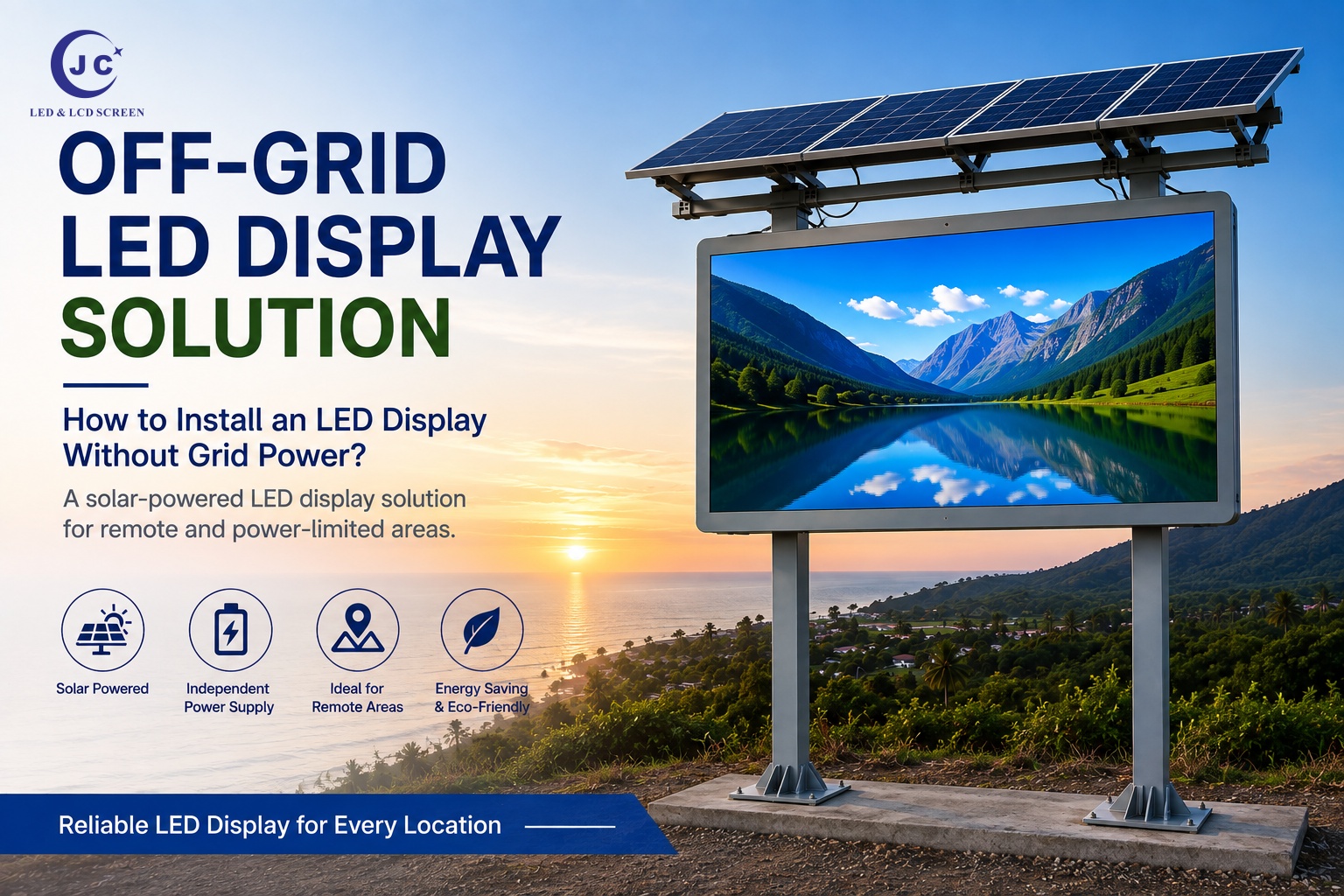
How to Install an LED Display Without Grid Power?
A Solar-Powered LED Display Solution for Remote and Power-Limited Areas
Quick Answer
Yes. An LED display can operate without conventional grid electricity when it is integrated with a properly designed solar generation and battery storage system.
An off-grid LED display typically combines four elements:
Solar Panels → Charging System → Battery Storage → LED Display
During daylight hours, solar panels generate electricity and charge the battery. Stored energy can then support the LED display when solar generation is limited or unavailable.
This type of system is particularly useful for remote areas, rural locations, highway advertising, tourism destinations, public information displays, and other sites where grid electricity is unavailable or unreliable.
A P3.84 solar LED display project in Papua New Guinea provides a practical example of how an outdoor LED display can be combined with solar generation and battery storage for an independent power solution.
Table of Contents
- Can an LED Display Work Without Grid Power?
- Why Install an LED Display Without Grid Electricity?
- Papua New Guinea Solar LED Display Project
- How Does an Off-Grid LED Display System Work?
- How to Size the Solar and Battery System
- Where Can Solar-Powered LED Displays Be Used?
- What Should Buyers Check Before Installation?
- Key Benefits of Off-Grid LED Displays
- FAQ: Off-Grid Solar LED Displays
- Conclusion
1. Can an LED Display Work Without Grid Power?
A conventional LED display normally connects to an AC power network. However, a grid connection is not the only way to supply electricity.
For projects in areas without reliable grid power, an LED display can be designed as part of an independent energy system.
The basic architecture is:
Solar Energy → Battery Storage → LED Display
The system can be designed according to:
- LED display size
- Pixel pitch
- Average power consumption
- Daily operating hours
- Required night-time operation
- Local solar conditions
- Battery capacity
- Required autonomy
- Installation environment
The important point is that an off-grid LED display should be treated as a complete display-and-energy system, rather than simply adding solar panels to an existing LED screen.
2. Why Install an LED Display Without Grid Electricity?
Not every LED display project has convenient access to utility electricity.
A project may be located far from existing infrastructure, or connecting to the grid may require additional construction, cabling, or infrastructure investment.
An off-grid solution can be considered when conventional power is difficult to obtain.
Remote Areas
Remote communities and rural areas may have limited access to stable electricity but still require digital information or advertising displays.
Highway Advertising
Outdoor advertising locations may be far away from buildings and existing electrical infrastructure.
Tourism Destinations
Scenic areas, parks, resorts, and remote attractions can use independent power systems for visitor information and commercial communication.
Public Information Displays
Government and community information displays may need to operate in locations where utility connections are limited.
Construction and Infrastructure Sites
Temporary or semi-permanent installations may not have a convenient permanent electrical connection.
Areas With Unreliable Electricity
Even when a grid connection exists, unstable electricity can affect display operation. A properly designed independent power system can provide an alternative energy architecture.
The objective is therefore not to replace grid electricity everywhere.
The objective is to make LED display deployment possible in locations where grid power is unavailable, unreliable, or difficult to extend.
3. Papua New Guinea Solar LED Display Project
A practical example is a P3.84 solar LED display project in Papua New Guinea.
For this project, Guangzhou JunChen Display Technology Co., Ltd. supplied five Max units and three Pro units, with a Standard configuration available for smaller display requirements. All three configurations use P3.84 pixel pitch but have different display dimensions, solar capacities, battery storage, and average power consumption.
Project Snapshot
| Item | Project Information |
|---|---|
| Country | Papua New Guinea |
| Display | P3.84 Outdoor Solar LED Display |
| Power System | Solar + Battery |
| Project Quantity | 5 × Max + 3 × Pro |
| Alternative | Standard Configuration |
| Application | Outdoor / Remote Power Environment |
| Manufacturer | Guangzhou JunChen Display Technology Co., Ltd. |
The project shows an important principle:
The LED display and the energy system should be designed together according to the actual application.
Project Configuration Comparison
| Parameter | Max | Pro | Standard |
|---|---|---|---|
| Pixel Pitch | P3.84 | P3.84 | P3.84 |
| Display Size | 1800 × 1200 × 800 mm | 600 × 1200 × 800 mm | 400 × 1200 × 800 mm |
| Solar Panels | 4 × 100W | 2 × 100W | 2 × 100W |
| Solar Capacity | 400W | 200W | 200W |
| Battery | 12.8V / 280Ah | 12.8V / 100Ah | 12.8V / 100Ah |
| Nominal Battery Energy | 3584Wh | 1280Wh | 1280Wh |
| Average Power | 100–150W | 50–80W | 40–60W |
| Battery Cycle Life | ≥3,000 cycles | ≥3,000 cycles | ≥3,000 cycles |
These specifications are taken from the current project documentation.
The three configurations illustrate why an off-grid LED display should not be selected according to screen size alone.
4. How Does an Off-Grid LED Display System Work?
A solar-powered LED display system can be understood through three main components.
Solar Panels
Solar panels convert sunlight into electrical energy.
The required solar capacity depends on:
- LED power consumption
- Daily operating hours
- Local solar conditions
- Battery charging requirements
- System losses
For example, the Max configuration in the Papua New Guinea project uses four 100W solar panels, providing 400W nominal solar capacity. Pro and Standard use two 100W panels, providing 200W nominal capacity.
However, nominal panel wattage does not guarantee a fixed amount of daily energy production.
Actual generation depends on sunlight, weather, panel orientation, temperature, shading, and charging efficiency.
Battery Storage
Solar generation is not continuous.
If the LED display needs to operate after sunset or during periods of low solar generation, stored energy is required.
The battery therefore acts as an energy reserve between solar generation and LED display operation.
The nominal battery energy can be estimated as:
Battery Energy = Voltage × Ampere-hours
For the Max configuration:
12.8V × 280Ah = 3,584Wh
The Pro and Standard configurations use:
12.8V × 100Ah = 1,280Wh
Therefore, the Max configuration provides approximately 2.8 times the nominal battery energy of Pro or Standard. Actual usable energy depends on battery discharge limits, temperature, conversion losses, and system management.
LED Display and Control System
The LED display is the final energy load.
Its actual energy consumption can vary according to:
- Display dimensions
- Pixel pitch
- Brightness
- Content
- Operating hours
- Refresh and control configuration
- Environmental conditions
This is why the solar and battery system should be matched to the actual LED load, rather than using a generic solar configuration.
5. How to Size the Solar and Battery System
There is no universal solar-panel or battery size for every off-grid LED display.
A basic design process should consider the following:
| Factor | Why It Matters |
|---|---|
| Screen Size | Determines display area and load |
| Pixel Pitch | Determines display resolution |
| Average Power | Determines energy demand |
| Daily Operating Hours | Determines daily consumption |
| Night Operation | Determines battery requirement |
| Solar Conditions | Determines available solar energy |
| Battery Capacity | Determines stored energy |
| Required Autonomy | Determines backup requirement |
| Brightness | Affects power consumption |
| Weather | Affects solar generation |
Daily Energy Demand
A simplified calculation is:
Daily Energy = Average Power × Operating Hours
For example, a display averaging 100W and operating for 10 hours would have a simplified daily load of:
100W × 10h = 1,000Wh
The actual engineering calculation should also consider system losses, charging efficiency, battery reserve, and operating conditions.
Battery-Only Runtime
A theoretical battery-only runtime can be estimated as:
Runtime = Nominal Battery Energy ÷ Average Power
For example, the Max configuration has approximately 3,584Wh nominal battery energy and an average power range of 100–150W.
That produces a theoretical range of approximately:
23.9–35.8 hours
This is only a calculation reference.
It should not be treated as a guaranteed operating time because actual runtime depends on usable battery energy, brightness, content, temperature, conversion losses, and system management.
The current project specifications also state approximately 80 hours under rainy conditions; this should be evaluated as a complete solar-generation and battery-storage system rather than as battery-only runtime.
Key Engineering Principle
Final autonomy should be calculated from the complete solar + battery + LED system, not from battery capacity alone.
6. Where Can Solar-Powered LED Displays Be Used?
An off-grid LED display can be considered for a wide range of outdoor applications.
Remote Communities
For public information, announcements, education, and community communication.
Rural Areas
For local advertising, commercial communication, and public information.
Highway Advertising
For digital advertising locations where extending grid electricity may be difficult.
Tourism Destinations
For visitor information, advertising, directions, and promotional content.
Construction Sites
For project information, safety communication, and temporary digital signage.
Mining and Industrial Areas
For outdoor communication at locations separated from conventional infrastructure.
Public Information Displays
For locations requiring independent digital communication.
The final suitability depends on the local solar resource, required operating schedule, screen size, installation structure, and environmental conditions.
7. What Should Buyers Check Before Installation?
Before requesting a quotation for a solar-powered LED display, buyers should provide as much project information as possible.
01. Installation Location
Country, region, and specific installation environment.
02. Screen Size
Required width and height of the LED display.
03. Pixel Pitch
Pixel pitch should be selected according to viewing distance and content requirements.
04. Daily Operating Hours
Specify how many hours the display needs to operate each day.
05. Night-Time Operation
Confirm whether the display must continue operating after sunset.
06. Solar Conditions
The project location should be evaluated for sunlight availability, shading, seasonal changes, and panel orientation.
07. Battery Autonomy
Define how long the display should continue operating when solar generation is limited.
08. Brightness Requirement
Outdoor displays require sufficient brightness for daylight visibility, but brightness also affects energy consumption.
09. Communication Method
Specify whether content will be updated through:
- 4G
- Wi-Fi
- Ethernet
- USB
- Other control methods
10. Installation and Maintenance
Confirm:
- Ground or pole installation
- Wind conditions
- Structural requirements
- Front/rear maintenance
- Access for servicing
- Weather exposure
These factors are also reflected in the project selection information for the Papua New Guinea system.
8. Key Benefits of Off-Grid LED Displays
Reduced Dependence on Grid Infrastructure
The display can operate through an independent energy architecture instead of relying entirely on utility power.
Suitable for Remote Locations
Solar power can expand the possible installation locations for outdoor digital signage.
Independent Power Supply
Solar generation and battery storage provide a dedicated energy system for the display.
Flexible Outdoor Deployment
The system can be considered for locations where conventional electrical infrastructure is difficult to access.
Renewable Energy Integration
Solar energy provides the primary generation source for the system.
Customized System Design
Different screen sizes can be matched with different solar and battery configurations.
The Papua New Guinea project demonstrates this approach clearly: Max, Pro, and Standard use the same P3.84 pixel pitch but different display areas and energy configurations.
9. FAQ: Off-Grid Solar LED Displays
Can an LED display work without grid electricity?
Yes. An LED display can operate without conventional grid electricity when it is integrated with a properly designed solar generation and battery storage system.
Can a solar LED display work at night?
Yes. Battery storage allows the system to provide energy when solar generation is unavailable. Required battery capacity depends on the LED load, operating hours, and required autonomy.
How many solar panels does an LED display need?
There is no universal number. Solar capacity depends on screen power consumption, operating hours, local solar conditions, battery charging requirements, and system losses.
How much battery capacity is required?
Battery capacity depends on the average LED power and required autonomy. A larger screen or longer operating schedule generally requires more usable energy storage.
Can solar LED displays be used in remote areas?
Yes. Remote areas are one of the main applications for off-grid LED display systems, especially where conventional electricity infrastructure is unavailable or unreliable.
What information should I provide when requesting a quotation?
Provide the installation location, screen size, pixel pitch, daily operating hours, required night operation, desired autonomy, brightness requirements, and installation environment.
How long can an off-grid LED display operate?
There is no universal runtime. Actual operating time depends on battery capacity, solar generation, average LED power, brightness, content, weather, and system efficiency.
10. Conclusion
An LED display does not always require conventional grid electricity.
For remote areas, rural locations, highway advertising sites, tourism destinations, and other power-limited environments, an off-grid LED display can combine solar generation, battery storage, and outdoor LED technology to create an independent display solution.
The Papua New Guinea P3.84 project demonstrates how different display configurations can be matched with different solar and battery capacities. The Max configuration uses 400W solar capacity and a 12.8V / 280Ah battery, while Pro and Standard use 200W solar capacity and 12.8V / 100Ah batteries.
However, there is no single solar or battery configuration that is suitable for every project.
The correct system should be designed according to:
Screen Size + Average Power + Operating Hours + Solar Conditions + Battery Autonomy + Installation Environment
The objective is not simply to add solar panels to an LED screen.
The objective is to create a complete energy-and-display system that can reliably deliver digital communication where conventional grid power is unavailable or unreliable.
Guangzhou JunChen Display Technology Co., Ltd. provides customized LED display solutions for outdoor, remote, and specialized projects. For an off-grid LED display project, provide your installation location, screen size, daily operating hours, viewing requirements, and required autonomy so the LED display and energy configuration can be evaluated according to the actual site conditions.
Wedding LED Display Solutions: 7 Types of LED Screens for Wedding Events
Why Is the LED Display Industry Worth Investing in 2026? A B2B Guide

Tell Us What Are You Looking For?
