
Why Is the LED Display Industry Worth Investing in 2026? A B2B Guide
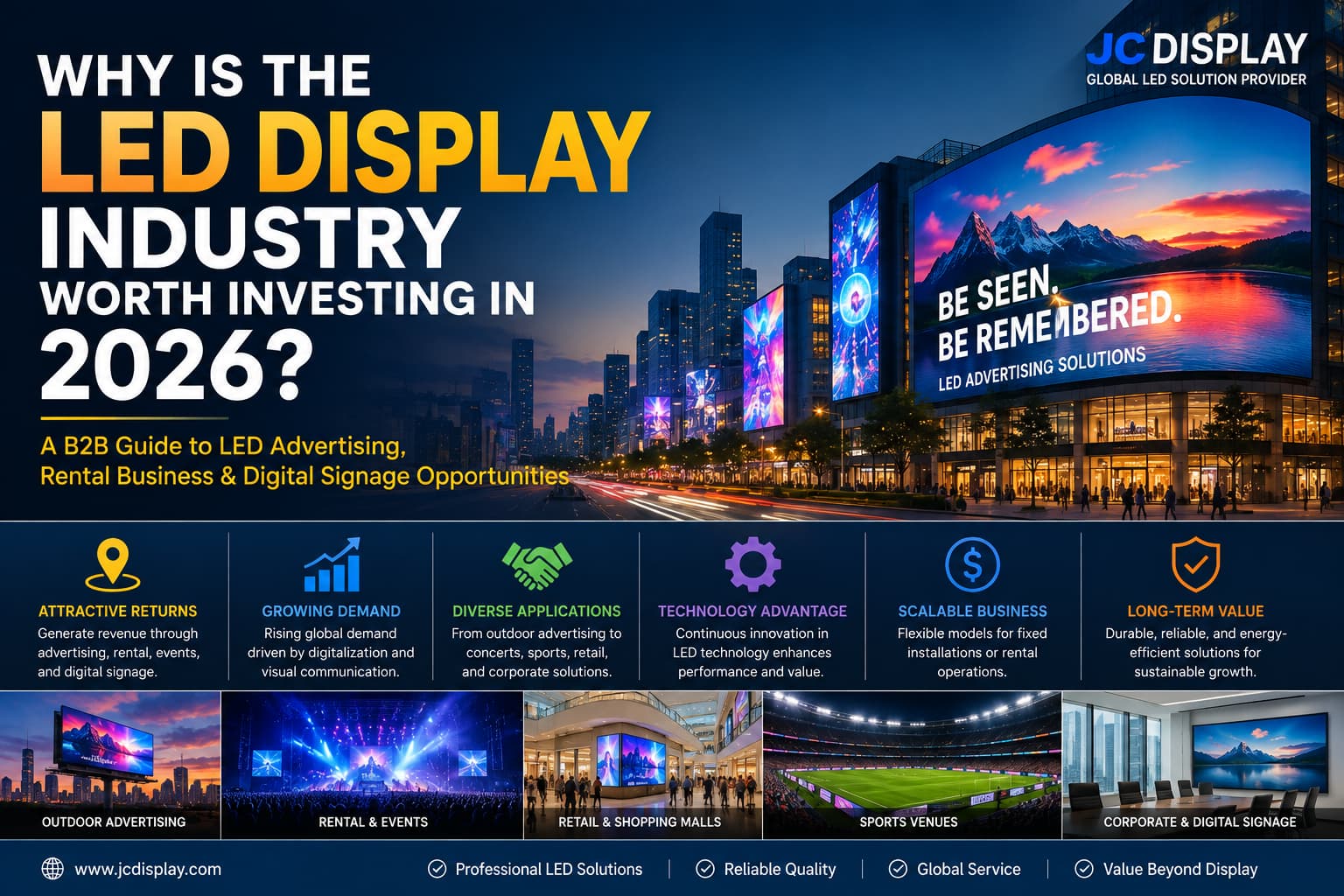
The LED display industry is worth evaluating in 2026 because LED systems can serve not only as visual communication equipment but also as commercial assets that support advertising, rental, event, digital signage, and venue-based revenue models.
For B2B investors, however, the opportunity should not be reduced to the statement that “LED screens can make money.” A profitable LED project depends on the relationship between market demand, application, equipment configuration, utilization, operating costs, and customer acquisition.
A fixed outdoor LED display may generate advertising revenue by selling digital media inventory. A rental LED system may generate project revenue by being deployed repeatedly at concerts, exhibitions, conferences, and other events.
This guide explains how these models work, which technical factors influence commercial value, and what businesses should evaluate before investing in an LED display system.
Table of Contents
- Why Is the LED Display Industry Worth Watching in 2026?
- How Can LED Displays Generate Revenue?
- Why Is Fixed LED Advertising an Investment Opportunity?
- Why Is Rental LED an Investment Opportunity?
- What Technical Factors Affect LED Investment Value?
- Fixed LED vs. Rental LED: Which Business Model Fits You?
- How Should You Calculate the Business Potential of an LED Project?
- What Are the Main Costs of an LED Investment?
- Who Should Consider Investing in LED Displays?
- What Should Buyers Confirm Before Purchasing?
- What Are the Risks of Investing in LED Displays?
- People Also Ask
- Frequently Asked Questions
- Overall Key Takeaways
- Conclusion
1. Why Is the LED Display Industry Worth Watching in 2026?
The LED display industry is closely connected to several growing commercial applications, including digital advertising, retail communication, events, entertainment, sports, corporate communication, exhibitions, and digital signage.
The important change is that LED displays are increasingly being considered as part of a commercial communication system rather than simply a large screen.
For a B2B buyer, that distinction matters.
A display installed inside a company headquarters may primarily provide communication value. A display installed in a high-traffic commercial location can potentially become an advertising asset. A rental LED system can become reusable equipment that supports multiple projects.
The same fundamental technology can therefore support very different business models.
Table 1. Major LED Business Models
| LED Business Model | Primary Revenue Source | Key Commercial Factor |
|---|---|---|
| Outdoor LED Advertising | Advertising fees | Location and advertising occupancy |
| Indoor Commercial LED | Advertising / promotion / service | Audience and application |
| Rental LED | Equipment rental | Utilization |
| Event LED Services | Project fees | Project volume and service capability |
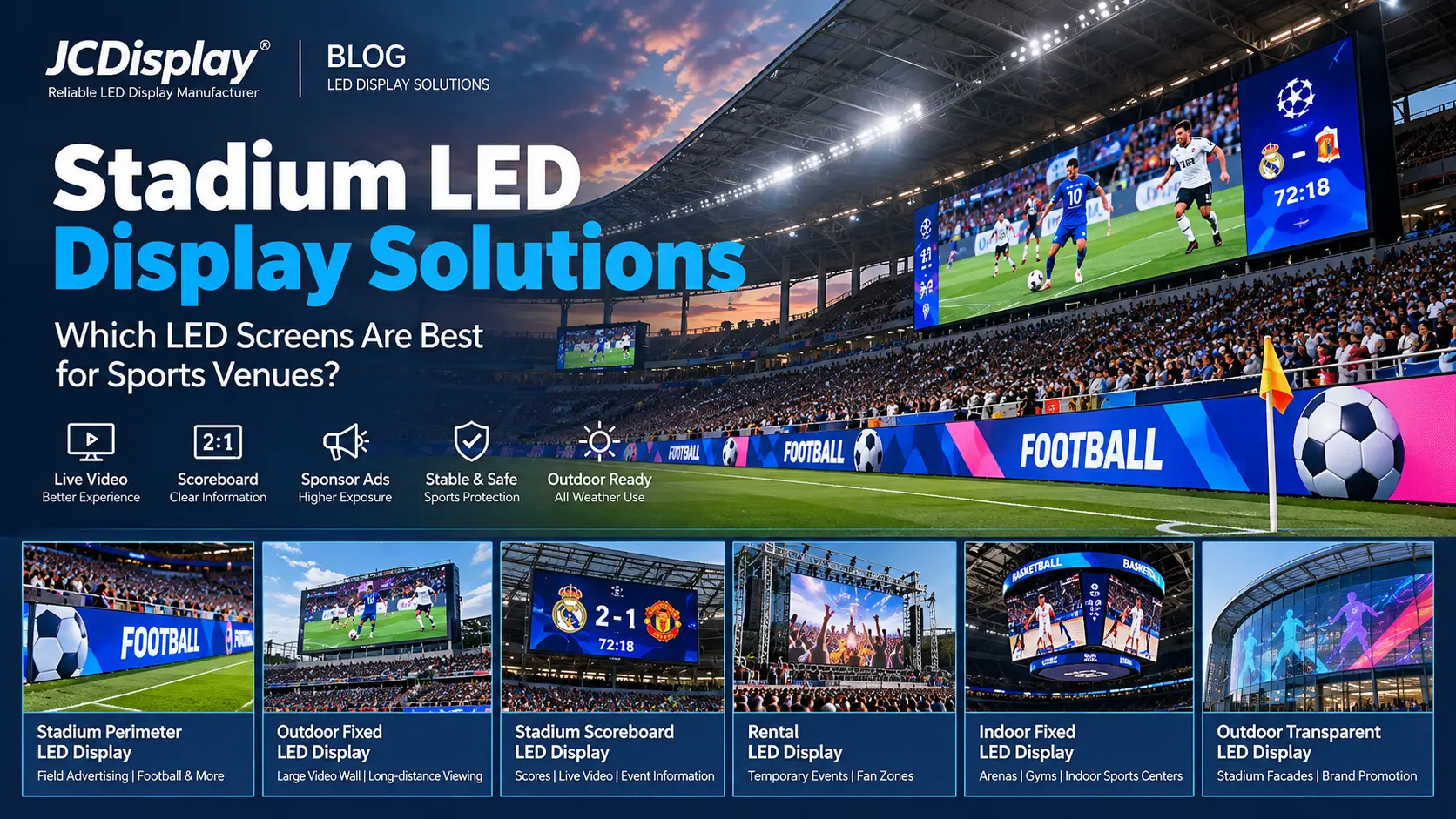
| Sports LED | Venue services / advertising | Audience exposure |
| Digital Signage | Service / advertising | Content and network management |
Interpretation: The commercial value of an LED display depends on how the equipment is deployed and monetized, not simply on the hardware itself.
2. How Can LED Displays Generate Revenue?
There are several ways an LED display business can generate revenue, but two models are particularly straightforward: fixed advertising and rental.
Fixed Advertising Model
The operator installs an LED display in a suitable location and sells advertising time.
The basic model is:
LED Display → Digital Advertising Inventory → Advertisers → Revenue
Instead of selling one physical advertising surface to one customer, the operator can schedule content from multiple advertisers.
Potential customers include:
- Retail brands
- Restaurants
- Hotels
- Real estate companies
- Automotive businesses
- Financial services
- Local businesses
- Event organizers
- Consumer brands
The display becomes a digital media platform.
Rental Model
Rental LED uses reusable equipment.
The basic model is:
LED Equipment → Project Deployment → Rental Fee → Reuse
The same equipment can potentially support:
- Concerts
- Exhibitions
- Conferences
- Product launches
- Corporate events
- Sports events
- Stage productions
The key business metric changes from advertising occupancy to utilization.
Figure 1. LED Display Investment Business Model
LED displays can become revenue-generating commercial assets when matched with the right business model, application, customer demand, and utilization strategy.
The key takeaway is that LED investment is not simply about purchasing a display. Commercial value comes from how effectively the display is deployed, utilized, maintained, and connected to a sustainable revenue model.

3. Why Is Fixed LED Advertising an Investment Opportunity?
Fixed LED advertising can be attractive when an operator has access to a commercially valuable location and a reliable pool of potential advertisers.
The screen creates digital advertising inventory that can be sold repeatedly.
However, the screen itself is only one part of the value proposition.
A useful commercial chain is:
Location → Visibility → Audience → Advertising Demand → Occupancy → Revenue
This leads to an important investment principle:
For fixed LED advertising, location quality can be more commercially important than simply purchasing a higher-specification display.
A technically advanced LED screen in a weak advertising location may have limited revenue potential.
Conversely, an appropriately specified display in a commercially strong location may provide greater business value.
Figure 2. Outdoor LED Advertising Business Model
Fixed outdoor LED displays can turn high-traffic locations into digital media assets by connecting audience exposure with advertising inventory and recurring revenue.

The commercial value of an outdoor LED advertising display is determined by more than the screen itself. Location quality, audience exposure, advertising demand, occupancy, operating efficiency, and maintenance all influence its revenue potential.
For this reason, investors should evaluate the advertising market and location before selecting the LED display configuration.
What Makes a Location Suitable for LED Advertising?
A potential location should be evaluated according to:
- Traffic volume
- Pedestrian exposure
- Viewing distance
- Viewing angle
- Visibility
- Nearby businesses
- Audience demographics
- Advertising demand
- Installation conditions
- Local regulations
- Power availability
- Network connectivity
The investor should validate the commercial value of the location before committing to major equipment expenditure.
4. Why Is Rental LED an Investment Opportunity?
Rental LED offers a different path to monetization.
Instead of relying on one permanent location, the business owns equipment that can move between projects.
This creates an important advantage:
The same LED equipment can potentially generate revenue from multiple customers and multiple events.
However, this does not mean rental LED is automatically profitable.
The critical variable is utilization.
If equipment is booked frequently, the capital asset can generate revenue repeatedly.
If equipment spends most of its time in storage, its commercial productivity is much lower.
Figure 3. Rental LED Business Model. Rental LED displays turn reusable equipment into a revenue-generating business asset by serving multiple events and customers over time.

Key Takeaway: The commercial potential of a rental LED business depends primarily on equipment utilization, customer demand, operational efficiency, and equipment reliability—not simply on the amount of LED equipment owned.
The more efficiently equipment is booked, transported, installed, maintained, and redeployed, the greater its potential to generate recurring project revenue.
What Determines Rental LED Utilization?
Several factors influence utilization:
- Customer network
- Event market size
- Seasonal demand
- Equipment configuration
- Rental pricing
- Equipment availability
- Transportation capability
- Installation capacity
- Technical support
- Project management
A rental company should therefore evaluate LED equipment together with its existing sales and operational capabilities.
5. What Technical Factors Affect LED Investment Value?
A professional buyer should not evaluate an LED display only by looking at its price.
Technical specifications influence installation, image quality, operating cost, maintenance, and application suitability.
The framework provided for this project specifically emphasizes explaining why specifications matter, rather than leaving the buyer with unexplained technical numbers.
Figure 4. LED Technical Investment Factors. Pixel pitch, brightness, refresh rate, cabinet design, maintenance, power consumption, control systems, environmental protection, and future expansion can all influence LED display performance, operating cost, reliability, and long-term investment value.

The best specification is therefore not necessarily the highest specification, but the configuration that matches the application, viewing environment, operating conditions, and business model.
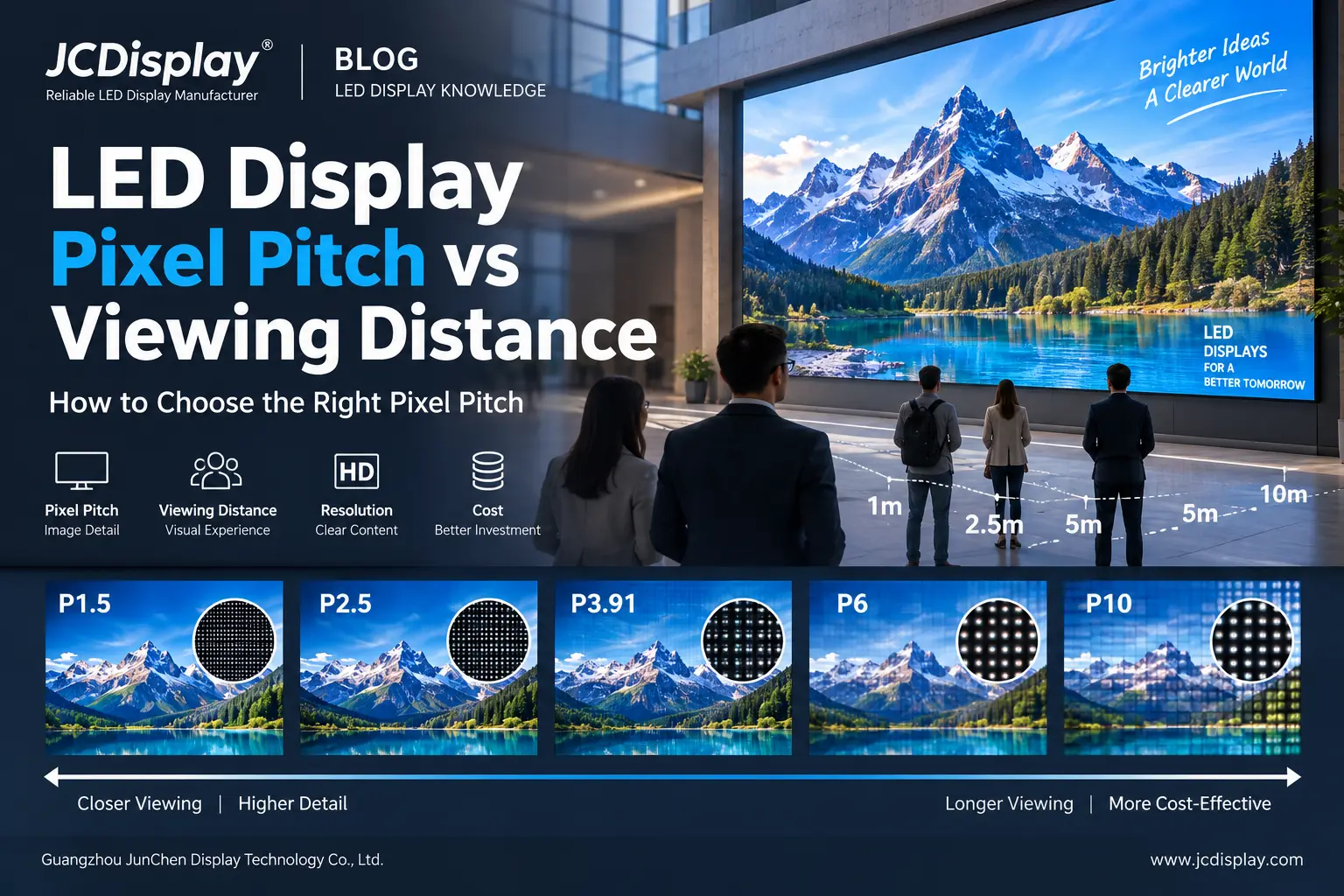
Pixel Pitch: Matching Resolution to Viewing Distance
Pixel pitch is one of the most visible LED specifications.
A smaller pixel pitch generally provides higher pixel density and supports closer viewing distances.
But smaller is not automatically better for every investment.
Consider an outdoor advertising screen viewed primarily from a long distance.
Selecting an extremely fine pixel pitch may increase capital expenditure without providing proportional commercial value.
The correct decision should follow:
Viewing Distance → Required Image Detail → Pixel Pitch → System Cost
For rental systems, the decision can be more complex because the same cabinets may be used at different venues.
Therefore, buyers should define the typical application range before selecting pixel pitch.
Brightness: Matching the Display to Ambient Light
Brightness is particularly important for outdoor applications.
The display must remain visible under the expected ambient-light conditions.
For outdoor advertising:
Ambient Light → Required Brightness → Visibility → Advertising Effectiveness
However, maximum brightness is not necessarily the target.
Higher output can influence power consumption and operating cost, so the buyer should consider the actual environment and operating schedule.
The practical question is:
What brightness level is appropriate for the installation environment?
rather than:
What is the highest brightness available?
Refresh Rate: Important for Professional Video
Refresh performance becomes particularly important when LED displays are recorded by cameras.
Applications such as:
- Broadcast
- Concerts
- Corporate productions
- Sports events
- Live entertainment
may involve professional camera systems.
For these applications, the LED system needs to be evaluated in relation to the camera environment and content requirements.
A specification should therefore be interpreted according to the actual use case.
Cabinet Design: A Business Cost Factor
Cabinet design affects more than the appearance of the display.
For rental LED, cabinet characteristics can influence:
- Transportation
- Handling
- Installation
- Storage
- Mechanical durability
- Maintenance
- Project turnaround time
This creates a useful engineering-to-business relationship:
Cabinet Design → Handling → Installation Time → Labor Cost → Project Margin
For fixed installation, cabinet design also needs to be considered alongside environmental conditions, structural requirements, maintenance access, and system architecture.
Maintenance Access
Maintenance design can influence the operating cost and downtime of a commercial LED system.
Front maintenance may be advantageous where rear access is restricted.
Rear maintenance can be practical where technicians have sufficient space behind the display.
The correct configuration depends on the installation.
For a commercial advertising screen, maintenance accessibility can affect downtime.
For rental LED, fast service can influence how quickly equipment returns to the next project.
Therefore:
Maintenance Architecture → Service Time → Downtime → Commercial Availability
Power Consumption
Power consumption becomes an important consideration for displays operating for long periods.
A simplified energy calculation is:
Energy Cost = Average Power Consumption × Operating Hours × Electricity Rate
The buyer should distinguish between maximum and typical operating conditions.
Actual consumption can depend on:
- Brightness
- Operating hours
- Content
- Display configuration
- Environmental conditions
For a fixed advertising screen operating every day, electricity is a recurring OPEX item.
For rental LED, energy costs can be incorporated into individual project pricing.
6. Fixed LED vs. Rental LED: Which Business Model Fits You?
There is no universally better LED investment model.
The right choice depends on the resources, customers, location, and operational capabilities of the business.
Fixed LED advertising is primarily based on a permanent installation where the operator sells advertising inventory.
Rental LED uses reusable equipment that can be deployed across different projects and customers.

Figure 5. Fixed LED vs. Rental LED Business Models. Fixed LED advertising is primarily driven by location, audience exposure, and advertising occupancy, while rental LED business performance depends on customer demand, equipment utilization, project frequency, and operational efficiency.
Key Takeaway: There is no universally better LED investment model. The right choice depends on whether the business has stronger access to high-value locations and advertisers, or to event customers and rental projects.
Fixed LED is generally more location-driven, while rental LED is more utilization-driven.
Table 2. Fixed LED Advertising vs. Rental LED
| Factor | Fixed LED Advertising | Rental LED |
|---|---|---|
| Main Revenue | Advertising | Rental / project fees |
| Primary Asset | Screen + location | Reusable equipment |
| Key Metric | Advertising occupancy | Equipment utilization |
| Installation | Permanent | Temporary |
| Main Customers | Advertisers | Events / production companies |
| Logistics | Relatively stable | Major consideration |
| Maintenance | Long-term | Frequent project turnaround |
| Sales Requirement | Advertiser acquisition | Event/customer acquisition |
| Main Risk | Unsold advertising inventory | Low booking frequency |
Interpretation: Choose the business model according to the resources you already control. Location access favors fixed advertising; event customers and operational capabilities favor rental.
7. How Should You Calculate the Business Potential of an LED Project?
An LED investment should be evaluated as a business model rather than a simple equipment purchase.
Advertising Revenue Model
A simplified planning formula is:
Potential Advertising Revenue = Advertising Rate × Sellable Time × Occupancy
For example, if an operator has 100% theoretical advertising capacity but sells only part of the available inventory, actual revenue will be determined by occupancy.
This is why advertising demand must be validated before equipment procurement.
Rental Revenue Model
A simplified rental model is:
Potential Rental Revenue = Rental Rate × Rental Days × Utilization
The same equipment may support several customers during a year.
The commercial objective is therefore to increase productive rental days while controlling:
- Transportation
- Installation
- Labor
- Maintenance
- Storage
- Equipment depreciation
Why Utilization Matters
Consider two businesses that purchase similar LED systems.
Business A
- High customer demand
- Frequent bookings
- Strong sales network
- Efficient installation
Business B
- Limited customer demand
- Low booking frequency
- Equipment remains in storage
Even if the two businesses purchased identical LED products, their commercial results could be very different.
Therefore:
Equipment capacity is not the same as productive utilization.
8. What Are the Main Costs of an LED Investment?
A professional evaluation should separate CAPEX from OPEX.
Table 3. LED Investment Cost Structure
| Cost Category | Typical Examples | Business Impact |
|---|---|---|
| LED Equipment | Modules, cabinets, power supplies | Initial capital |
| Control System | Controller, processor, sending/receiving components | System functionality |
| Structure | Mounting/support structure | Installation cost |
| Installation | Labor, electrical work | Project CAPEX |
| Electricity | Daily operating power | Recurring OPEX |
| Maintenance | Parts and service | Lifecycle cost |
| Transportation | Delivery and project logistics | Major rental cost |
| Storage | Warehouse space | Rental business OPEX |
| Site Cost | Property/site expenses | Advertising OPEX |
| Networking | Connectivity and management | Recurring service cost |
Interpretation: The purchase price of the LED display represents only part of the investment. A meaningful business evaluation needs to consider lifecycle costs.
9. Who Should Consider Investing in LED Displays?
LED investment can be particularly relevant for businesses that already have access to customers, locations, or service infrastructure.
Advertising Companies
Advertising operators can use LED displays to expand digital inventory.
The core advantage is the ability to sell multiple advertising campaigns through one digital platform.
Event Companies
Event companies may benefit from owning rental LED equipment rather than outsourcing every project.
This can provide greater control over project scheduling and equipment availability.
LED Rental Companies
Rental specialists can treat LED equipment as reusable project assets.
Their business model depends strongly on utilization, logistics, maintenance, and customer relationships.
Commercial Property Owners
Shopping centers, hotels, office buildings, and other commercial properties can use LED displays for internal communication while potentially creating additional advertising inventory.
Sports and Entertainment Venues
LED systems can support:
- Advertising
- Event information
- Branding
- Live content
- Audience communication
The display can therefore serve both operational and commercial functions.
10. What Should Buyers Confirm Before Purchasing?
The V6 framework recommends that professional buying decisions consider application, technical requirements, compatibility, connectivity, installation, power, environment, maintenance, future expansion, and optional accessories.
For an LED investment project, use the following checklist.
Market
- Who are the customers?
- What problem does the LED system solve?
- Is there existing demand?
- What competitors already operate in the market?
Application
- Fixed or rental?
- Indoor or outdoor?
- What is the viewing distance?
- How many hours will the display operate?
Technical
- What pixel pitch is appropriate?
- What brightness is required?
- Is camera compatibility important?
- What cabinet configuration is appropriate?
- What control system is required?
Installation
- Is front or rear maintenance required?
- What structure is needed?
- What electrical infrastructure is required?
- How will signal and network connections be provided?
Operating Cost
- What is typical power consumption?
- How much maintenance is expected?
- What are transportation requirements?
- Is storage required?
Lifecycle
- Are spare parts available?
- How quickly can components be replaced?
- Can the system be expanded?
- Is the control architecture compatible with future requirements?
Who May Not Need to Invest in LED?
LED equipment is not suitable for every business.
A company may want to reconsider an LED investment if:
- It has no clear customer base.
- It has no suitable installation location.
- Rental utilization is expected to be very low.
- It lacks technical support capability.
- Transportation costs make rental projects uneconomical.
- Local regulations restrict the intended application.
- The company cannot support maintenance and spare parts.
This is an important distinction:
A good technology does not automatically create a good investment.
The business environment must support the technology.
11. What Are the Risks of Investing in LED Displays?
-
Product lifecycle
-
Spare parts
-
Upgrade paths
-
System compatibility
-
Future expansion
12.People Also Ask
-
Is the LED display industry worth investing in 2026?
-
How can an LED display generate revenue?
-
Is LED advertising a profitable business?
-
Is LED screen rental a good business?
-
What is better for business: fixed LED or rental LED?
-
How do I calculate the ROI of an LED advertising screen?
-
What LED specifications matter most for advertising?
-
What should I consider before buying an LED display for business?
13.Frequently Asked Questions
Is the LED display industry worth investing in 2026?
It can be, when the LED system is connected to a viable commercial application. Fixed displays can support advertising revenue, while rental displays can generate project-based revenue. However, the investment should be evaluated according to customer demand, utilization, location, equipment cost, operating expenses, maintenance, and local requirements rather than assuming that LED hardware automatically generates profit.
How can an LED display generate revenue?
An LED display can generate revenue through advertising, rental, event services, digital signage, and venue services. Fixed LED displays can sell advertising time to multiple advertisers. Rental LED systems can be deployed repeatedly for concerts, exhibitions, conferences, sports, and corporate events. The revenue model should be established before choosing the LED configuration.
Is LED advertising a profitable business?
LED advertising can be commercially viable when the display has strong audience exposure and sufficient advertiser demand. Location, visibility, viewing distance, advertising occupancy, operating hours, electricity, maintenance, and site costs all affect the business model. A high-performance LED display cannot compensate for a location that cannot attract advertisers.
Is LED screen rental a good business?
LED rental can work well when equipment utilization and customer demand are sufficiently strong. Rental operators need more than LED equipment: they also need sales channels, transportation, installation capability, storage, technical support, and maintenance processes. The key metric is productive utilization rather than equipment capacity alone.
What is better for business: fixed LED or rental LED?
Neither is universally better. Fixed LED is generally more dependent on location and advertising demand, while rental LED is more dependent on event customers and equipment utilization. Businesses should choose the model that matches their existing resources, customer network, operating capabilities, and market demand.
What LED specification matters most for advertising?
There is no single specification that matters most in every advertising project. Pixel pitch should match viewing distance, brightness should match ambient light, cabinet design should match installation requirements, and the control system should match content and operating needs. Professional buyers should evaluate the complete system rather than selecting equipment based on one specification.
How do I calculate the ROI of an LED advertising screen?
Start by estimating realistic advertising revenue and then subtract operating and capital costs. A simplified model can use advertising rate × sellable time × occupancy to estimate potential revenue. The broader calculation should include LED equipment, installation, structure, electricity, maintenance, networking, site costs, labor, and other expenses. Actual ROI depends on project-specific assumptions.
What should I confirm with an LED supplier before purchasing?
Confirm application suitability, technical configuration, installation, maintenance, compatibility, power requirements, control architecture, spare parts, and expansion options. Buyers should also clarify what is included in the quoted system and what must be sourced separately. A professional supplier should be able to discuss the complete system rather than only the LED panel price.
14.Overall Key Takeaways
- The LED display industry can provide commercial business opportunities, but LED hardware itself is not a guaranteed investment.
- Fixed LED displays can create revenue through digital advertising inventory.
- Rental LED systems can generate revenue through repeated project utilization.
- Location is a critical commercial factor for fixed advertising.
- Customer relationships and utilization are critical for rental LED.
- Pixel pitch should be selected according to viewing distance and image requirements.
- Brightness should match the ambient-light environment rather than simply maximizing output.
- Refresh performance can become important when professional cameras record the display.
- Cabinet design can affect transportation, installation, maintenance, and labor cost.
- Power consumption is a recurring operating expense and should be included in TCO.
- Maintenance access can influence downtime and commercial availability.
- CAPEX and OPEX should be evaluated before purchasing.
- The right LED system is determined by the application and business model.
- Investors should validate customers and utilization before making major equipment purchases.
- Spare parts, maintenance, compatibility, and future expansion should be considered during procurement.
- The strongest LED investment strategy is not “buy the most advanced screen”; it is match the right LED system to a repeatable commercial application.
15.Conclusion
The LED display industry offers a distinctive B2B investment opportunity because LED systems can function as both communication infrastructure and revenue-generating commercial assets.
For advertising operators, a fixed LED display can transform physical space into digital advertising inventory. For rental companies and event businesses, LED equipment can be repeatedly deployed across different projects. Commercial properties and venues can also combine internal communication with advertising, branding, and event services.
But the investment case depends on more than the LED display itself.
Location, customers, utilization, technical configuration, operating cost, maintenance, and lifecycle management all influence commercial performance.
For fixed advertising, the first question should be whether the location can attract sufficient advertiser demand. For rental LED, the key question is whether the equipment can achieve enough productive utilization. In both cases, the technical configuration should follow the application rather than the other way around.
This is why professional LED procurement should evaluate the complete system:
Business Model → Application → Technical Requirements → CAPEX → OPEX → Utilization → Maintenance → Expansion
The result is a more practical way to assess LED investment in 2026.
LED displays are not simply screens. When correctly deployed, they can become business infrastructure.
How to Install an LED Display Without Grid Power?
Top 10 Investment Opportunities in 2026: Industries Worth Watching

Tell Us What Are You Looking For?
