
What Is an LED Screen Rental and How Should You Choose One?
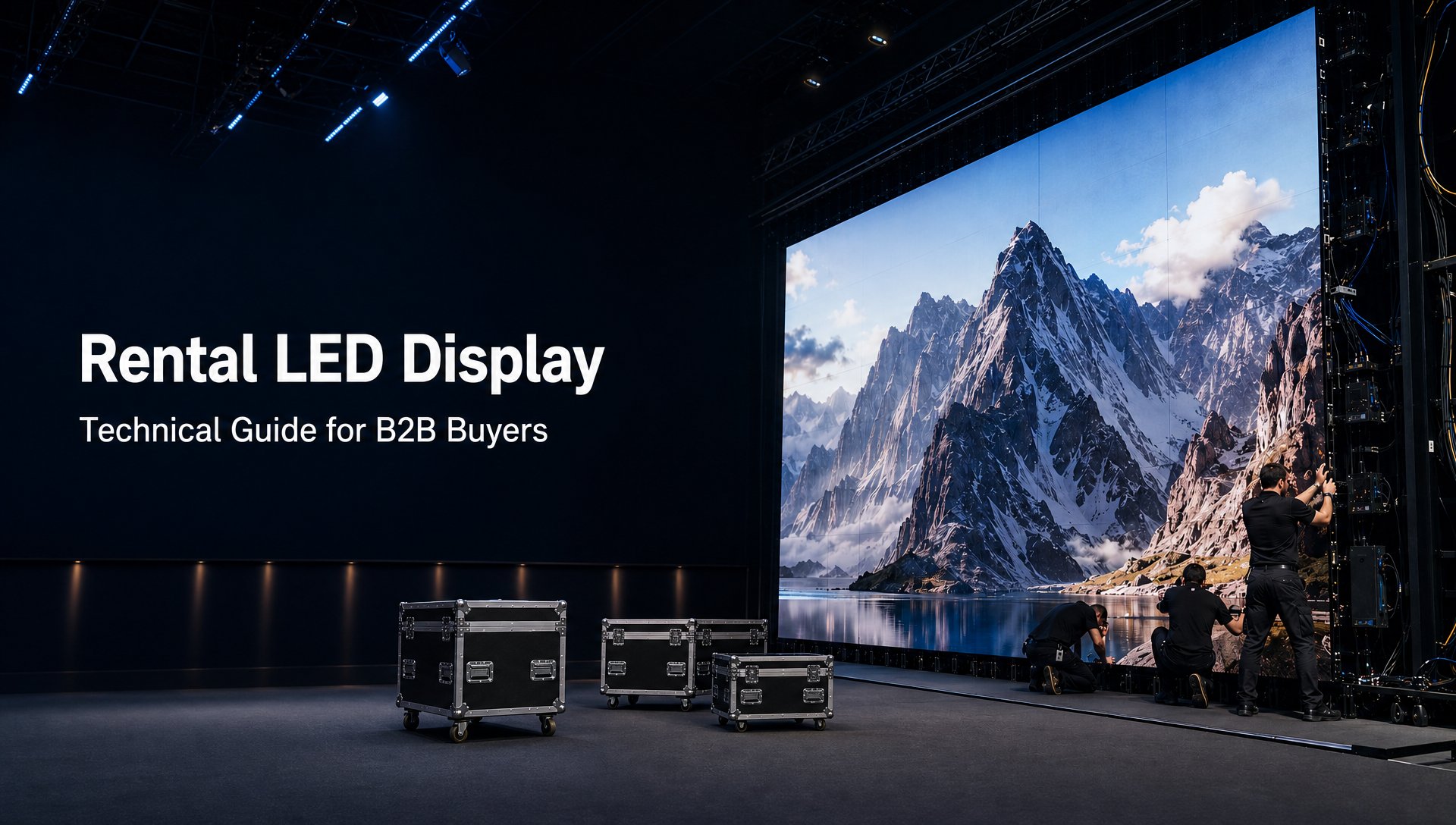
An LED screen rental is a modular LED display system designed for temporary installation, repeated deployment, transportation, and reconfiguration. Unlike fixed LED displays, rental systems place greater emphasis on cabinet portability, mechanical connection, installation efficiency, and flexibility between events.
For professional buyers, however, choosing a rental LED screen is not simply a matter of selecting a screen size. Pixel pitch, viewing distance, brightness, environment, cabinet construction, signal processing, power distribution, maintenance, transportation, and technical support all affect the suitability of the system.
This guide explains the engineering considerations behind rental LED displays and provides a practical framework for distributors, AV integrators, event companies, contractors, and procurement teams.
Table of Contents
- What Is an LED Screen Rental?
- How Is a Rental LED Screen Different From a Fixed LED Display?
- How Should You Choose Pixel Pitch and Viewing Distance?
- What Technical Specifications Matter in a Rental LED Screen?
- How Do Cabinet Design and Installation Affect Rental Projects?
- How Does the LED Control and Signal System Work?
- Where Are Rental LED Screens Commonly Used?
- How Should You Choose a Rental LED Screen Supplier?
- Frequently Asked Questions
- Conclusion
1. What Is an LED Screen Rental?
An LED screen rental is a modular LED display designed to be installed temporarily, dismantled after an event, transported to another location, and reused for future projects. Its design typically prioritizes lightweight cabinets, modular connections, practical transportation, and flexible screen configurations. JUNCHEN LED's rental LED range, for example, is positioned for exhibitions, events, temporary venues, and other rental applications, with modular splicing and quick assembly/disassembly.
The key difference is therefore deployment philosophy. A fixed LED display is normally designed around a permanent mounting structure, while a rental system is engineered around repeated handling.
What Makes a Rental LED Display Different?
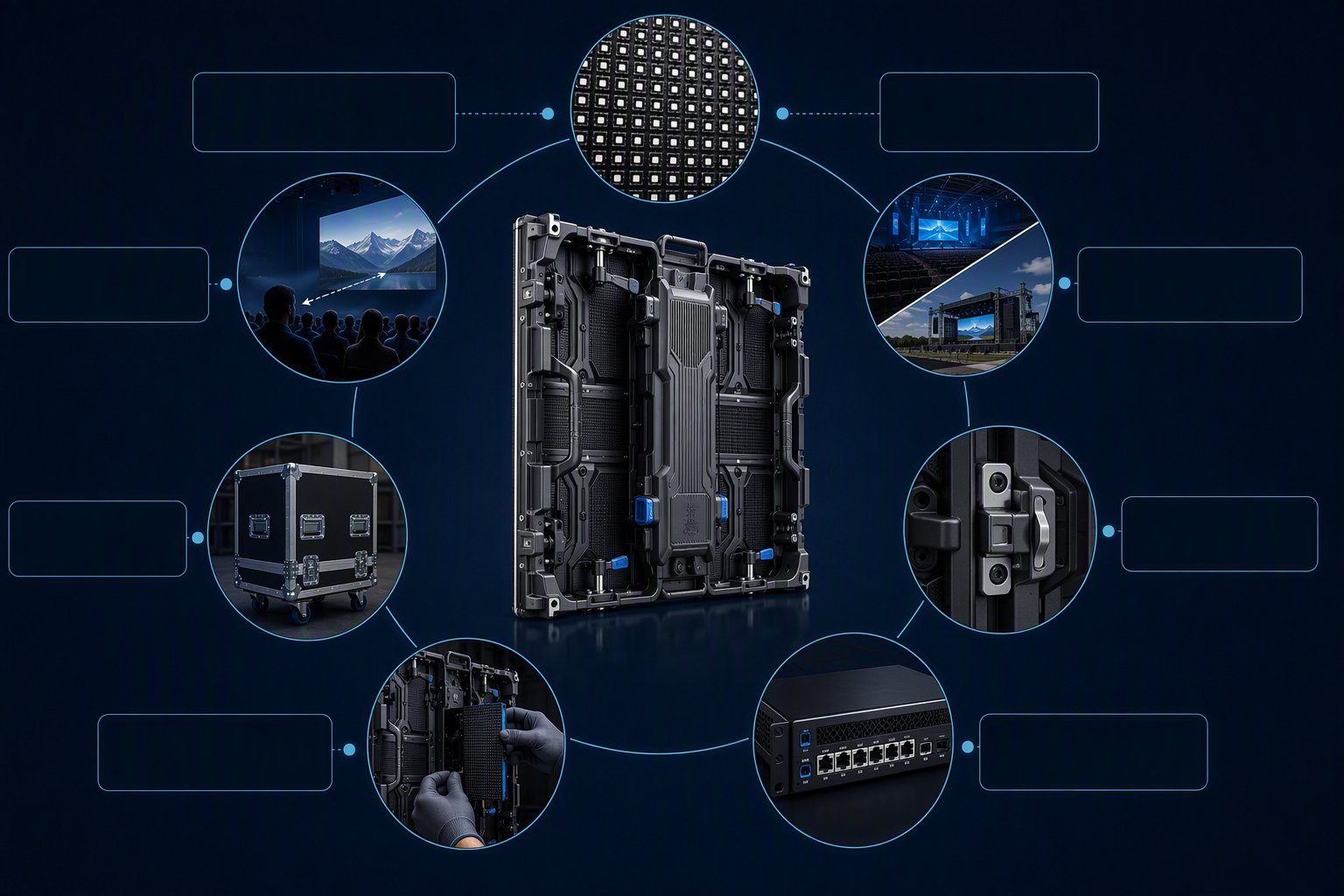
A professional rental system commonly includes:
- modular LED cabinets
- mechanical locking or connection mechanisms
- power and signal connections
- LED receiving cards
- sending or control equipment
- video processing equipment where required
- flight cases or transportation solutions
- installation and rigging accessories where applicable
The LED cabinet is only one part of the complete system.
For buyers: the right rental LED screen should be evaluated as a complete deployment system rather than as a collection of LED modules.
2. How Is a Rental LED Screen Different From a Fixed LED Display?
A rental LED screen is optimized for mobility and repeated installation, while a fixed LED display is optimized for long-term installation at one location. Rental systems generally emphasize cabinet handling, modularity, connection efficiency, and transportation; fixed systems place more emphasis on permanent structure, long-term maintenance access, and site-specific installation.
Table 1. Rental LED Screen vs. Fixed LED Display
The following table summarizes the main differences that matter during project planning.
| Factor | Rental LED Screen | Fixed LED Display |
|---|---|---|
| Installation | Temporary/repeated | Permanent |
| Cabinet handling | Designed for frequent handling | Less frequent handling |
| Transportation | Important consideration | Usually limited |
| Configuration | Flexible | More site-specific |
| Mechanical design | Modular and connection-focused | Structure-focused |
| Maintenance | Depends on cabinet design | Depends on installation structure |
| Typical applications | Events, stages, exhibitions | Advertising, buildings, corporate spaces |
| Main buying priority | Mobility + flexibility | Long-term installation |
Summary: Rental and fixed LED displays are not simply two versions of the same product. Their mechanical and operational priorities are different, so the selection should start with the project's deployment model.
3. How Should You Choose Pixel Pitch and Viewing Distance?
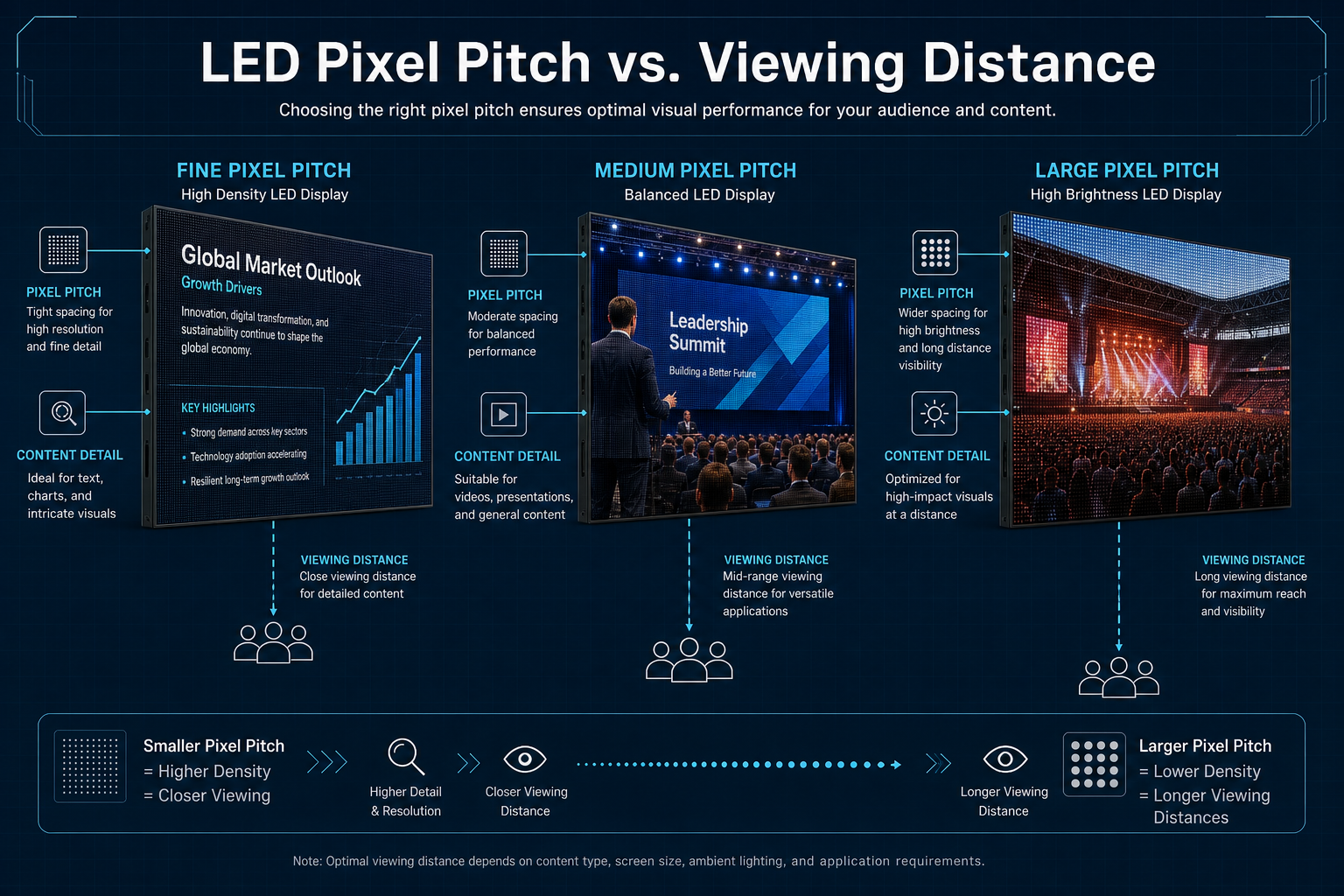
Pixel pitch should be selected according to the expected viewing distance, content requirements, screen size, and application environment. A smaller pixel pitch provides higher pixel density and can better support close-viewing applications, while larger pixel pitches can be appropriate when audiences are farther from the display.
What Is Pixel Pitch?
Pixel pitch is the distance between the centers of two adjacent LED pixels, normally expressed in millimeters.
For example, a P2.5 display has a nominal pixel pitch of approximately 2.5 mm.
As pixel pitch decreases, more pixels can fit into the same physical area. This can improve image detail when viewers are relatively close to the screen.
Why Does Viewing Distance Matter?
A common purchasing mistake is choosing the smallest available pixel pitch without considering the venue.
For a large outdoor event where most viewers are far away, an extremely fine pixel pitch may provide limited practical benefit compared with an appropriately selected pitch. For a conference or exhibition where viewers stand relatively close to the screen, finer pixel pitch can become more important.
The correct decision should therefore consider:
- nearest expected viewing distance
- typical audience distance
- screen dimensions
- content type
- camera requirements
- indoor or outdoor environment
- project budget
JUNCHEN LED's current rental range includes P1.95–P4.81 options, illustrating how rental products can cover different application requirements rather than relying on a single pitch.
4. What Technical Specifications Matter in a Rental LED Screen?
The most important rental LED specifications depend on the application, but buyers should normally evaluate pixel pitch, brightness, refresh rate, cabinet dimensions, weight, environmental protection, viewing conditions, power requirements, and control compatibility. No single specification determines whether a screen is suitable.
Table 2. Key Rental LED Screen Specifications
The following specifications provide a practical starting point for technical evaluation.
| Specification | What It Means | Why It Matters |
|---|---|---|
| Pixel pitch | Distance between adjacent pixels | Affects image detail and viewing suitability |
| Brightness | Light output of the display | Important for ambient-light conditions |
| Refresh rate | Frequency at which the display updates | Important for camera and video applications |
| Cabinet size | Physical dimensions of each cabinet | Affects transportation and screen configuration |
| Cabinet weight | Weight of each modular unit | Affects handling and installation planning |
| IP rating | Degree of ingress protection | Important for outdoor or exposed environments |
| Viewing angle | Usable viewing range | Important when audiences are spread across the venue |
| Power consumption | Electrical demand | Affects power distribution and operating planning |
| Control system | Equipment used to process and distribute content | Determines system compatibility and workflow |
Brightness should be considered together with ambient light rather than treated as a simple “higher is always better” specification. Similarly, refresh rate matters particularly when cameras will capture the LED screen, such as during concerts, broadcasts, and corporate productions.
Indoor vs. Outdoor Requirements
Indoor rental applications usually have different environmental requirements from outdoor events.
For outdoor deployment, buyers should verify:
- required IP protection
- expected weather conditions
- ambient temperature
- installation structure
- wind exposure
- power distribution
- cable protection
Do not assume that an indoor rental cabinet is suitable for outdoor use simply because the LED modules themselves can produce a bright image.
5. How Do Cabinet Design and Installation Affect Rental Projects?
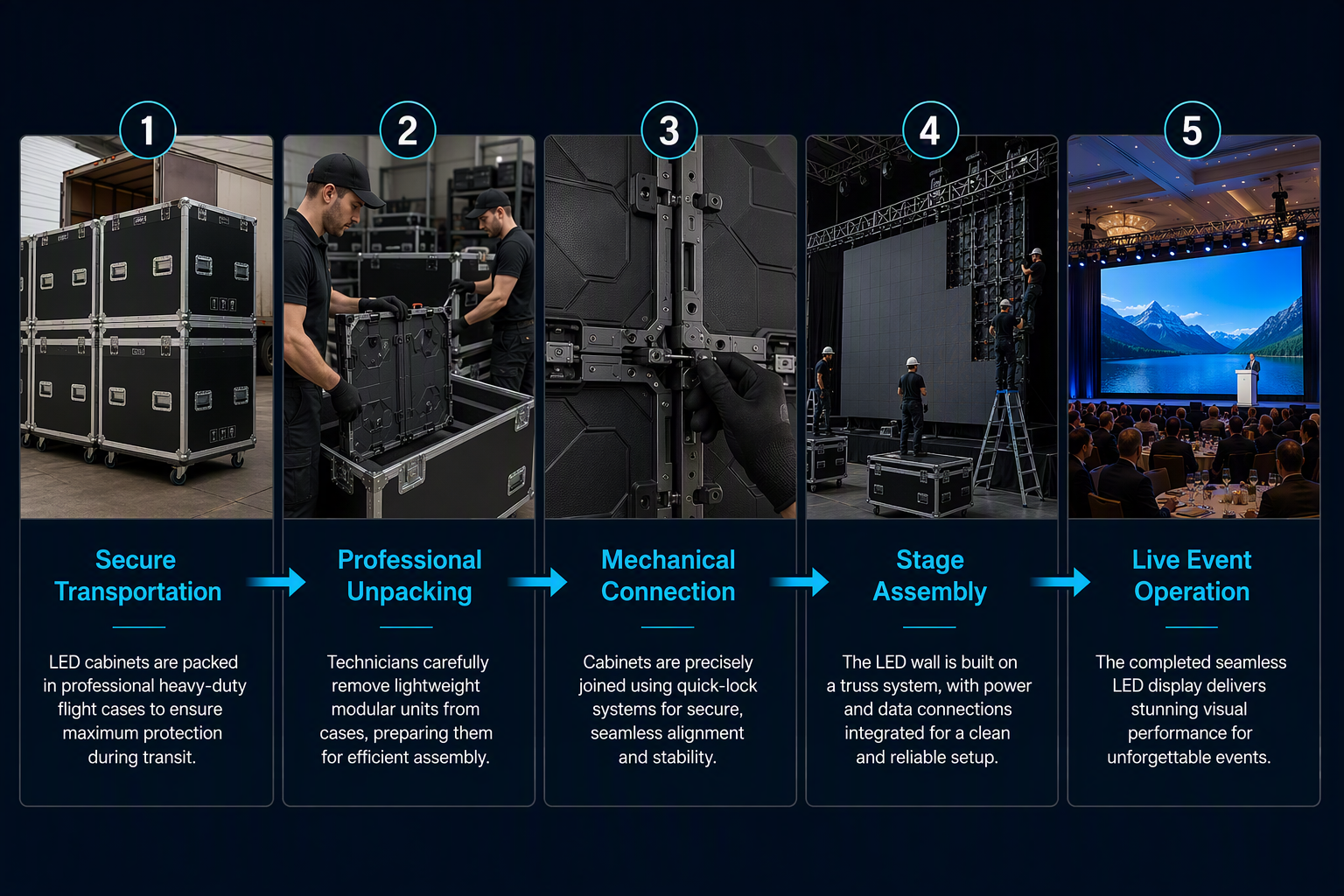
Cabinet design directly affects how efficiently an LED rental system can be transported, assembled, configured, maintained, and reused. A rental cabinet therefore needs to balance structural strength, weight, connection efficiency, serviceability, and compatibility with the intended installation method.
JUNCHEN LED describes its rental LED range as using die-cast aluminum cabinets, modular 500 × 500 mm and 500 × 1000 mm configurations, and options for curved screens. These are manufacturer-specific characteristics and should not be assumed for every rental LED product.
Why Cabinet Weight Matters
Lower cabinet weight can simplify transportation and manual handling, but weight alone should never be treated as a quality indicator.
The buyer should also evaluate:
- cabinet strength
- corner protection
- connection design
- service access
- component protection
- stacking or rigging compatibility
- transportation method
Why Modular Dimensions Matter
Modular cabinets allow technicians to build larger displays from repeated units. Standardized cabinet dimensions can also simplify spare-parts management and replacement planning.
For rental companies, this has a direct operational benefit: the same cabinet inventory can potentially serve different screen sizes and event configurations.
Installation Planning
A rental LED installation should be planned around the complete structure, not only the LED cabinets.
Depending on the project, planning may include:
- ground support
- hanging or rigging structure
- wind conditions
- power distribution
- signal distribution
- cable routing
- safety procedures
- access for maintenance
6. How Does the LED Control and Signal System Work?
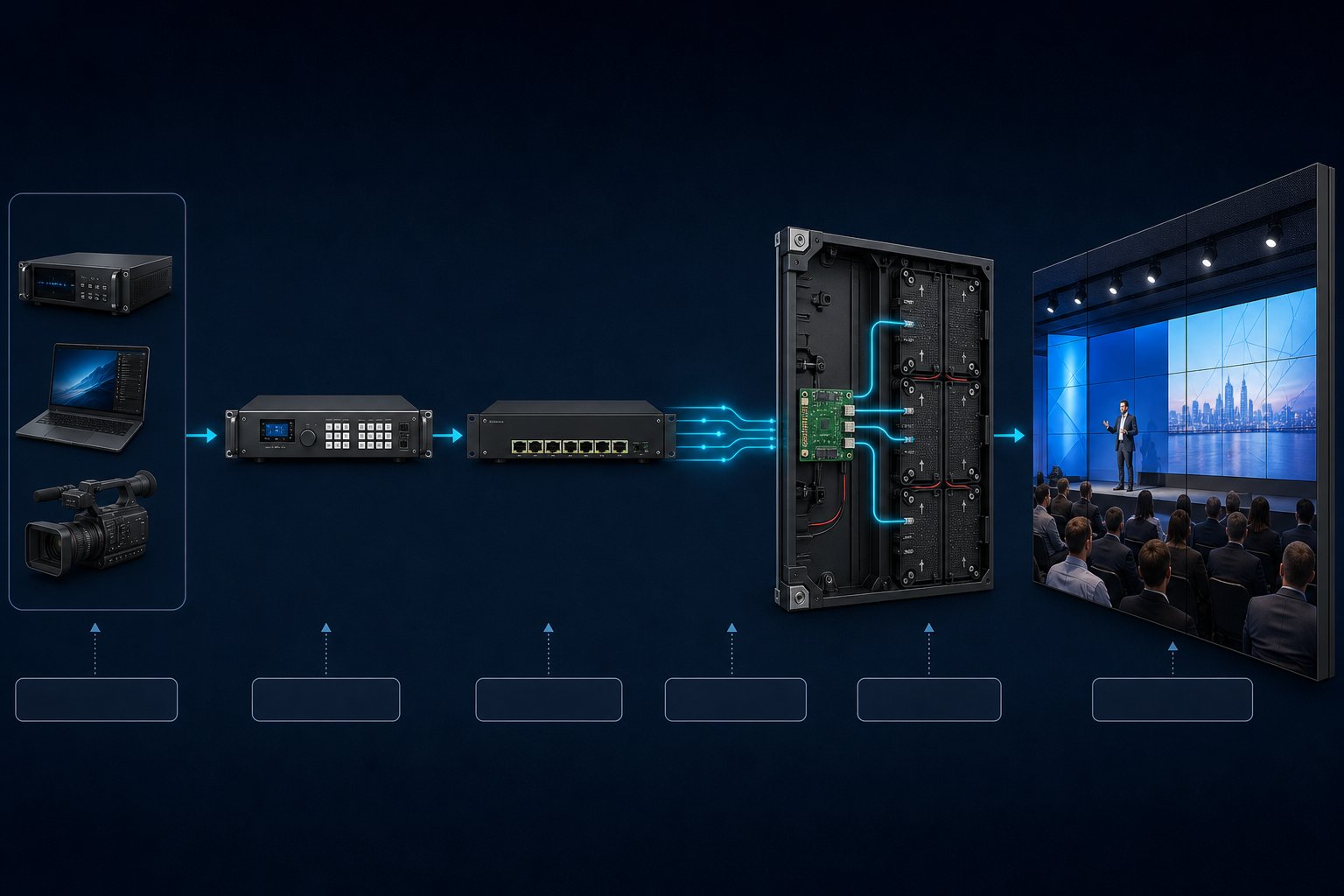
A rental LED display normally requires a signal chain that converts content from a source into the data required by the LED cabinets. Depending on the system architecture, the workflow can include a content source, video processor, LED controller or sending system, receiving cards, and LED cabinets.
Typical Signal Flow
Content Source → Video Processor → LED Controller/Sending System → Receiving Cards → LED Cabinets
The exact architecture depends on the display size, resolution, control equipment, content source, and project requirements.
What Does the Video Processor Do?
A video processor can handle functions such as input selection, scaling, switching, and signal processing, depending on the model.
For professional events, this becomes important when the LED wall needs to display content from multiple sources, cameras, presentation systems, or live production equipment.
What Does the Receiving Card Do?
The receiving card is installed within the LED display system and receives processed display data before distributing it to the LED modules.
A receiving-card configuration must be compatible with the LED module, cabinet wiring, controller system, and required resolution.
Why Does This Matter to Buyers?
A display can have excellent LED modules but still perform poorly if the control architecture does not match the project's requirements.
Before purchasing, confirm:
- input sources
- required resolution
- processor requirements
- controller compatibility
- receiving-card configuration
- signal cable requirements
- redundancy requirements where applicable
- software compatibility
7. Where Are Rental LED Screens Commonly Used?
Rental LED screens are particularly useful where a display must be installed temporarily, transported between locations, or configured differently for different events. Common applications include concerts, corporate events, exhibitions, product launches, sports events, festivals, weddings, and temporary commercial installations.
Table 3. Rental LED Application Scenarios
The following table connects common applications with their main technical requirements.
| Application | Key Requirement | Important Selection Factors |
|---|---|---|
| Concerts | Large visual area and camera-friendly performance | Pixel pitch, refresh rate, brightness |
| Corporate events | Clear presentations and video | Pixel pitch, resolution, signal compatibility |
| Trade shows | Compact temporary installation | Cabinet design, portability |
| Sports events | Long viewing distances | Screen size, brightness, viewing distance |
| Festivals | Outdoor deployment | IP protection, brightness, structure |
| Weddings | Flexible creative layouts | Cabinet configuration, appearance |
| Product launches | High-quality multimedia | Pixel pitch, processing, content compatibility |
JUNCHEN LED's event positioning includes concerts, trade exhibitions, corporate launches, weddings, sporting events, and outdoor markets, demonstrating the broad range of temporary applications for rental LED technology.//jcdisplay.com/new-case.html
8. How Should You Choose a Rental LED Screen Supplier?
A professional rental LED supplier should be evaluated on more than product price. Buyers should review technical documentation, cabinet consistency, control-system compatibility, quality control, spare-parts availability, warranty terms, technical support, customization capability, and the supplier's ability to support the complete project.
Supplier Evaluation Checklist
Before requesting a quotation, prepare the following information:
- display width and height
- indoor or outdoor environment
- minimum viewing distance
- expected audience size
- content type
- camera or broadcast requirements
- installation method
- event duration
- transportation requirements
- required control system
- expected reuse frequency
Then ask suppliers to provide:
- product datasheet
- cabinet dimensions and weight
- pixel pitch information
- brightness specification
- refresh-rate specification
- IP rating where applicable
- power requirements
- control-system compatibility
- warranty conditions
- spare-parts policy
- technical support terms
Rental Cost Should Be Evaluated as a System
Rental pricing can include more than the LED cabinets themselves. Delivery, installation, dismantling, technical operators, transportation, equipment configuration, and support may all affect project cost.
For a rental company purchasing equipment rather than hiring a one-time event service, total cost of ownership (TCO) is even more important.
Consider:
Initial equipment cost + transportation + storage + maintenance + spare parts + labor + expected utilization.
A lower purchase price does not necessarily produce the lowest operating cost if the equipment is difficult to maintain, transport, configure, or repair.
Who Should Consider Rental LED?
Rental LED is particularly suitable for:
- event production companies
- AV rental companies
- staging companies
- exhibition contractors
- concert production teams
- corporate event suppliers
- distributors building rental inventories
Who May Prefer Fixed LED?
A fixed LED display may be more appropriate when:
- the screen remains in one location
- the installation is intended for long-term operation
- transportation is unnecessary
- the structure can be permanently engineered
- the application is continuous digital signage or a permanent video wall
The decision should be based on deployment frequency and operational requirements, not simply on the initial equipment price.
People Also Ask
- What is an LED screen rental?
- How do I choose a rental LED screen?
- What pixel pitch is best for a rental LED screen?
- What is the difference between rental LED and fixed LED?
- How does a rental LED display control system work?
- What should I check before renting an LED screen?
- How much does an LED screen rental cost?
9. Frequently Asked Questions
What is an LED screen rental?
An LED screen rental is a modular LED display system designed for temporary installation and repeated use. It typically uses cabinets that can be transported, assembled, configured, dismantled, and reused for different events. Rental systems are commonly used for concerts, corporate events, exhibitions, sports, festivals, and other temporary installations.
What is the difference between rental LED and fixed LED?
Rental LED displays are designed around mobility, modularity, transportation, and repeated installation. Fixed LED displays are generally engineered for permanent installation at one location. A rental system can therefore be more appropriate for event companies and temporary venues, while a fixed display may be better for permanent advertising, corporate, retail, or architectural installations.
What pixel pitch is best for a rental LED screen?
There is no single pixel pitch that is best for every rental project. The selection should consider viewing distance, screen size, content detail, camera requirements, environment, and budget. Smaller pixel pitches generally provide higher pixel density and can be advantageous for closer viewing, while larger pitches may be suitable when the audience is farther away.
Does a rental LED screen need a video processor?
Not every system requires the same processing architecture. A video processor may be needed when the project requires scaling, switching, multiple input sources, camera feeds, or other processing functions. The appropriate processor depends on the LED screen resolution and the project's content and signal requirements.
Is rental LED suitable for outdoor events?
Yes, rental LED can be used for outdoor events when the selected system is specifically designed for the environment. Buyers should verify IP protection, brightness, temperature range, cabinet construction, structural installation requirements, power distribution, and weather exposure before outdoor deployment.
How often can rental LED cabinets be reused?
A rental LED cabinet is designed for repeated deployment, but its actual service life depends on construction quality, handling procedures, transportation, storage, installation practices, maintenance, and operating conditions. Rental companies should establish inspection and maintenance procedures rather than assuming that all cabinets will have the same usable life.
How much does an LED screen rental cost?
There is no universal rental price because cost depends on screen size, pixel pitch, event duration, location, transportation, installation, technical support, and other project requirements. Published rental prices should therefore be treated as market-specific estimates rather than universal benchmarks.
What should I ask an LED rental supplier before placing an order?
Ask for the complete technical specification, cabinet dimensions and weight, pixel pitch, brightness, refresh rate, environmental rating, control-system compatibility, power requirements, warranty, spare-parts policy, and technical support terms. For a rental company, also ask about cabinet consistency, replacement parts, transportation cases, and long-term availability of the same configuration.
10. Conclusion
An LED screen rental is best understood as a complete temporary display system rather than simply a collection of LED cabinets. The value of a rental system comes from its ability to support repeated deployment while maintaining predictable image performance, practical transportation, flexible configuration, and manageable installation workflows.
For professional buyers, the first decision should be the application. Define the venue, viewing distance, audience position, content type, indoor or outdoor environment, installation method, and expected reuse frequency before selecting specifications.
Pixel pitch is important, but it should not be evaluated in isolation. Cabinet weight and dimensions affect logistics; brightness and IP protection affect environmental suitability; refresh rate and signal processing can matter for camera-based production; and the control system determines how efficiently content reaches the LED display.
Supplier evaluation is equally important. A technically suitable rental LED screen should be supported by clear documentation, compatible control equipment, spare parts, warranty coverage, and responsive technical support.
If you are planning a rental LED project, compare the complete system rather than focusing on one specification or the lowest quotation. You can review the current JUNCHENLED Rental LED Display range or contact the manufacturer to discuss your required screen size, pixel pitch, application environment, and control requirements.
Overall Key Takeaways
- An LED screen rental is designed for temporary installation and repeated deployment.
- Rental LED systems prioritize modularity, transportation, installation efficiency, and reuse.
- Pixel pitch should be selected according to viewing distance and content requirements.
- Smaller pixel pitch is not automatically the best choice for every rental project.
- Brightness should be matched to the ambient-light environment.
- Outdoor rental applications require appropriate environmental and structural planning.
- Cabinet weight and dimensions directly influence transportation and installation.
- The LED cabinet is only one component of the complete display system.
- Video processors, LED controllers, receiving cards, and signal distribution may all affect system performance.
- Professional buyers should evaluate warranty, spare parts, technical support, and documentation.
- Rental companies should consider total cost of ownership rather than purchase price alone.
- The best rental LED solution is the one that matches the project's technical and operational requirements.
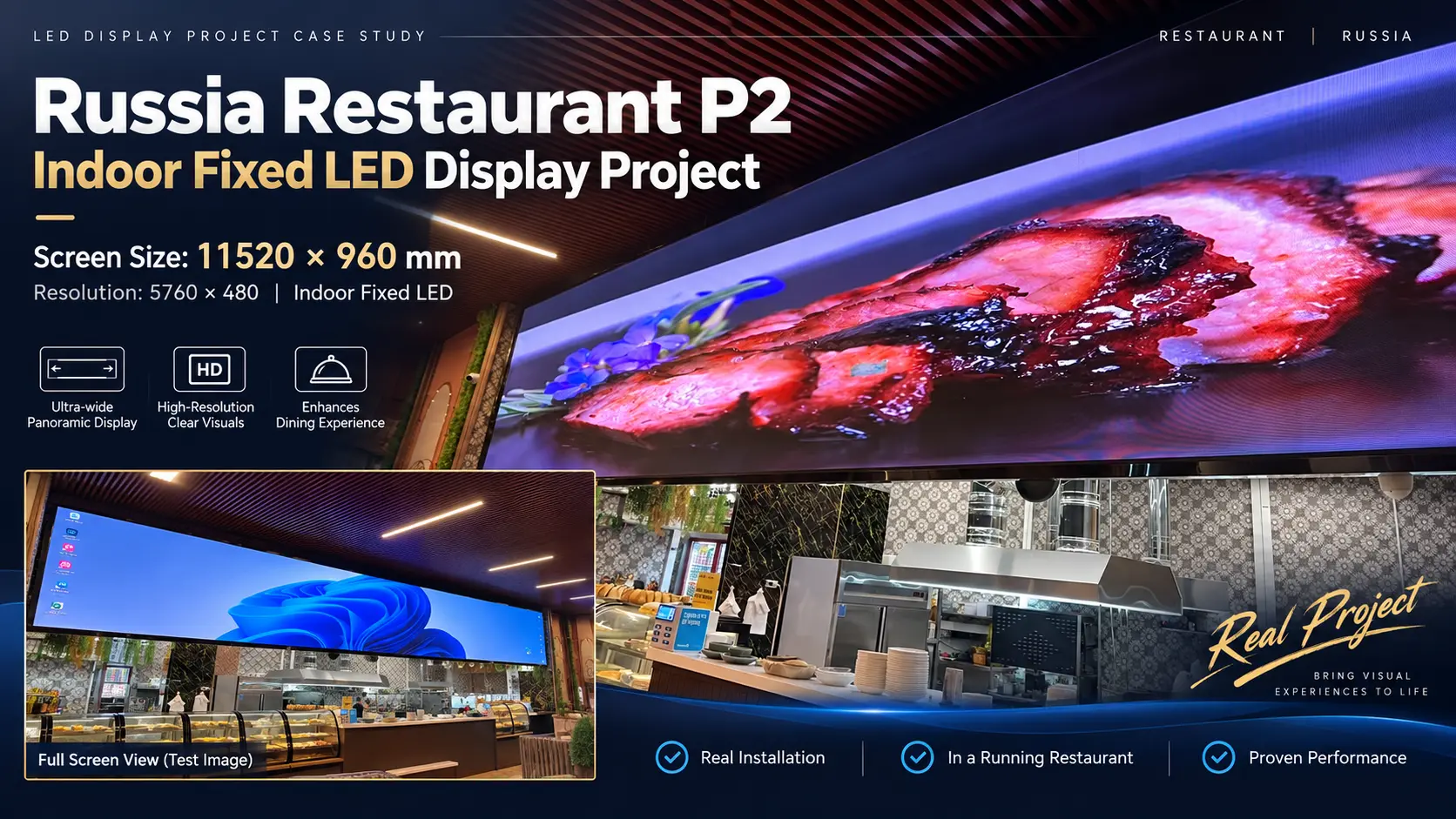
Restaurant P2 Indoor Fixed LED Display Project: 11.52m × 0.96m Panoramic LED Screen
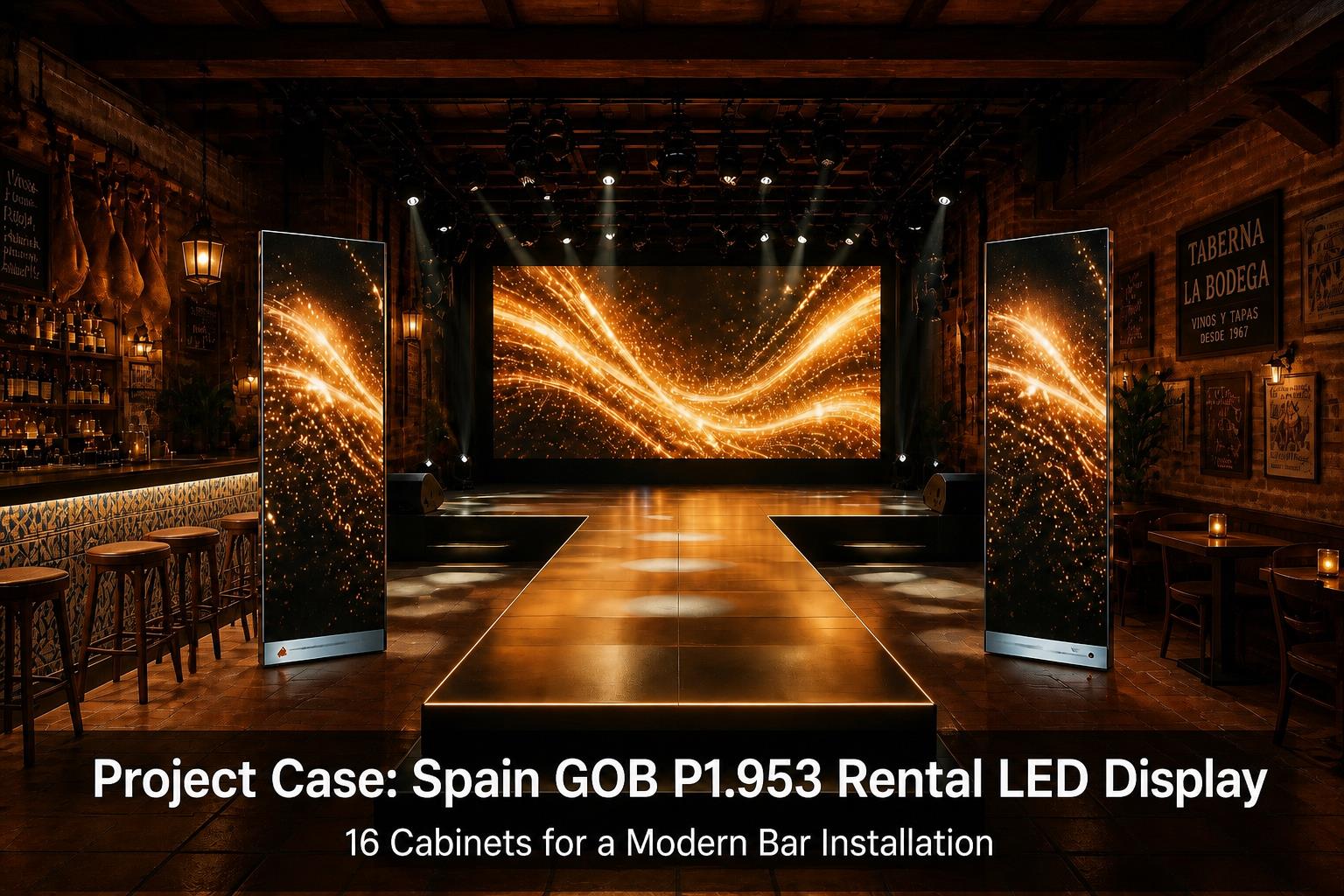
Project Case: Spain GOB P1.953 Rental LED Display – 16 Cabinets for a Modern Bar Installation

Tell Us What Are You Looking For?
